US-Japan Summit Held
Japan Pledges to Expand US Energy Imports and Increase Defense Spending
Trump: "Nippon Steel, Investment Rather Than Acquisition of US Steel"
Mentions US Trade Deficit with Japan and Signals Reciprocal Tariffs
Japanese Prime Minister Shigeru Ishiba unveiled a $1 trillion investment package for the United States at the first US-Japan summit held after the launch of Donald Trump's second term administration. By expanding imports of American energy, increasing defense spending, and boosting investment in the US, he aimed to build a close relationship with the US and expressed his determination to "open a golden era of the US-Japan alliance." Meanwhile, President Trump promised Japan 100% security deterrence but also rejected Nippon Steel's acquisition of US Steel and left open the possibility of imposing tariffs.
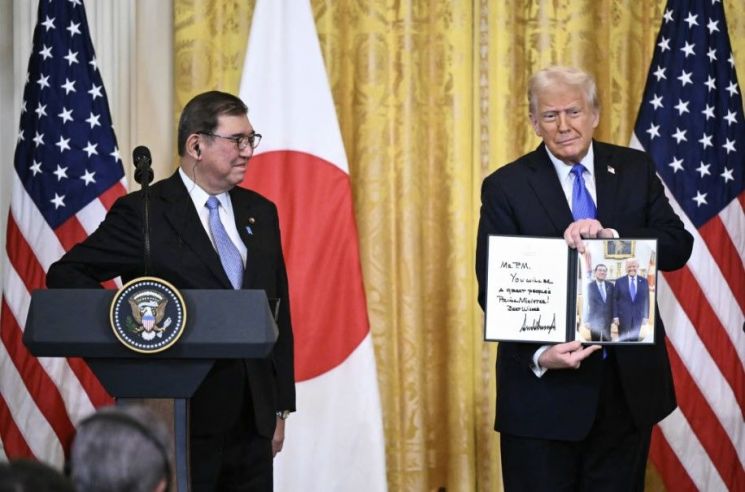
On the 7th (local time), President Trump shared the outcomes of the summit with Prime Minister Ishiba during a press conference held after the US-Japan summit at the White House.
Prime Minister Ishiba attracted significant attention as the second foreign leader to meet President Trump after Benjamin Netanyahu of Israel. Amid expectations of pressure from the Trump administration’s second term to resolve trade imbalances and increase defense spending, Ishiba proactively presented gifts to President Trump in trade and security matters.
President Trump said, "Japan has promised to double its defense spending by 2027 compared to my first term." Until now, President Trump has consistently pressured allies to increase defense spending relative to their Gross Domestic Product (GDP), and Japan has proactively accepted this demand.
Japan also pledged to expand imports of American energy and increase investment in the US.
President Trump explained, "Japan will soon begin record-scale imports of American liquefied natural gas (LNG)," and added, "We are discussing joint investments between Japan and the US related to oil and gas in Alaska." He also expressed expectations that these measures would contribute to improving the US trade deficit with Japan.
Prime Minister Ishiba explained that Japan would significantly increase its investment in the US to $1 trillion and expand cooperation in advanced technology industries such as artificial intelligence (AI) and semiconductors.
On the other hand, while President Trump was pleased with the gift package brought by Prime Minister Ishiba, he firmly rejected Nippon Steel's acquisition of US Steel and raised the issue of trade imbalance, warning of possible tariff imposition.
He said that Nippon Steel is "doing something very interesting with US Steel" and that "investment rather than acquisition will be considered." He also stated that he would meet with the head of Nippon Steel next week to engage in "mediation and coordination."
Earlier, Nippon Steel announced plans in December 2023 to acquire US Steel for $15 billion but faced opposition from political circles and labor unions. The previous Biden administration rejected Nippon Steel's acquisition of US Steel last month citing national security concerns, and President Trump also confirmed the policy of rejecting the acquisition on this day. After President Trump's remarks, Prime Minister Ishiba explained that Japanese technology would be provided to American steel plants and that it would be a mutually beneficial investment.
President Trump told Prime Minister Ishiba that he wants to reduce the US trade deficit with Japan and believes the issue can be resolved without tariff measures. He also announced plans to impose reciprocal tariffs on several countries, saying, "We will announce mutual trade measures next week." Reciprocal tariffs mean that the US imposes tariffs on imported goods from foreign countries at the same rate as those countries impose on American imports. President Trump emphasized, "By doing so, we can be treated equally with other countries. We do not want to be treated more or less."
At the press conference, Prime Minister Ishiba was asked whether Japan would retaliate if the US imposed tariffs. He replied, "I cannot answer hypothetical questions. That is the official position." President Trump ended the press conference by saying, "That is a very good answer. He knows what he is doing."
© The Asia Business Daily(www.asiae.co.kr). All rights reserved.
![Clutching a Stolen Dior Bag, Saying "I Hate Being Poor but Real"... The Grotesque Con of a "Human Knockoff" [Slate]](https://cwcontent.asiae.co.kr/asiaresize/183/2026021902243444107_1771435474.jpg)















