Trump's Remarks at the U.S.-Japan Summit
"Reciprocal Tariffs Will Affect Everyone"
Car Tariffs "A Very Big Issue... Must Be Made Equal"
U.S. President Donald Trump announced plans to impose 'reciprocal tariffs' on several countries next week. He indicated the possibility of raising tariffs on automobiles, calling the automotive sector a particularly big issue.
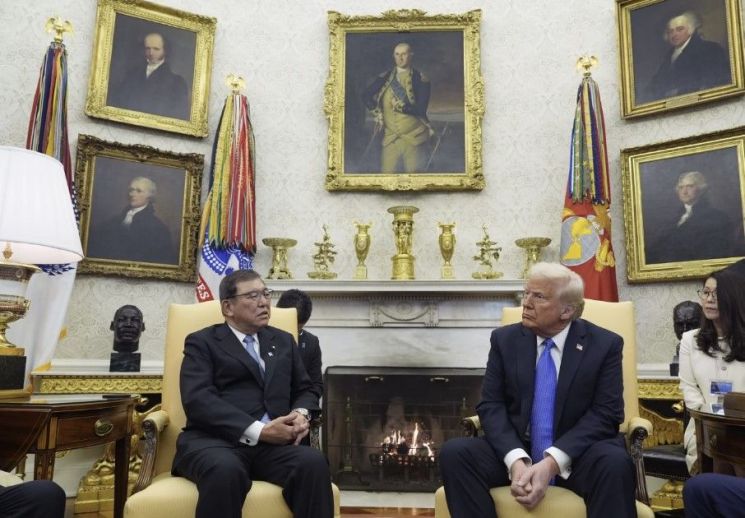
According to Bloomberg and other sources on the 7th (local time), President Trump made these remarks during a U.S.-Japan summit with Japanese Prime Minister Shigeru Ishiba held at the White House that day.
President Trump said the reciprocal tariff measures would affect "everyone," but did not disclose specific details.
He told Prime Minister Ishiba that he wants to reduce the trade deficit with Japan and believes the issue can be resolved without tariff measures. The U.S. trade deficit with Japan stands at $68 billion.
Speaking to the press in the Oval Office, the White House presidential office, Trump said, "We will announce reciprocal trade next week," adding, "We have to do this so that we can be treated equally with other countries. We do not want to be treated more or less."
Earlier, President Trump pledged during his candidacy to introduce a 'reciprocal trade law.' The core idea is to impose tariffs on imported goods from overseas at the same rate as tariffs imposed by foreign countries on U.S. exports. The current average U.S. tariff rate is about 3%, which is very low compared to other countries. President Trump has already signaled tariff increases on the European Union (EU) and sector-specific tariffs on industries such as semiconductors and steel.
He told reporters that he is particularly considering imposing tariffs on automobiles.
President Trump said, "That is always under discussion and a very big issue," emphasizing, "We have to make it (car tariffs) reciprocal."
Accordingly, attention is focused on whether South Korea will be included in the U.S. reciprocal tariff targets. Moreover, South Korea runs a large trade surplus with the U.S. in the automotive sector, so if President Trump raises car tariffs, the impact is expected to be inevitable. During his first term, Trump significantly raised steel tariffs based on Section 232 of the Trade Expansion Act citing national security threats, and he may take similar measures on automobiles in his second term. Some speculate that the U.S. could raise the passenger car tariff rate from the current 2.5% to the truck rate of 25%.
Since taking office on the 20th of last month, President Trump has been pushing an aggressive tariff increase policy with the start of his second term. On the 1st, he signed an executive order imposing a 25% tariff on all imports from Canada and Mexico and an additional 10% tariff on all Chinese imports on top of existing tariffs, citing failure to stop illegal immigration and drugs entering the U.S. from those countries. The tariffs on Canada and Mexico were abruptly postponed for one month a day before enforcement, but the tariff increase on China took effect at midnight on the 4th.
© The Asia Business Daily(www.asiae.co.kr). All rights reserved.
![Clutching a Stolen Dior Bag, Saying "I Hate Being Poor but Real"... The Grotesque Con of a "Human Knockoff" [Slate]](https://cwcontent.asiae.co.kr/asiaresize/183/2026021902243444107_1771435474.jpg)















