Trump's High Tariff Policy Brings Greater Inflationary Pressure Than His First Term
"Universal Tariffs Would Have a Significant Impact"
Korea Faces Tariff Effects Through Both Direct and Indirect Exports
"Need to Strengthen Cooperation With Japan, Taiwan, and Germany"
Essential to Maintain Links Between Large Corporations and SMEs
"U.S. President Donald Trump often mentioned former U.S. President William McKinley during the election process. In his inauguration speech, he said that McKinley made America wealthy through taxation and that it is important to return to that era. (However) McKinley was assassinated after his re-election, and near the end of his life, he said, 'Free trade seems to be a good thing.' We need to see how long it will take Trump to understand this."
Lee Si-wook, President of the Korea Institute for International Economic Policy, said this on the 7th at the 56th Anniversary Hall of Hannam University in Daejeon during the 2nd plenary session held under the theme "Trump's Second-Term Trade Policy and Korea's Response." This session was part of the detailed events of the two-day "2025 Joint Economics Conference" that started the day before. Lee delivered a keynote speech on the prospects and impacts of the trade policy of Donald Trump's second-term administration.
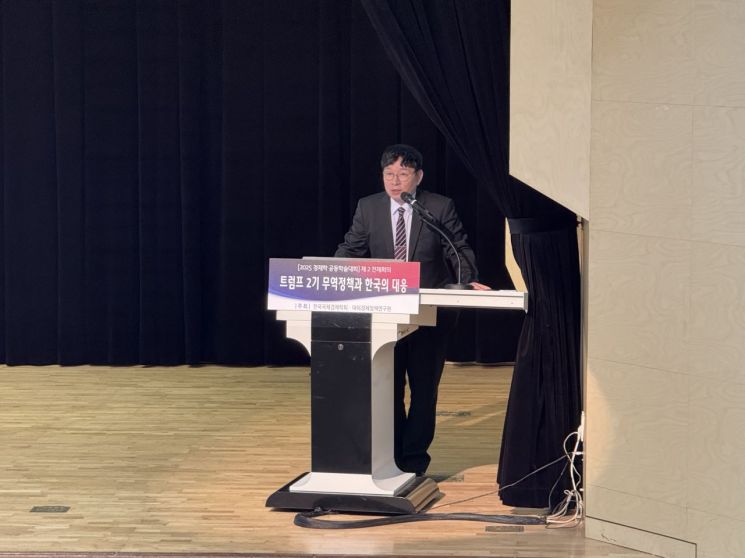 Lee Si-wook, President of the Korea Institute for International Economic Policy, is delivering the keynote speech at the 2nd General Meeting held on the 7th at Hannam University’s 56th Anniversary Hall in Daejeon, under the theme "Trump's Second-Term Trade Policy and South Korea's Response." Photo by Kim Pyeong-hwa
At this event, Lee explained that President Trump's recent actions are a combination of the policies of the 25th U.S. President (1897?1901), McKinley, and the 40th President (1981?1989), Ronald Reagan. He particularly evaluated that President McKinley’s past use of high tariffs to nurture domestic industries and his expansionist policies to enlarge U.S. territory had a significant influence on President Trump.
Lee viewed President Trump's tariff policy as resulting not only from political factors aimed at securing voter support but also from industrial and trade factors such as resolving trade imbalances and restoring manufacturing jobs. He also explained that with forecasts suggesting the U.S. fiscal deficit could reach between $4.6 trillion and $11 trillion over the next decade, tariffs are being used as a means to secure imports.
Lee said, "To examine whether Trump's tariff policy is practically sustainable, we need to look at how U.S. macro variables will change, whether tariff increases will stimulate inflation, and how much they will affect the fiscal deficit." Regarding the discussion of universal tariffs emerging in the second term, unlike the first term which focused on China, he said, "If universal tariffs are implemented, there will be a very significant impact," adding, "Unlike the first term, there will be effects on prices."
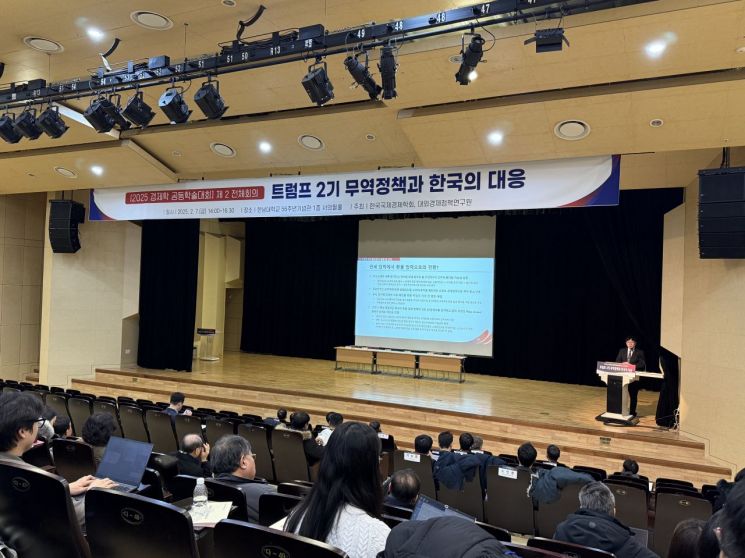 On the 7th, the 2nd General Meeting was held at Hannam University’s 56th Anniversary Hall in Daejeon on the theme of "Trump's Second-Term Trade Policy and Korea's Response." Photo by Kim Pyeonghwa
Lee assessed that if price increases due to universal tariffs and a stronger U.S. dollar occur, the U.S. trade deficit is likely to expand. He stated, "In a situation where inflationary pressures are gradually increasing, the key point will be when Trump ultimately feels what President McKinley felt at the end (free trade > tariffs)." He also forecasted, "Next year's U.S. midterm elections could be the first watershed moment for the success or failure of trade policy."
In Korea's case, not only direct exports to the U.S. but also indirect exports related to Chinese products flowing into the U.S. mean that Korea could fall under the influence of tariffs. Since countries such as Vietnam, Mexico, Taiwan, Canada, and Japan are also connected to indirect exports, Lee argued that it is necessary for countries that could face pressure to come together, cooperate, and create alternatives.
He explained, "We need to strengthen cooperation with countries like Japan, Taiwan, and Germany more than now, while also considering cooperation with the Global South (developing countries in Asia, Africa, and South America)." He also emphasized, "If large corporations invest overseas due to onshoring policies, the link between these large corporations and medium and small enterprises domestically could weaken. We need to consider how to maintain and strengthen this link in a healthy way."
© The Asia Business Daily(www.asiae.co.kr). All rights reserved.


















