"Respect for Advisory Role of the Committee" vs "Guarantee of Voting Rights" Remain Unresolved
Legislation and Agreement Unlikely Within This Month Even After Public Hearing on the 14th
The government and the medical community will begin full-scale discussions on establishing the 'Medical Workforce Supply and Demand Estimation Committee,' which will decide the quota for medical school admissions. However, opinions differ on the scope of the committee's role and authority, making it unlikely that an agreement on next year's medical school quota will be reached soon.
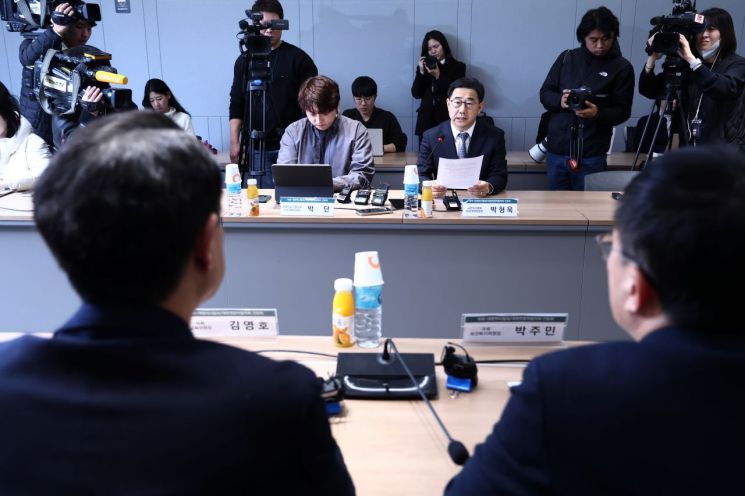 On December 19 last year, Park Hyung-wook, the Emergency Response Committee Chairman of the Korean Medical Association, is speaking at a meeting between the National Assembly, the Medical Association, and resident doctor organizations held at the Korean Medical Association in Yongsan-gu, Seoul. Photo by Yonhap News
According to the Ministry of Health and Welfare and the medical community on the 10th, the National Assembly's Health and Welfare Committee will hold a public hearing on the 14th with government and medical representatives to discuss the legislative process for establishing the committee.
So far, the medical community has argued for the establishment of a discussion body involving medical professionals, claiming that the government did not reflect their opinions when increasing medical school quotas. The government also plans to incorporate the medical community's views through the committee, making adjustment of next year's medical school quota via this committee the only solution to the current government-medical community conflict.
All related bills submitted to the Health and Welfare Committee aim to discuss the appropriate number of medical personnel through the committee to increase social acceptance. However, there are differences in details such as where the committee will be placed, how it will be composed, and the extent of its authority. The government holds the position that if the committee serves an advisory role regarding medical school quotas, it will respect its decisions. On the other hand, the medical community insists that the committee should have voting rights to decide the medical school quotas. The Korean Medical Association submitted a statement last month regarding the committee, demanding "complete independence for the committee and granting it a decision-making role so that its decisions are directly reflected."
Due to these differing positions, it is expected that discussions on next year's medical school quota will be difficult. Considering university admission schedules, the quota for next year should be finalized by the end of this month at the latest. However, even if the committee's establishment is discussed immediately, it is unrealistic to form the committee and reach an agreement on the medical school quota within the remaining 20 days. Some in the medical community hoped that freezing or reducing next year's medical school quota might allow residents to return to training hospitals and medical school classes to resume before March, but this is also practically impossible.
Meanwhile, the Medical Policy Research Institute under the Korean Medical Association recently released an estimation result stating that increasing the medical school quota by 2,000 compared to the 2024 academic year and maintaining the current physician working days (289.5 days) would result in an 'excess supply of physicians' of 11,481 more than demand in 10 years. The institute also predicted that maintaining the 2024 medical school quota without increase would result in a supply exceeding demand by 3,161 physicians in 10 years.
© The Asia Business Daily(www.asiae.co.kr). All rights reserved.
![Clutching a Stolen Dior Bag, Saying "I Hate Being Poor but Real"... The Grotesque Con of a "Human Knockoff" [Slate]](https://cwcontent.asiae.co.kr/asiaresize/183/2026021902243444107_1771435474.jpg)















