"Second Foreign Leader to Visit the White House After Netanyahu"
Key Agenda: U.S.-Japan Security Cooperation and North Korea Nuclear Response Strategy
Complex Economic Issues... Likely Emphasis on Bilateral Cooperation Triggered by SoftBank AI Investment
Significance for Ishiba Personally
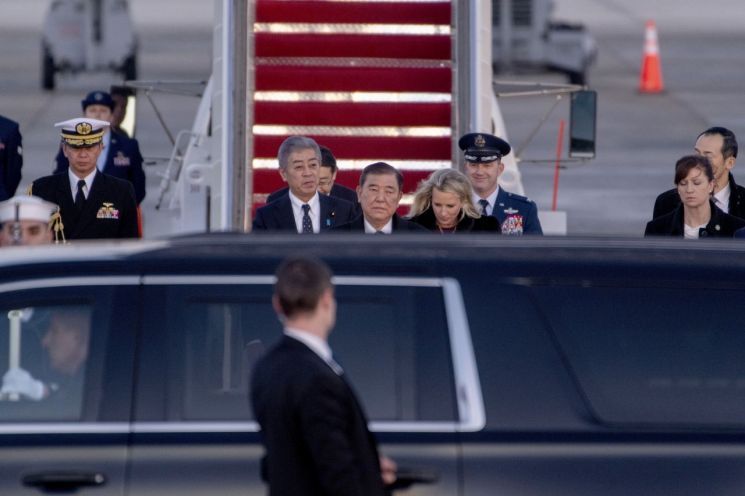 Japanese Prime Minister Shigeru Ishiba arrived and moved at Andrews Joint Base in Maryland near Washington DC, USA, on the 6th (local time). Prime Minister Ishiba will hold his first US-Japan summit with US President Donald Trump at the White House on the 7th (local time). /AP·Yonhap News
Japanese Prime Minister Ishiba Shigeru and U.S. President Donald Trump will hold their first meeting at the White House on the afternoon of the 7th (local time). Since Trump administration officials have consistently mentioned the policy of resolving trade deficits without exception for allies including South Korea and Japan, it is expected that Ishiba will exercise caution during economic cooperation talks.
"Second Foreign Leader to Visit the White House After Netanyahu"
Nicholas Szechenyi, a senior fellow at the U.S. think tank Center for Strategic and International Studies (CSIS), stated in a post on the 4th (local time) that "Prime Minister Ishiba is scheduled to hold talks with President Trump at the White House on February 7th to reaffirm the strength of the U.S.-Japan relationship and that Japan is a 'reliable ally.'"
He added, "The two leaders are expected to issue a joint statement addressing various security and economic issues," and "this meeting could serve as an important occasion to strategically signal to potential adversaries that the alliance (Japan) will continue to play a pivotal role in the U.S.'s Asia strategy."
With this summit, Prime Minister Ishiba is set to become the second foreign leader to visit the White House following Israeli Prime Minister Benjamin Netanyahu.
Senior Fellow Szechenyi noted, "This indicates Japan's strategic importance," and said, "Japanese diplomacy has always aimed for 'America First,' and if Prime Minister Ishiba can effectively convey this, it could lay a solid foundation for strengthening the U.S.-Japan alliance."
He also pointed out that while the media will focus on the personal rapport between Prime Minister Ishiba and President Trump, the message from Ishiba himself is more important.
Senior Fellow Szechenyi said, "At first, it may seem like a hastily arranged summit, but this could be the starting point for shaping the regional balance in Asia in a way favorable to the U.S. alliance network."
Key Agenda: U.S.-Japan Security Cooperation and North Korea Nuclear Response Strategy
The key agenda includes strengthening U.S.-Japan security cooperation and coordination on North Korea's nuclear strategy. Currently, Japan has prepared a plan to enhance its defense capabilities. The goal is to increase defense spending to about 2% of Japan's Gross Domestic Product (GDP).
Senior Fellow Szechenyi said, "Prime Minister Ishiba will want to discuss how important U.S.-Japan defense cooperation is in deterring China," and "he may also seek to promote U.S.-Japan coordination on North Korea's nuclear strategy to address the threat posed by North Korea's nuclear weapons and ballistic missile programs, ensuring Japan's national interests are reflected."
Earlier, on the 31st of last month, Japanese Defense Minister Nakatani Gen agreed with U.S. Secretary of Defense Pete Hekse on expanding the military presence of both countries in the Nansei Islands during a phone call. In the approximately 40-minute call, both sides agreed on strengthening the deterrence and response capabilities of the U.S.-Japan alliance.
Complex Economic Issues... Likely Emphasis on Bilateral Cooperation Triggered by SoftBank AI Investment
The economic issues are somewhat more complicated. President Trump and his administration, emphasizing 'America First,' have been attacking the U.S. trade deficit globally, including with allies such as South Korea and Japan. High tariffs are one of Trump's strong tools.
Senior Fellow Szechenyi said, "President Trump is likely to criticize Japan's trade surplus with the U.S., but Prime Minister Ishiba is expected to alleviate these concerns with Japan's new investment plans in the U.S. economy," citing the possible announcement of Japan's plan to import liquefied natural gas (LNG) from the U.S. He also suggested that Japan might employ a strategy emphasizing the import of U.S.-made defense equipment in its defense enhancement plan and latest defense budget request.
In particular, it is analyzed that Prime Minister Ishiba is likely to propose ways to further strengthen cooperation between the two countries based on the recent joint generative artificial intelligence (AI) investment plan with Japan's SoftBank announced by President Trump.
On the other hand, there are parts that are difficult to mention. He said, "The acquisition of U.S. Steel by Nippon Steel can be mentioned in a historical context, but discussing this issue in detail could shift the focus of discussions to U.S. trade policy, thereby diluting the overall message of economic cooperation."
He also noted, "Similarly, explaining in detail the negative impact of U.S. tariff policies on Japanese industries such as automobiles could lead to trade disputes," and "Prime Minister Ishiba should approach economic cooperation talks cautiously and strategically emphasize that Japan continues to contribute to U.S. economic growth."
Significance for Ishiba Personally
The summit holds special significance for Prime Minister Ishiba personally. His political position, leading a minor party, is unstable. It is expected that by achieving meaningful results through this summit, he can demonstrate his diplomatic capabilities and strengthen his political base at home.
Senior Fellow Szechenyi said, "Prime Minister Ishiba has obtained a brief opportunity to step away from parliamentary deliberations for this Washington visit, aiming to prove his diplomatic skills and strengthen domestic political support," but he drew a line by saying, "However, this visit is not simply to resolve his political issues."
He added, "Prime Minister Ishiba will want a joint statement reaffirming strategic cooperation on regional security issues and expressing a shared commitment to strengthening the U.S.-Japan security alliance as a foundation for stability and prosperity in Asia."
© The Asia Business Daily(www.asiae.co.kr). All rights reserved.

















