Authorities Show Lukewarm Response, Stressing "Careful Review"
Industry Remains Cold, Citing "Low Policy Effectiveness"
The ruling party has taken out the temporary relaxation card for the Debt Service Ratio (DSR) to resolve unsold apartments in local areas, but the response from authorities and the industry is cold. This is because the policy, whose effectiveness is in question, was brought up belatedly.
According to political circles on the 10th, the Financial Services Commission is considering a temporary relaxation of the DSR in non-metropolitan areas at the request of the People Power Party. On the 4th, the People Power Party addressed the issue of unsold apartments in local areas as the first agenda item at the economic party-government council and urged the relaxation of the DSR to resolve it. On the 5th, they held a construction industry listening session as the first policy meeting, continuously raising the issue of unsold apartments in local areas.
The authorities have shown a lukewarm response. The Financial Services Commission stated, "There are many matters to be carefully considered, such as the necessity, validity, effectiveness, and policy consistency of the temporary relaxation of the DSR." This is interpreted as meaning it is difficult to touch the basic principle of the DSR. This is because they have maintained the principle of "borrowing only what you can repay" to manage the quality of household debt. The impeachment political situation, which has narrowed the authorities' room for maneuver, is also a variable. A financial sector official said, "In a situation where it is unclear where the administration is headed, they will inevitably make conservative judgments to avoid taking responsibility."
The real estate industry questions the effectiveness. Considering the average price of apartments in non-metropolitan areas, which is around 300 million won, the DSR regulation is not a major obstacle to purchasing a home. Except for some areas, most can receive policy fund loans that are not subject to the DSR. Eunhyung Lee, a research fellow at the Construction Policy Research Institute, analyzed, "Will properties that do not sell due to location or price sell just because more loans are given? The relaxation of the DSR will be limited in resolving the unsold apartment problem."
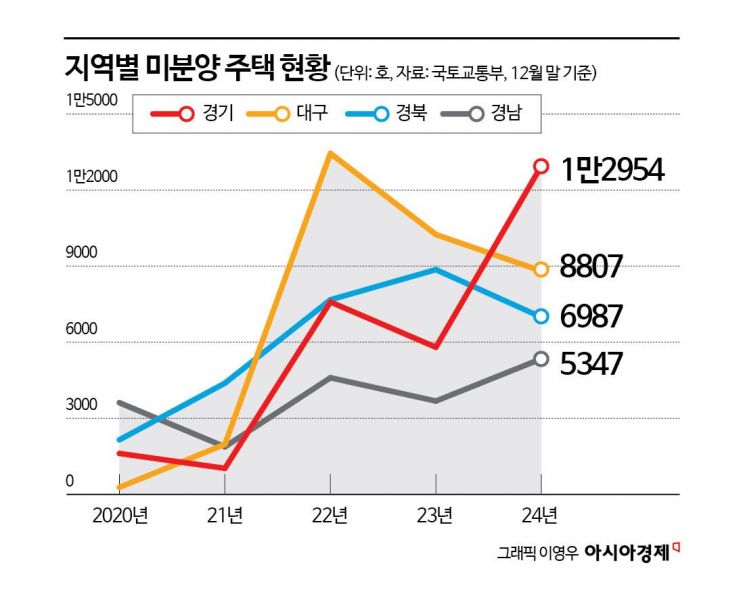
Accordingly, there is an evaluation that this is a strategy considering votes rather than policy effects. As the possibility of an early election increases, measures reflecting regional public sentiment have been presented. In fact, about 60% of post-construction unsold houses, called "malignant unsold," come from Daegu and Gyeongbuk regions, strongholds of the ruling party. However, these areas have passed the peak of the crisis, with the increase in unsold apartments slowing down.
Yoon Sumin, a real estate specialist at NH Nonghyup Bank, pointed out, "In the future, unsold apartments in Gyeonggi Province will become more serious than those in local areas," adding, "If you only look at the already late timing of the local unsold apartment problem, it can be labeled as a vote-conscious move." Jeong Taeho, a member of the Democratic Party and ranking member of the National Assembly's Planning and Finance Committee, criticized, "As the election approaches, they have taken out a card whose effectiveness cannot be guaranteed. The easiest way to boost economic growth is to stimulate the real estate market, but the results have never been good."
© The Asia Business Daily(www.asiae.co.kr). All rights reserved.

















