USAID Workforce Slashed from 10,000 to 290
Mass Layoffs Hit Government-Related Agencies and Companies
Even After Finding New Jobs, Fears of "Being Laid Off Again" Persist
Experts Warn "Economic Impact Cannot Be Ignored"
Job losses are occurring across the United States due to the Trump administration's extensive federal funding cuts and freeze policies. There are warnings that this downward trend could accelerate in the coming weeks, potentially threatening the entire U.S. labor market.
On the 6th (local time), The New York Times (NYT) reported that thousands of private sector jobs in the U.S. have been lost over the past two weeks as a result of federal funding cuts. According to the Brookings Institution, more than 7.5 million Americans work in jobs directly connected to the federal government. Millions more are employed in positions indirectly linked to the federal government.
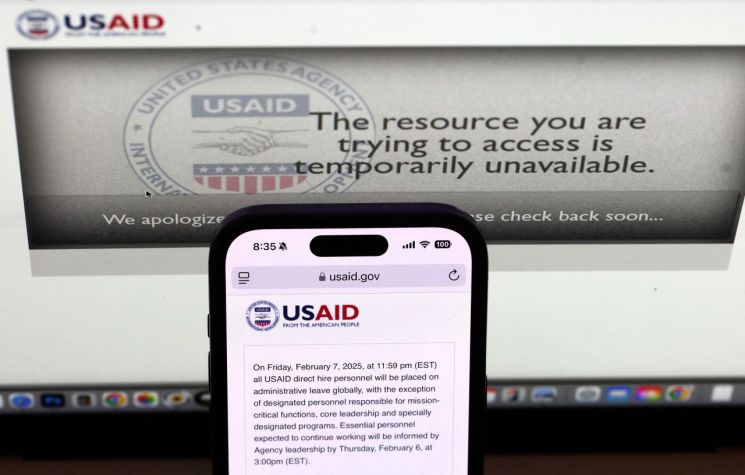 The website of the United States Agency for International Development (USAID), which the Donald Trump administration has begun restructuring. Getty Images Yonhap News
Experts, citing the U.S. Department of Labor's January employment report to be released on the 7th, expect that nonfarm payrolls increased by 154,000 last month, down from 256,000 the previous month, with the unemployment rate holding steady at 4.1%. However, economists believe it will take several weeks to months before government-related job losses are reflected in these indicators.
The NYT reported that President Trump plans to retain only 290 of the 10,000 employees at the U.S. Agency for International Development (USAID), which is undergoing restructuring. Additionally, the Trump administration is promoting a voluntary retirement program aimed at reducing the federal workforce of approximately 2.3 million employees by 5 to 10%, with over 40,000 employees having applied for retirement by the 5th.
Government-related agencies and companies are canceling projects and laying off staff one after another. Contract jobs were canceled in Fayetteville, North Carolina, and Austin, Texas, and employees at independent living facilities in West Virginia, who are paid with federal funds, were laid off. In Maine’s after-school programs and Virginia’s community health centers, federal funding delays have led employees to take leave.
Washington D.C.-based international development company Chemonics International placed 600 American employees on leave and reduced working hours for 300 after USAID-funded projects were ordered to halt. DAI Global in Bethesda, Maryland, furloughed 400 workers, accounting for 70% of the American employees hired by the company.
Federal government-related jobholders generally have high educational levels and can find new employment quickly even if they lose their jobs. However, economists see the situation as complicated due to the recent massive scale of job cuts. For example, those working in international development, environmental, or climate-related sectors may face difficulties finding new jobs as the entire industry contracts.
Julia Pollak, chief economist at ZipRecruiter, pointed out that federal employees participating in the voluntary retirement program can receive pay until September, but employees in the private sector and nonprofit organizations dependent on government funding do not have this benefit.
Washington D.C., where 40% of the economy depends on the federal government, is likely to suffer the greatest impact from these government policies. However, other regions are not exempt. Terry Clower, director of the Center for Regional Analysis at George Mason University, said that for every five federal government jobs lost, two additional jobs disappear nationwide, explaining, "If funding is cut for a scientist working in a university lab, that person loses their job, household spending decreases, and other jobs are affected."
Harry Holzer, a Georgetown University professor and former chief economist at the U.S. Department of Labor, stated, "If funding is cut too quickly, government contracts are at risk, health research is put on hold, and millions of employees receive confusing messages about their jobs," adding, "We don’t know where this will lead, but the economic impact cannot be ignored."
© The Asia Business Daily(www.asiae.co.kr). All rights reserved.
![Clutching a Stolen Dior Bag, Saying "I Hate Being Poor but Real"... The Grotesque Con of a "Human Knockoff" [Slate]](https://cwcontent.asiae.co.kr/asiaresize/183/2026021902243444107_1771435474.jpg)















