Successive DeepSeek Bans Over "Excessive Data Collection"
Large Corporations Lead in Building Their Own "AI Assistants"
Addressing Security Concerns... Accelerating the "AI Internalization" Strategy
Domestic defense companies have also joined in blocking China's generative artificial intelligence (AI) 'DeepSeek.' Given its close connection to national security, they have decided to implement strong security measures. This appears to be based on the judgment that existing security systems that separate internal and external networks cannot completely prevent new AI-based threats.
According to the defense industry on the 7th, SNT Dynamics and SNT Motive, subsidiaries of the SNT Group, recently announced internally that "there is a concern that DeepSeek extensively collects user data and leaks it to China," and have blocked access within the company. They also requested restraint in using it on personal communication devices, stating, "Please be careful not to input company business information or technical data when connecting personal information communication devices."
Hyundai Rotem and STX Engine also announced the block through internal notices on the same day. This is a measure for national security and confidentiality protection, prioritizing security enhancement. Hanwha Aerospace and Hanwha Systems had already taken measures since last year to prevent the installation of generative AI on company computers.
Large domestic companies have not issued separate measures regarding the DeepSeek access block. Since they have already restricted access to external generative AI since the ChatGPT surge in 2023, they see no significant change from their existing stance. There is a growing tendency to focus on developing AI systems in-house to be free from security issues and data leakage concerns.
An industry insider said, "When using external AI services including DeepSeek, it is unclear where the input information is stored," adding, "There is a possibility of leakage of trade secrets or important technical information, so strengthening internal AI systems is the best option."
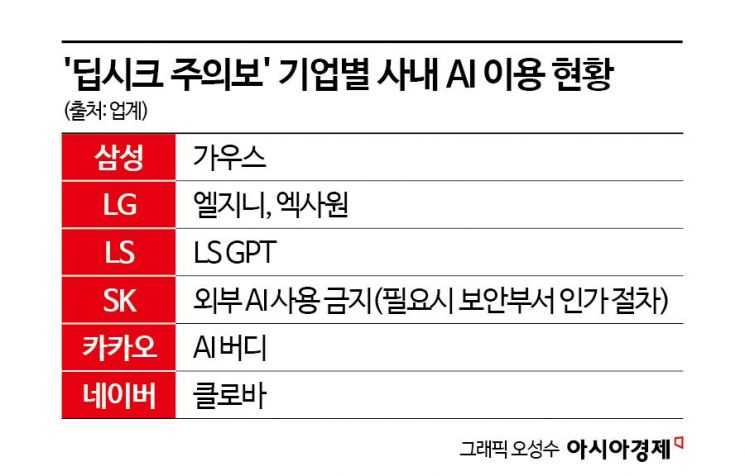
Accordingly, large companies such as Samsung are supporting employees' research and development (R&D) and work with their self-developed 'AI assistants.' There is also an expectation that the AI internalization strategy will lead to strengthening industrial competitiveness.
Samsung Electronics has the work AI 'Gauss,' which was unveiled at the end of 2023. It was recently upgraded to 'Gauss2,' a multimodal version capable of processing different types of data simultaneously. LG has the work AI 'LGni' and the R&D-focused 'ExaOne.' LS Group operates 'LS GPT,' developed based on the OpenAI GPT model.
The information technology (IT) industry also uses its own AI programs. Kakao, which built an 'alliance front' with OpenAI CEO Sam Altman’s visit to Korea, has also issued a DeepSeek ban. Inside the company, the 'AI Buddy' takes on the role instead. Naver is enhancing efficiency and productivity in internal work through 'CLOVA.'
An industry insider said, "As AI technology advances, security threats are also increasing," and added, "Domestic companies should further strengthen their own AI development and move toward reducing dependence on external sources."
Meanwhile, DeepSeek has been criticized for excessively collecting user data compared to other generative AI services. According to its privacy policy, it collects not only information directly entered by users in prompts but also device information, serial numbers, IP addresses, and even accumulates keyboard input patterns and rhythm information.
© The Asia Business Daily(www.asiae.co.kr). All rights reserved.


















