40,000 KRW for Mobilization Training Type II (Years 1-4),
6,000 KRW for Operational Plan Training (Years 5-6)
The Ministry of National Defense announced on the 7th that the '2025 Reserve Forces Training' will be conducted at 160 reserve forces training centers nationwide starting from March 4.
Mobilization Training Type I (formerly Mobilization Training) will be conducted as in previous years with a 2-night, 3-day training at the mobilization unit or mobilization training site, and Mobilization Training Type II (formerly Dongmicham Training) will also be held as in previous years at reserve forces training centers or scientific regional reserve forces training centers.
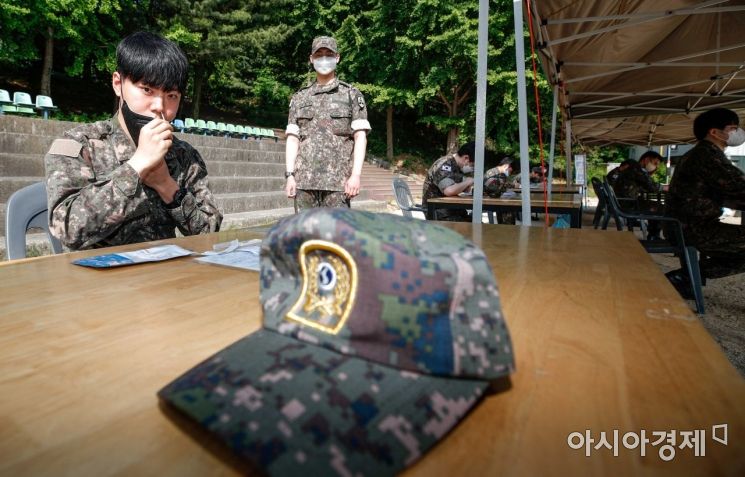 Since the suspension in December 2019 due to the COVID-19 pandemic, the reserve forces training resumed on the 2nd. A reservist visiting the Science Reserve Forces Training Center in Seocho-gu, Seoul, is testing with a self-diagnosis kit before the training. Photo by Jinhyung Kang aymsdream@
The Ministry of National Defense stated that the existing training names (Mobilization Training, Dongmicham Training) made it difficult to understand the nature of the training, so the mobilization training for reservists in years 1 to 4 who are subject to troop mobilization summons (mobilization designated) is called 'Mobilization Training Type I,' and the training for reservists in years 1 to 4 who are not subject to troop mobilization summons (mobilization undesignated) is called 'Mobilization Training Type II.'
Additionally, regional reserve forces training targets reservists in years 5 to 6, with basic training conducted at regional reserve forces training centers or scientific regional reserve forces training centers, and operational plan training conducted in operational or similar areas. Furthermore, remote education will be implemented as in the previous year for reservists in year 6, by attending 2-hour online lectures over a 4 to 6 month period.
The standing reserve forces (formerly non-active reserve forces) will continue to be operated to address security gaps caused by a decrease in manpower resources, secure insufficient mobilization resources, and ensure practical combat readiness. This year, 3,500 short-term personnel (mobilized for 15 to 30 days annually) and 200 long-term personnel (mobilized for up to 180 days annually) will be recruited and selected for operation, with plans to gradually expand the scale of operation. In particular, a pilot 30-day annual training model will be applied to about 320 short-term standing reserve forces to analyze operational effectiveness and outcomes, with plans to expand the application target.
The Ministry of National Defense will especially provide training participation fees starting this year to improve the training environment for reservists. Mobilization Training Type II (4 days, non-camping) participants will receive a training fee of 40,000 KRW (10,000 KRW per day), and regional reserve forces training participants will receive operational plan training transportation expenses of 6,000 KRW (twice a year / 3,000 KRW per session) for the first time.
Also, to guarantee attendance conditions and improve convenience for reserve forces training, a system allowing reservists to apply for training (basic training, Mobilization Training Type II) on their preferred dates will be piloted for the Army (3 divisions). Additionally, the construction of scientific regional reserve forces training centers and modernization projects for mobilization training sites will continue.
The Ministry of National Defense stated, "We will conduct practical and substantial training so that the reserve forces, an important pillar of national defense, can immediately perform their duties in emergencies, and at the same time, we will continuously strive to improve the rights and benefits of reservists."
© The Asia Business Daily(www.asiae.co.kr). All rights reserved.
![Clutching a Stolen Dior Bag, Saying "I Hate Being Poor but Real"... The Grotesque Con of a "Human Knockoff" [Slate]](https://cwcontent.asiae.co.kr/asiaresize/183/2026021902243444107_1771435474.jpg)















