US: "Agreement Reached on Government Vessel Toll Exemption"
Panama President: "Condemning Diplomacy Based on Lies"
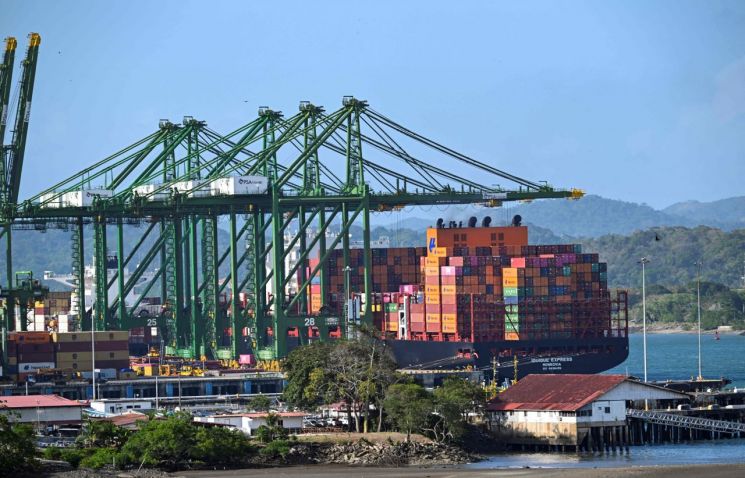
The conflict between the United States and Panama over the Panama Canal escalated into a dispute over the truth on the 6th (local time). After the U.S. government announced that it had reached an agreement with the Panamanian government to exempt government vessels, including the Navy, from tolls when passing through the Panama Canal, the Panamanian government directly refuted the claim, stating that no such agreement exists.
The previous day, the U.S. State Department announced via social media platform X (formerly Twitter), "U.S. government vessels can now pass through the Panama Canal without paying tolls," adding, "The U.S. government will save millions of dollars annually."
The U.S. Department of Defense also stated, "Secretary of Defense Pete Hegseth spoke with Panamanian President Jos? Ra?l Mulino," and "Secretary Hegseth and President Jos? Ra?l Mulino agreed to expand cooperation between the U.S. and Panamanian militaries, emphasizing broad and expanding collaboration."
However, President Mulino said at a press conference broadcast live on the presidential office's YouTube channel that day, "The U.S. claims regarding the passage of U.S. government vessels are based on false information," adding, "As far as I know, bilateral relations between allied countries are not handled this way. I condemn diplomacy based on lies." He also requested the Panamanian ambassador to Washington to challenge the State Department's claims and announced plans to speak with President Trump on the afternoon of the 7th.
According to the Panamanian government, Article 76 of the law concerning the establishment and operation of the Panama Canal Authority (ACP) stipulates that "neither the government nor the ACP can exempt tolls or fees for the use of the interoceanic waterway (Panama Canal)." The local daily La Prensa Panama reported that the ACP board holds the authority to decide tolls, and even if the ACP board passes a toll change, it must receive final approval from the National Council of Ministers.
The U.S. daily The Wall Street Journal (WSJ) reported that the number of U.S. Navy vessels passing through the Panama Canal is about 40 annually, accounting for only 0.5% of the total canal traffic. It estimated that if these vessels do not pay tolls, the U.S. Department of Defense could save $13 million out of its $850 billion budget.
President Mulino questioned, "What significance would a saving of about $10 million have for a country like the U.S.?" and criticized, "The canal tolls are not enough to bankrupt the U.S. economy." He further pointed out, "Why would an agency managing foreign policy under the direction of the U.S. president issue an important official statement based on lies?"
WSJ, citing sources familiar with the negotiations, reported that the U.S. State Department's announcement was ahead of legal procedures, and Panamanian officials perceived it as a tactic to corner them.
The Panama Canal Authority warned that exempting tolls for certain vessels is unprecedented and that the issue of preferential treatment for U.S. vessels could lead to a series of international lawsuits with other countries. Ricaurte V?squez Morales, administrator of the Panama Canal Authority, said in an interview with WSJ last month, "Violating the obligation to maintain the permanent neutrality of canal management would cause great confusion."
The United States built the canal under a treaty with Panama and managed and controlled it for over 80 years before transferring operational rights to Panama in 1999 under conditions including the guarantee of permanent neutrality. However, since taking office, President Trump has repeatedly declared his intention to reclaim the Panama Canal. In particular, he claimed that China controls the Panama Canal because two ports were granted operational rights to a Hong Kong-based company, arguing that this violates the 1999 treaty between the U.S. and Panama.
© The Asia Business Daily(www.asiae.co.kr). All rights reserved.

















