Mayor Kang Requests Support for "AI Phase 2"
Proposes Establishment of National AI Computing Center in Gwangju
On-site Roundtable with AI Companies... Listening to Challenges
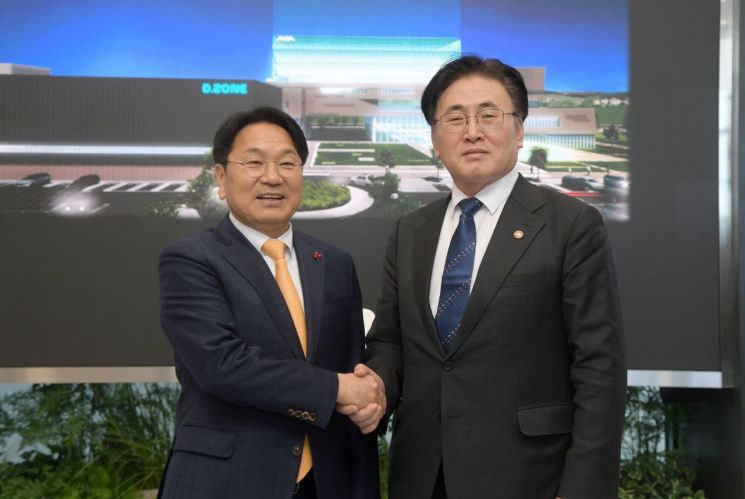 Gwangju Mayor Kang Gijeong is taking a commemorative photo with Minister Yoo Sangim of the Ministry of Science and ICT at the National AI Data Center within the Gwangju AI Cluster on the morning of the 6th. Photo by Gwangju City
On the 6th, Gwangju Mayor Kang Gijeong stated, "The government must shorten the global AI technology gap through timely investment," and urged the government to "promptly finalize the exemption from the preliminary feasibility study for the second phase of the Gwangju AI project."
On this day, Mayor Kang met with Minister of Science and ICT Yoo Sangim, who visited the Gwangju AI Cluster, and said, "Gwangju is the first non-capital region to establish an initial ecosystem for artificial intelligence (AI). To ensure the seamless progress of the second phase project following the first phase, we request a prompt exemption from the preliminary feasibility study and the allocation of a supplementary budget," he said.
Mayor Kang told Minister Yoo, "Through the first phase of the AI project, Gwangju has completed an AI industry ecosystem that enables 'infrastructure?technology development?demonstration?commercialization.' The second phase project is being promoted so that companies can utilize the infrastructure for research and development. Full government support is needed so that companies can use resources such as computing power (GPU) and large-scale driving simulators for R&D," he emphasized.
Mayor Kang also proposed the establishment of a National AI Computing Center in Gwangju. As Gwangju is home to the nation's only National AI Data Center, the city is ready to compete for AI leadership. For large-scale AI, a national data center with more than 100,000 GPUs is required. Gwangju holds half of the domestic 'H100' GPUs, has operational experience with the National AI Data Center, and is considered an optimal location with a robust AI talent development pipeline.
In response, Minister Yoo said, "To become one of the top three global AI powerhouses in this rapidly changing AI era, national capabilities must be consolidated and the potential of AI must be actively utilized in local communities. We will support local AI R&D infrastructure so that AI companies can secure competitiveness and grow in a favorable environment, and collaborate to ensure that AI contributes to regional development."
He added, "Based on the AI infrastructure established through Gwangju's first phase project, we will work together to ensure that Gwangju AI becomes a leading model for regional innovation."
On the morning of the same day, Minister Yoo visited the Gwangju AI Cluster located in the Cheomdan 3 District to inspect the operation of the Gwangju AI Data Center and review the achievements of the first phase AI project.
This on-site visit was organized to check the progress and achievements of the 'Gwangju AI Cluster Development Project,' a leading model of the 'AI Cluster,' and to gather feedback from Gwangju-based AI companies through a roundtable, with the aim of strengthening national AI competitiveness in partnership with the region and seeking AI policies that the public can experience firsthand.
To strengthen communication on the AI frontlines, Minister Yoo also held a roundtable with AI companies in Gwangju. Seven outstanding AI venture and startup companies from Gwangju, including a company that started locally and succeeded globally by winning the '2025 CES Innovation Award,' participated in the event.
During the roundtable, participants shared successful cases of regional industry and AI convergence through the AI Cluster's infrastructure and various AI company support programs, as well as achievements in developing innovative products and services. They also listened to companies' difficulties and policy suggestions.
Meanwhile, the Gwangju AI Cluster Development Project (AI Phase 1) was selected as an exemption project from the preliminary feasibility study under the National Balanced Development Project in 2019 and has since been promoted. The goal is to create an AI ecosystem by concentrating key resources needed for AI development?such as data, technology, talent, and demonstration environments?in one location.
Through the first phase project, the country’s only and largest (88.5PF) National AI Data Center and 77 types of AI demonstration equipment, including a large-scale driving simulator, have been established. The National AI Data Center, which houses high-performance AI accelerators essential for AI, opened in October 2023. It has been providing computing resources to support startups and venture companies in conducting AI R&D and developing products and services in a stable manner.
In fact, based on this AI infrastructure, computing resources (GPU) for 1,946 projects have been provided to companies, supporting the development of AI products and services.
The city of Gwangju is advancing the AI infrastructure, including various AI technologies and services established through the first phase, and is promoting the 'AX Demonstration Valley Development Project (AI Phase 2)' so that AI companies can use it for research and development. In September last year, the city applied for an exemption from the preliminary feasibility study and is currently consulting with financial authorities to have the proposal included in the Cabinet meeting agenda.
© The Asia Business Daily(www.asiae.co.kr). All rights reserved.
![Clutching a Stolen Dior Bag, Saying "I Hate Being Poor but Real"... The Grotesque Con of a "Human Knockoff" [Slate]](https://cwcontent.asiae.co.kr/asiaresize/183/2026021902243444107_1771435474.jpg)















