Major Financial Holding Companies Successfully Defend 13% CET1 Ratio Despite High Exchange Rate
Active Shareholder Return Policies Expected to Continue This Year
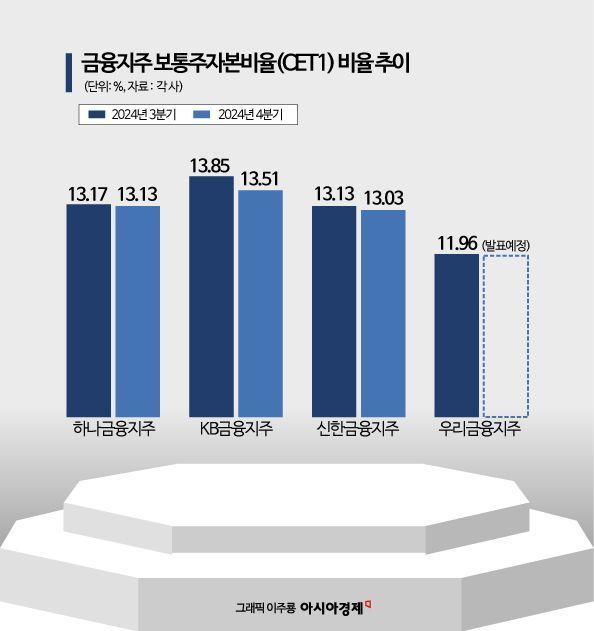
Last year's sharp rise in the exchange rate during the fourth quarter raised concerns about the financial soundness of financial holding companies, but it has been revealed that they succeeded in defending the Common Equity Tier 1 (CET1) ratio, which is the standard for soundness, by actively managing their capital. With the successful defense of CET1, expectations for aggressive shareholder return policies this year have also increased.
Major Financial Holding Companies Successfully Maintain CET1 in the 13% Range
According to the financial sector on the 7th, Hana Financial Group recorded a CET1 ratio of 13.13% as of the end of last year. This is a 0.04 percentage point decrease from 13.17% recorded in the third quarter of last year. During the same period, Shinhan Financial Group's CET1 ratio fell by 0.1 percentage points from 13.13% to 13.03%, and KB Financial Group's dropped by 0.34 percentage points from 13.85% to 13.51%.
CET1, a representative financial soundness indicator for banks, is the ratio of common equity capital to risk-weighted assets (RWA). The Bank for International Settlements (BIS) recommends a CET1 ratio of 8% or higher, while Korean financial authorities and financial holding companies aim for a more stable level above 13%. When CET1 exceeds 13%, the surplus capital can be used for more active shareholder returns such as share buybacks, cancellations, and dividends, making it a key indicator for financial companies' value-up policies in the market.
In the financial sector, concerns were raised that the CET1 ratio of financial holding companies could significantly decline due to the sharp rise in the won-dollar exchange rate following the martial law situation in December last year. When the exchange rate rises sharply, the won-converted amount of foreign currency-denominated asset RWAs, a key factor in CET1 calculation, increases, which can generally lower banks' soundness indicators such as CET1 and total capital ratios. It is known that a 100 won increase in the exchange rate can cause a maximum 0.3 percentage point arithmetic decline in the CET1 ratio. The average won-dollar exchange rate surged by more than 100 won in just one quarter, from 1,332 won in September last year to 1,436 won in December.
Despite these concerns, Hana Financial Group's CET1 ratio fell by only 0.04 percentage points from the third to the fourth quarter of last year, and Shinhan Financial Group also showed a favorable result with a 0.1 percentage point decline. KB Financial Group experienced a larger drop of 0.34 percentage points compared to the others.
Active RWA Management Ensures Soundness; Shareholder Return Policies Expected to Continue This Year
The reason financial holding companies succeeded in defending CET1 despite the sharp rise in the exchange rate is that they actively managed RWAs in the fourth quarter of last year. Banks took preemptive measures against the exchange rate surge by liquidating high-risk RWAs.
A Hana Financial Group official explained, "Despite the exchange rate increase, the result was due to group-wide comprehensive RWA management efforts combined with a profitability-focused asset growth strategy." Shinhan Financial also stated, "We maintained a stable capital ratio through appropriate RWA management in the fourth quarter."
Choi Jung-wook, a researcher at Hana Securities, analyzed, "Despite the sharp rise in the exchange rate in the fourth quarter, Hana Financial's CET1 ratio only slightly declined. Although the sensitivity to derivatives caused the exchange rate increase effect, the negative impact was offset by efforts to reduce and sell high-risk RWAs."
In the case of KB Financial, although the CET1 decline was larger than that of other companies, it is still evaluated as stable enough to maintain the industry's top position. Kim Do-ha, a researcher at Hanwha Investment & Securities, said, "Due to the exchange rate impact, KB Financial Group's CET1 was lower than expected," but added, "Since the exchange rate is an external factor, the indicators could improve once stability is restored."
With major financial holding companies successfully defending against the high exchange rate, aggressive value-up policies are expected to continue this year following last year. Hana Financial Group emphasized that starting this year, it will fix the total annual cash dividend amount and implement equal quarterly cash dividends to increase predictability of dividend size, while also expanding the proportion of share buybacks and cancellations. Shinhan Financial Group also plans to raise its total shareholder return ratio, which was below 40% last year, up to a maximum of 44%.
© The Asia Business Daily(www.asiae.co.kr). All rights reserved.
![Clutching a Stolen Dior Bag, Saying "I Hate Being Poor but Real"... The Grotesque Con of a "Human Knockoff" [Slate]](https://cwcontent.asiae.co.kr/asiaresize/183/2026021902243444107_1771435474.jpg)















