Open Discussion for Revitalizing the Korean Stock Market
Deepening Youth Outflow, Need to Expand Long-Term Investment Demand

"Our capital market is facing a 'Two-Front War' crisis, challenged by the gap with advanced markets and the virtual asset market." (Lee Bok-hyun, Governor of the Financial Supervisory Service)
"Korea is a market focused on short-term investment. To become an advanced market, it is very important to expand the foundation for long-term investment." (Seo Yoo-seok, Chairman of the Korea Financial Investment Association)
The domestic stock market, long plagued by the chronic Korea discount controversy, has been painfully diagnosed as facing an unavoidable threat to growth due to the outflow of the future core investors?the youth generation?and domestic and international uncertainties. To enhance the competitiveness of the domestic stock market, continuous calls have been made for the application of a single-rate separate taxation system, the introduction of a minor Individual Savings Account (ISA), expansion of retirement pension participation in the capital market, corporate restructuring, and reallocation.
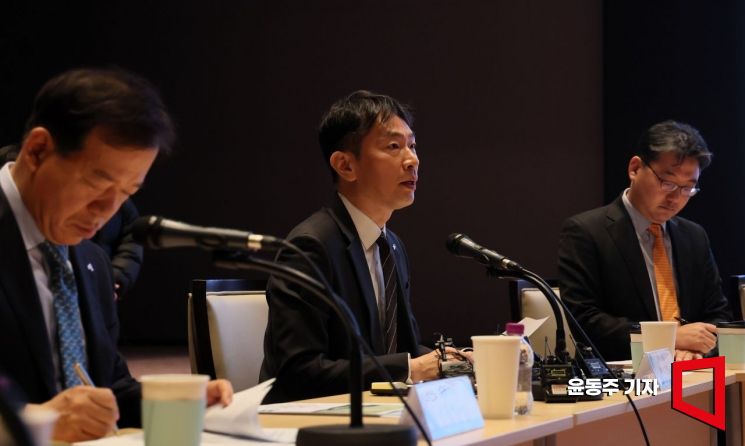 Lee Bok-hyun, Governor of the Financial Supervisory Service, is delivering opening remarks at the "Open Discussion for Revitalizing the Korean Stock Market" held at the Korea Exchange in Yeouido, Seoul on the 6th. 2025.02.06 Photo by Yoon Dong-joo
On the morning of the 6th, the Financial Supervisory Service and the Korea Financial Investment Association held an 'Open Discussion for Revitalizing the Korean Stock Market' at the Korea Exchange in Yeouido, attended by experts from academia, research institutes, the financial industry, and individual and institutional investors. The discussion, organized to evaluate past efforts to advance the capital market and discuss ways to strengthen competitiveness, was filled with concerns about the challenging current environment surrounding the domestic stock market.
Lee Bok-hyun, Governor of the Financial Supervisory Service, who spoke first, diagnosed that "we must face the reality of the capital market coldly," stating that the Korean capital market is shrinking. He expressed concern that "the supply of quality investment opportunities has been reduced due to concentration in specific industries and delays in the growth of innovative industries," and that "the outflow of foreign capital and the concentration of individual investors in the U.S. market are weakening the investment demand base." Furthermore, he analyzed that global trade frictions following the inauguration of U.S. President Donald Trump and the competition for technological supremacy are delivering a direct blow not only to the real economy but also to the fundamentals of the capital market.
Looking at the cumulative performance of major countries' stock markets over the past two years, the KOSPI and KOSDAQ have fallen by 10% and 22%, respectively, while the U.S. Nasdaq has risen by 84%. Particularly, the rapid increase of so-called 'Seohak Ants' (Korean investors investing in U.S. stocks) and virtual asset investors among the youth is deepening the outflow from the domestic stock market, posing a significant threat to the future growth of the Korean stock market. Unlike the U.S. and Japan, the supply-demand conditions centered on short-term investment are also a cause for concern.
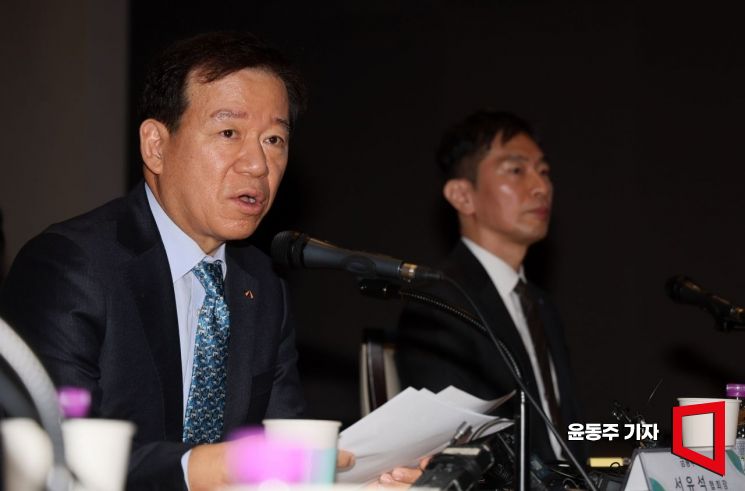 Seo Yu-seok, Chairman of the Korea Financial Investment Association, is delivering opening remarks at the "Open Discussion for Revitalizing the Korean Stock Market" held at the Korea Exchange in Yeouido, Seoul on February 6, 2025. Photo by Yoon Dong-joo
Chairman Seo stated, "If we have talked about governance and corporate value-up until now, it is time to talk about the supply-demand conditions of the Korean stock market," pointing out that "Korea is a market focused on short-term investment." Looking at the turnover rate, which is the trading volume divided by market capitalization, as of 2024, Korea's rate is 200%, significantly higher than the U.S. (96%) and Japan (117%). He added, "To become an advanced market, it is very important to expand the demand base for long-term investment from the supply-demand perspective alongside corporate value-up."
To this end, Chairman Seo raised his voice for regulatory reforms to promote pension asset investment and tax improvements to support long-term investment activation, including dividend taxation. The Korea Financial Investment Association also argued in a separate announcement on 'Support Measures for Stock Market Revitalization' for the necessity of applying a single-rate separate taxation system, improving fund taxation, introducing a Junior ISA to support long-term asset formation from youth, expanding retirement pension participation in the capital market, and allowing inclusion of listed stocks.
There was also a claim that the key to enhancing stock market competitiveness is ultimately restructuring and reallocation. Lee Seung-woo, Head of Research at Eugene Investment & Securities, who presented the 2025 Korean stock market outlook, pointed out, "Foreign investors continue to withdraw from the Korean market," and "the attractiveness of the (domestic) stock market in terms of fundamentals has significantly declined." He emphasized the need to expel insolvent companies, saying, "In the U.S., the removal of unhealthy companies from the stock market is routine, but this is not the case in Korea," and "the lack of qualitative improvement in listed companies is a burden on the market."
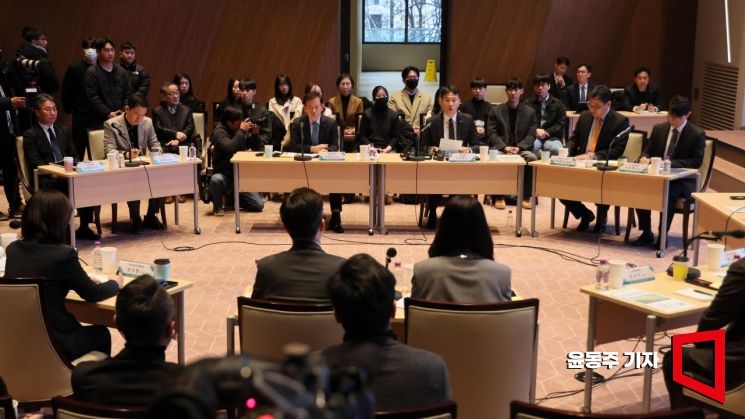 Lee Bok-hyun, Governor of the Financial Supervisory Service, is delivering opening remarks at the "Open Discussion for Revitalizing the Korean Stock Market" held at the Korea Exchange in Yeouido, Seoul on the 6th. 2025.02.06 Photo by Yoon Dong-joo
Park Se-young, Executive Director at Nomura Financial Investment, who participated in the panel discussion, agreed, saying, "Foreign investors need good products to choose from, but the reality is not easy," and "there must be many quality listed companies to revitalize the stock market." Kim Soo-yeon, Research Fellow at the law firm Kwangjang, pointed out that we should look at the case where the Japanese stock market led to a boom, stating, "The Tokyo Stock Exchange improved the overall market's soundness and reliability with quality over quantity, but Korea is not like that. There are too few delisted companies and many zombie companies."
Governor Lee of the Financial Supervisory Service reiterated the urgent need to turn past policy efforts into 'substantial results' with the desperation that "this is the last chance," emphasizing the expansion of long-term investment demand, the fiduciary duty of corporate management to shareholders, and the prompt promotion of capital market reform.
© The Asia Business Daily(www.asiae.co.kr). All rights reserved.



















