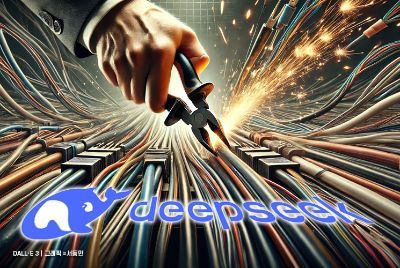
The government’s decision to block access to the Chinese AI service 'Deepseek' has raised concerns about potential impacts on South Korea-China trade relations. Deepseek has faced controversy over excessive collection of user data during its AI training process, and currently, major government ministries including the Ministry of Trade, Industry and Energy, the Ministry of Foreign Affairs, and the Ministry of National Defense have independently imposed access restrictions on Deepseek.
According to government officials on the 6th, this measure was taken from the perspective of national security and information protection, and is not aimed at any specific country. A Ministry of Trade, Industry and Energy official stated, "The Personal Information Protection Commission found it unclear how personal data entered into Deepseek is processed and transferred to third parties," adding, "We temporarily blocked access to Deepseek to protect ministry employees."
Previously, the Ministry of the Interior and Safety sent an official letter to central government agencies and local governments advising caution in using generative AI services such as Deepseek and ChatGPT. The letter included recommendations to refrain from inputting personal information and to avoid unconditional trust in AI-provided information. However, since the letter did not specifically call for restricting Deepseek usage alone, the government’s decision to block Deepseek is considered unusual.
The issue now lies in China’s response. Although the Chinese government has yet to issue an official reaction, if this matter is interpreted as a trust issue regarding its own technology, it could become a new variable in South Korea-China economic cooperation.
The Chinese government has historically reacted sensitively to foreign restrictions on technologies developed by its domestic companies. For example, when the U.S. sanctioned Huawei in the past, China retaliated by blacklisting American companies like Cisco and restricting their product distribution. While the current situation differs somewhat, during the THAAD incident, China imposed economic retaliation against South Korean companies using non-tariff barriers. Should AI and data regulation issues escalate into trade frictions, South Korean exporters to China could face irregular regulatory measures.
Considering the economic structures of South Korea and China, AI regulatory measures could extend beyond simple security concerns to trade disputes. South Korea maintains close cooperation with China in key industries such as semiconductors, batteries, and electric vehicle parts. Last year, South Korea’s exports to China reached $133 billion, with 86% consisting of intermediate goods like semiconductors, displays, and wireless communication components. If China raises non-tariff barriers targeting South Korean companies or imposes disadvantages in specific industrial sectors, Korean firms could suffer direct damage.
Given that AI technology is a subject of cooperation and research, positions among South Korean ministries are subtly divided. In particular, the Ministry of Science and ICT, which oversees AI, takes a cautious stance on blocking access to Deepseek. The ministry sees its role as leading South Korea’s AI technological advancement by studying cases like Deepseek, which developed high-performance generative AI at low cost. Internally, the Ministry of Science and ICT views it as contradictory for the ministry responsible for AI policy and support to block access to generative AI services including Deepseek. For these reasons, a ministry official said, "Blocking Deepseek is not a matter to be decided hastily."
For now, the government plans to send an official inquiry to Deepseek’s headquarters to confirm the items and procedures for personal data collection, as well as methods of processing and storage. This inquiry will also include questions about whether personal data is used for AI training. A Personal Information Protection Commission official stated, "We will review the response and, if necessary, initiate an investigation."
The Ministry of Trade, Industry and Energy also stated it will closely monitor the situation and respond accordingly. A ministry official said, "It is important to maintain a balance between AI security regulations and trade relations," adding, "We will continue consultations with China to ensure that Korean companies do not suffer disadvantages."
© The Asia Business Daily(www.asiae.co.kr). All rights reserved.

















