Discovery of a Large Building Site on the East Side of Wolji
A Separately Constructed Wonji Found Inside
"A New Opportunity to Reinterpret 'Donggung and Wolji'"
"Regarding the Crown Prince always residing in the Eastern Palace, it is said that in the four seasons, the east represents spring, and thus the growth of all things lies in the east. The west represents autumn, and therefore the fulfillment of all things lies in the west. For this reason, the king resides in the Western Palace, while the Crown Prince always stays in the Eastern Palace."
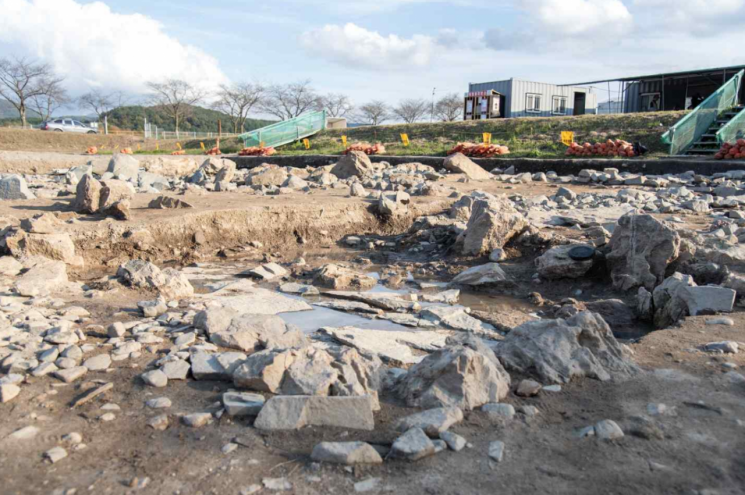 A view of the water outlet of the pond created inside the east side of Wolji
[Photo by National Heritage Administration]
This is the principle explained by the Tang dynasty scholar Kong Yingda (574-648) in his commentary on the "Chunqiu Zuozhuan Zhengyi." He believed that distinguishing the residences of the king and the crown prince was essential for the prosperity of the nation and the glory of the royal family. Around that time, Silla also established a separate Eastern Palace for the Crown Prince. According to the Samguk Sagi, in the 14th year of King Munmu's reign (674), the pond Wolji was created, and five years later, a building was constructed. "A pond was dug inside the palace, mountains were built, flowers and plants were planted, and rare birds and animals were raised."
It had long been believed that the auxiliary palace, which concentrated the civil engineering technology of the era, was located on the west side of Wolji. However, on February 6, at the "New History of Silla" press conference held at COEX in Seoul, the National Heritage Administration completely overturned this conventional view. Based on ten years of excavation results, the agency confirmed that the Eastern Palace was located on the east side of Wolji. Commissioner Choi Eungcheon stated, "Recently, we identified a building site of a lower rank than those on the west side in the east side of Wolji. It is reasonable to regard this building site as the Eastern Palace, and to view the west side building site, which had previously been assumed to be the Eastern Palace, as the king's quarters."
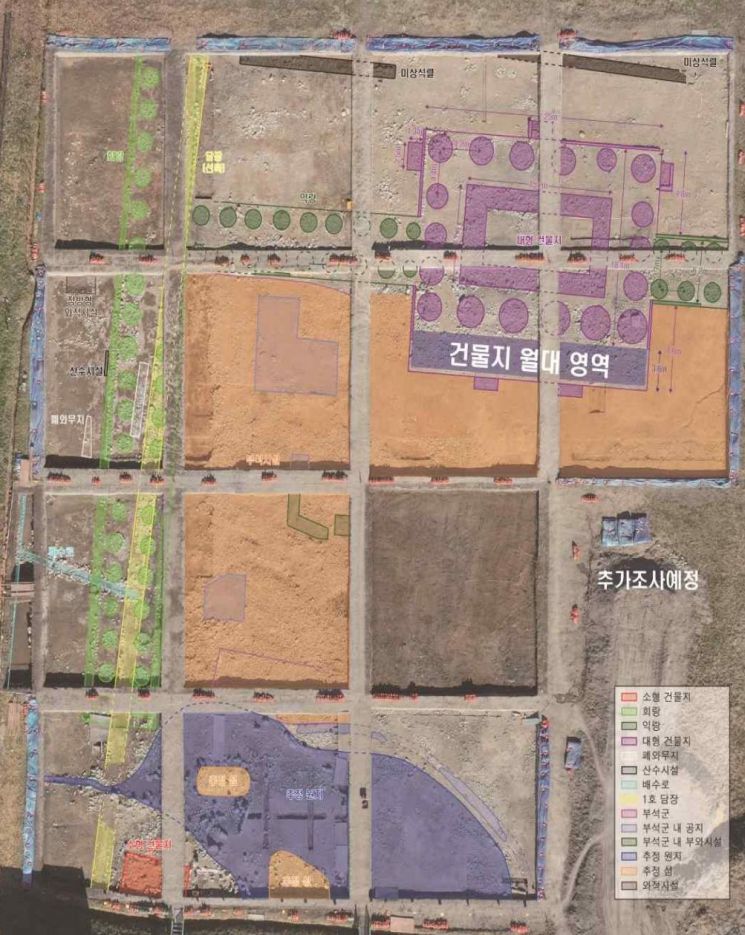
Until now, the building site on the west side of Wolji was considered the Eastern Palace because it was located east of Wolseong, where the Silla royal palace stood. However, since it was situated on elevated ground and the buildings there were of high rank, it was difficult to definitively identify it as the Eastern Palace. The heritage recently identified on the east side of Wolji includes a large building site surrounded by corridor-style buildings, a courtyard facility in front of it, a cloister (hoerang), and a wing corridor (ikrang). The main large building site measures five bays across the front (25 meters) and four bays on the side (21.9 meters), and features a reduced-column (gamju) structure with no interior pillars. Traces of an expanded woldae (moon terrace) area and five staircases were also discovered.
Inside the east side of Wolji, there was also a separately created wonji (an irregularly shaped pond within a garden). The width and length identified so far are 43.56 meters and 17.2 meters, respectively. Traces of islands built in the center and south of the pond suggest that it had a beautiful landscape. Commissioner Choi stated, "With its independent drainage system, this discovery not only demonstrates the civil engineering skills of the Silla people, but also provides an opportunity to completely reinterpret 'Donggung and Wolji.'"
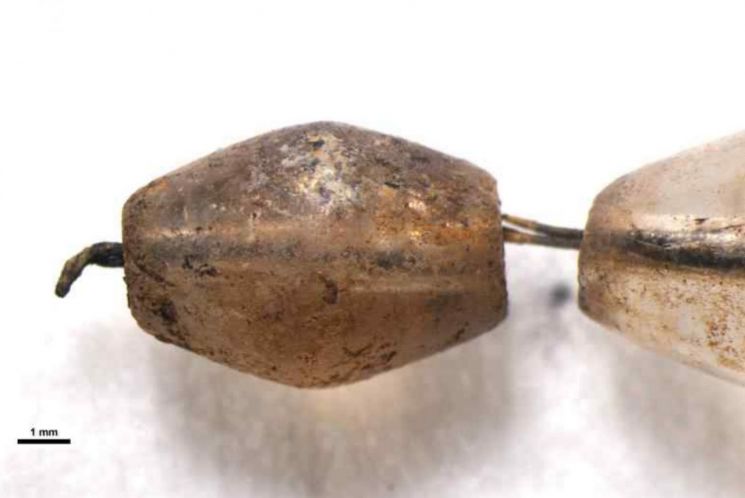
On this day, the National Heritage Administration also unveiled previously undisclosed ritual artifacts recently discovered at Wolseong. These include a wooden box containing a dog and a crystal necklace offered as ritual items, a round ring-shaped knife, shark teeth, and about 1,200 beans. The most eye-catching artifact is a crystal necklace found inside a lacquered wooden box. Commissioner Choi said, "The necklace was found with the string still intact, which is remarkable, and we expect it to provide important clues to understanding the ritual practices of Silla during the Saro-guk period."
© The Asia Business Daily(www.asiae.co.kr). All rights reserved.



















