Arctic Air Once Trapped by the Polar Vortex
Now Reaches the Korean Peninsula Due to Warming
The recent severe cold wave that struck the Korean Peninsula has been attributed to Arctic warming. The Arctic is currently experiencing such severe warming that temperatures are more than 20 degrees Celsius higher than the average for this time of year.
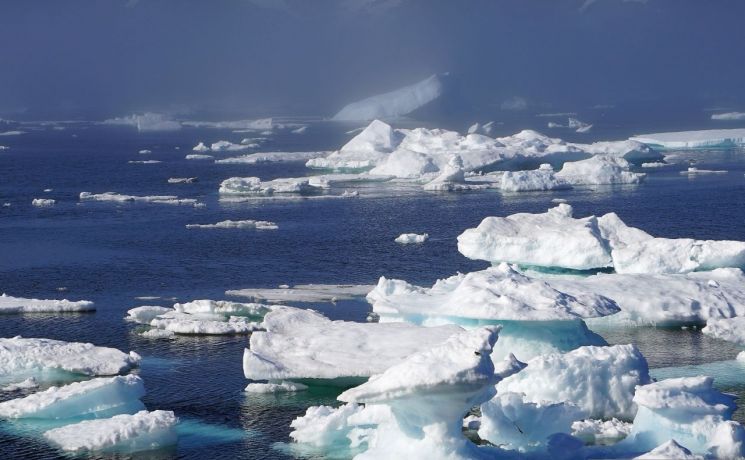 The Arctic is currently experiencing severe warming, with temperatures rising more than 20 degrees above the average for this time of year. Pixabay
According to a report by the British daily The Guardian on the 4th (local time), observations from the Copernicus Climate Change Service (C3S), the European Union's climate monitoring agency, showed that as of the 2nd, Arctic temperatures were more than 20 degrees Celsius above the 1991?2020 average. At 87 degrees north latitude, temperatures rose to minus 1 degree Celsius, approaching the melting point of ice at 0 degrees. Finnish meteorologist Mika Rantanen described this as an "extremely extreme winter warming phenomenon," stating that it is among the most severe events that can occur in the Arctic.
This abnormally warm temperature is analyzed to be caused by a low-pressure system over Iceland bringing warm air into the Arctic. Such an unusual warming phenomenon has disrupted the airflow in the Arctic, causing cold air to descend all the way to our country. Normally, the polar cold air is trapped in a massive vortex called the "polar vortex," which prevents it from affecting Korea. However, as the Arctic warms, the jet stream that holds the vortex weakened, allowing the cold air to move southward and reach the Korean Peninsula.
Arctic Warming Four Times Faster... “Only Two Years Left Until the ‘Ice-Free Day’”
The Arctic warming, which causes abnormal climate, is accelerating. Although the Earth's temperature has risen about 1.3 degrees Celsius since pre-industrial times due to fossil fuel combustion, warming in polar regions is much faster because the ice that used to reflect sunlight is melting. Since 1979, the Arctic has warmed about four times faster than the global average. Dirk Notz, a climatologist at the University of Hamburg, pointed out that warming above the freezing point causes ice to melt, which raises further concerns about warming. He analyzed, "It is obvious that as long as temperatures continue to rise, ice will gradually disappear," and predicted, "The Arctic Ocean could lose its summer sea ice for the first time within the next 20 years."
There is also a warning that the first ice-free day, when Arctic sea ice practically melts completely, could occur as soon as 2027, just two years from now. Professor Alexandra Jahn of the University of Colorado Boulder and Professor Celine Hoelz of the University of Gothenburg in Sweden revealed last December through computer simulations that an "ice-free day," when the Arctic ice area falls below 1 million square kilometers, could occur within three years.
© The Asia Business Daily(www.asiae.co.kr). All rights reserved.
![Clutching a Stolen Dior Bag, Saying "I Hate Being Poor but Real"... The Grotesque Con of a "Human Knockoff" [Slate]](https://cwcontent.asiae.co.kr/asiaresize/183/2026021902243444107_1771435474.jpg)















