One Year Since Mass Resident Resignations:
Medical Staff Fatigue Mounts, Patient Care Plummets
Medical Community Continues to Resist Unilateral Government Policies
Reform Momentum Lost Amid Impeachment Crisis...
Dialogue May Resume at This Month's Public Hearing
As the government’s announcement to increase the medical school quota by 2,000 students has fueled ongoing conflict between the medical community and authorities for a full year, there is still no sign of resident doctors returning to the field, and the number of newly licensed doctors has plummeted. The government’s medical reform initiatives, which aimed to address issues such as “emergency room shuttling” and “pediatric department open runs,” now face the risk of being halted before full implementation due to the current impeachment crisis.
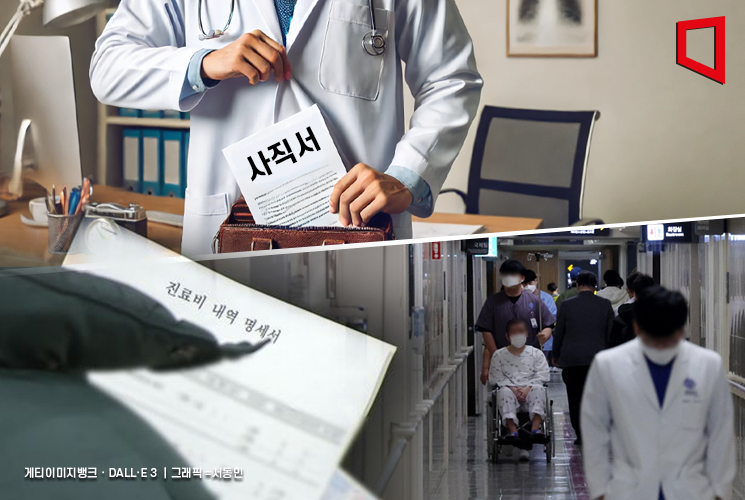
According to the medical community on February 6, 221 training hospitals across the country held recruitment for first-half-year interns on March 3 and 4, targeting 2,967 individuals who resigned or declined their internship appointments last year. However, only a very small number of applicants responded.
Most of the so-called “Big 5” tertiary hospitals-Samsung Medical Center, Seoul National University Hospital, Seoul St. Mary’s Hospital, Asan Medical Center, and Severance Hospital-reportedly received only single-digit numbers of applications. With the collective leave of absence by medical students already reducing the number of candidates for the medical licensing exam and sharply decreasing the supply of new doctors, even the residents who left the hospitals are not returning. Only a few residents have expressed willingness to resume their training; in the first-half recruitment for residents, held from January 15 to 19 for 9,220 resigned residents, only 199 applied, resulting in an application rate of just 2.2%.
Large hospitals, where residents once made up 40% of the workforce, are now struggling to operate due to a sharp decline in patient numbers and surgeries. Among the Big 5, Seoul National University Hospital, Seoul St. Mary’s Hospital, Asan Medical Center, and Severance Hospital each recorded losses exceeding 200 billion won in the first half of last year alone. The gaps left by departing residents in operating rooms and other departments are being barely filled by professors, specialists, and physician assistant (PA) nurses. However, many hospitals have had to restrict outpatient care for new patients, and transfers to secondary hospitals have surged.
The government had planned to accelerate medical reform by introducing the first phase of measures through the Presidential Committee on Medical Reform, which included restructuring tertiary hospitals, focusing support on critical and essential medical services, and innovating resident training. However, the committee’s discussions excluded key medical associations from the outset, and it failed to resolve issues such as excessive workloads in the field and delays in patient care, resulting in continued backlash from the medical community. The bipartisan consultative body, formed to resolve the conflict, held its first meeting without the participation of the opposition party and medical associations but soon collapsed. Additionally, President Yoon Suk Yeol’s declaration of the December 3 Martial Law and the inclusion of “punishment of residents” in the emergency proclamation further intensified the conflict. With the impeachment crisis and the possibility of a change in administration now being discussed, concerns have grown that medical reform could be suspended.
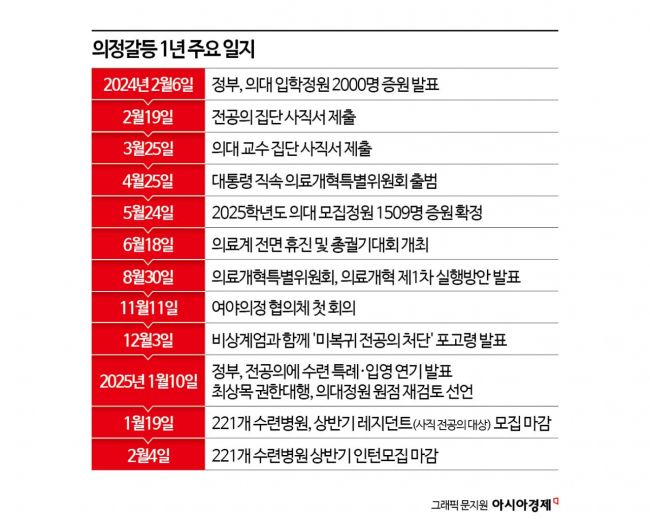
As a result, the second phase of the medical reform plan, originally scheduled for public release at the end of last year, has not been finalized, and its announcement continues to be delayed. Deputy Prime Minister and Minister of Economy and Finance Choi Sangmok, who is currently serving as Acting President, along with other government officials, has stepped back, stating that the issue of increasing the medical school quota will be reconsidered from the beginning. However, the medical community maintains that the current medical reform efforts must be halted immediately. Kim Taekwoo, president of the Korean Medical Association, stated, “With the president absent, the activities of the medical reform committee have lost their meaning,” and demanded, “The government must abandon its stubborn stance and immediately stop its misguided policies.”
Both inside and outside the government and the medical community, there are hopes that a breakthrough in the conflict might be found at the public hearing on the “legislation of the Medical Workforce Supply and Demand Estimation Committee,” scheduled for February 14 in the National Assembly. The amendment to the Framework Act on Health and Medical Services, proposed by Assemblywoman Seo Myungok of the People Power Party, reflects the opinions of the medical community and calls for the establishment of a committee to estimate the supply and demand of medical personnel, as well as providing a legal basis for adjusting quotas. A bill proposed by Assemblywoman Kang Sunwoo of the Democratic Party includes a clause allowing for quota reductions if social side effects arise from the previous year’s increase, making it possible to reduce the medical school quota for the 2026 academic year based on this provision.
The government plans to actively participate in discussions on the medical school quota while also continuing to pursue medical reform for policy continuity. A Ministry of Health and Welfare official stated, “Regarding the 2026 medical school quota, we will consult with the Korean Medical Association before the new academic year begins in March,” adding, “The second phase of the reform plan, which includes reforms to the indemnity insurance structure and stronger oversight of non-covered services, will also be announced within this month.”
© The Asia Business Daily(www.asiae.co.kr). All rights reserved.


















