"Iran Will Not Acquire Nuclear Weapons During My Term"
China Is the Major Buyer of Iranian Oil
China's Energy Sector Unavoidably Impacted
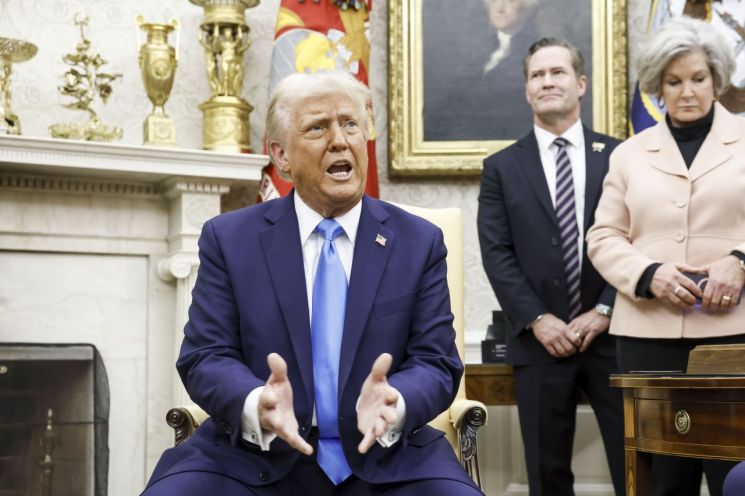 On the 4th (local time), U.S. President Donald Trump held a press conference ahead of a summit meeting with Israeli Prime Minister Benjamin Netanyahu. Photo by EPA and Yonhap News
U.S. President Donald Trump announced that he would intensify economic sanctions on Iran to the maximum extent to completely block its oil exports. This is interpreted as an effort to weaken Iran's influence, which backs Middle Eastern militant groups such as Hamas that attacked Israel, in order to stabilize the Middle East situation. However, there is also an interpretation that behind this move lies an intention to pressure China, which heavily depends on Iranian oil, ahead of tariff negotiations with China.
"Zero Iranian Oil Exports" Declares Strengthened Sanctions Against Iran
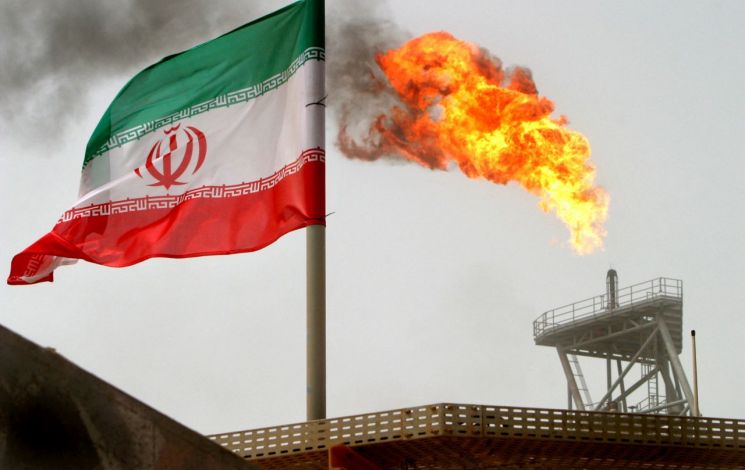
On the 4th (local time), President Trump signed a memorandum at the White House directing the government to strengthen economic sanctions on Iran to the maximum level and to enhance responses to violations of these sanctions. The memorandum instructs the U.S. Treasury and State Departments to take measures to reduce Iran's oil exports to 'zero.'
Upon signing the memorandum, President Trump stated, "If we had continued a tough stance against Iran, Hamas, which was supported by Iran, would not have launched a surprise attack on Israel," adding, "We hope not to use these measures extensively and will see if any negotiations with Iran can be pursued in the future."
Additionally, President Trump held a meeting with Israeli Prime Minister Benjamin Netanyahu, who visited the White House, and at a joint press conference said, "The United States will take control of the Gaza Strip and will do what needs to be done there. We will take responsibility for removing dangerous unexploded ordnance and other weapons left behind while we own the area."
Along with the strengthened sanctions on Iran, measures such as taking control of the Gaza Strip are seen as moves to significantly weaken Iran's influence in the Middle East. The New York Times (NYT) analyzed, "Iran-backed militant groups like Hamas and Hezbollah have been considerably weakened due to clashes with Israel, and the pro-Iran regime of Syria's Al Assad has also collapsed. In this context, the U.S. and Israel have announced very tough measures to bring Iran to the negotiating table."
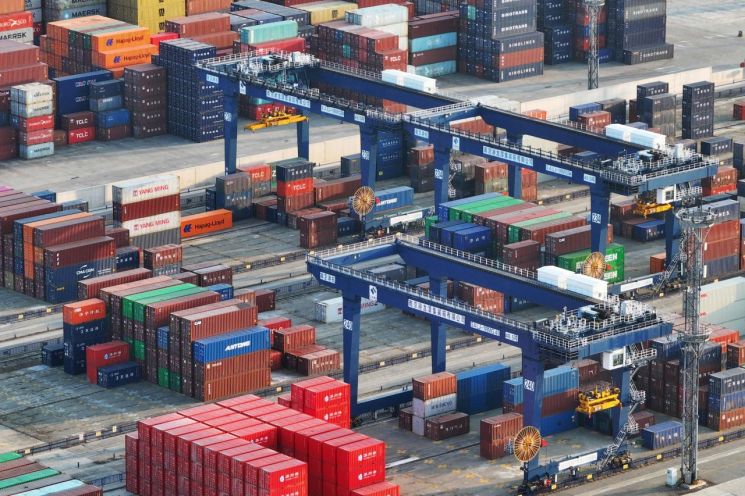 On the 4th (local time), export containers waiting to be loaded at Nanjing Port, Jiangsu Province, China. Photo by AFP and Yonhap News.
However, some analysts suggest that the strengthening of sanctions against Iran also considers the ongoing tariff war with China. Strengthening sanctions on Iran's oil exports could deal a significant blow to China's energy strategy, as China is the largest importer of Iranian oil.
Last year, Iran's oil exports amounted to $54 billion (approximately 78 trillion won), marking the highest level in six years since the 2018 sanctions against Iran. It is known that over 90% of this oil was exported to China. Although the U.S. government imposed sanctions on Iranian crude oil exports to China starting in April last year, it has been unable to stop Iran's oil exports to China.
BBC recently reported that China and Iran are using a "shadow fleet" to transport oil in order to evade U.S. sanctions. The shadow fleet refers to a group of aging, second-hand oil tankers that turn off their Automatic Identification System (AIS) to avoid tracking and do not use standard marine insurance, facilitating oil smuggling.
Iranian oil arriving in China via the shadow fleet is relabeled as originating from Malaysia or the United Arab Emirates (UAE) before being purchased by small independent refineries. To avoid dollar transactions, payments are made in yuan through small banks that are difficult to track. The BBC pointed out, "China imports Iranian oil at prices about $5 to $10 per barrel cheaper than the international average oil price," noting that "this has increased China's dependence on Iranian oil."
© The Asia Business Daily(www.asiae.co.kr). All rights reserved.
![Clutching a Stolen Dior Bag, Saying "I Hate Being Poor but Real"... The Grotesque Con of a "Human Knockoff" [Slate]](https://cwcontent.asiae.co.kr/asiaresize/183/2026021902243444107_1771435474.jpg)

















