Professor Kwang-Hyun Cho's Team Identifies
Molecular Switches That Revert Cancer Cells to Normal
Capturing the Critical Transition Moment in Cancer Development
New Technology Offers Hope for Reversible Cancer Therapies
Professor Kwang-Hyun Cho's research team at the Department of Bio and Brain Engineering, KAIST, announced on the 5th that they have, for the first time in the world, successfully captured the critical transition phenomenon occurring at the moment normal cells transform into cancer cells, analyzed it, and developed a technology to discover molecular switches that can revert cancer cells back to normal cells.
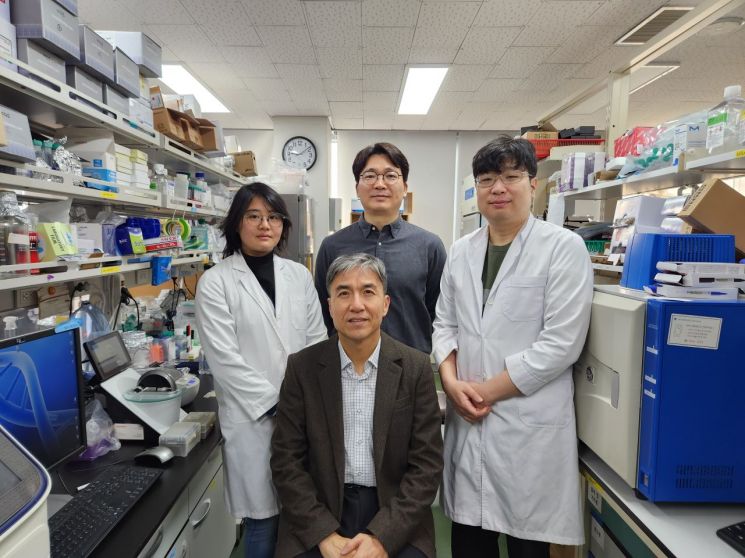 Research team led by Professor Kwanghyun Cho, Department of Bio and Brain Engineering, KAIST. Clockwise from the left: Seoyoon Jeong, PhD candidate; Dongkwan Shin, PhD; Kwanghyun Cho, Professor; Jeongryeol Gong, PhD. Courtesy of KAIST
Professor Cho's team had previously developed a fundamental technology for reversible cancer therapy that transforms cancer cells into a state similar to normal cells without killing them. This new research is expected to provide an important clue for reverting cancer cells back to normal cells.
'Critical transition' refers to a sudden state change occurring at a specific point, such as water turning into steam at 100°C. This critical transition phenomenon also appears in the process where normal cells transform into cancer cells due to the accumulation of genetic and epigenetic changes at a certain point.
The research team discovered that just before normal cells convert into cancer cells during cancer development, there exists an unstable critical transition state where normal and cancer cells coexist. By analyzing this critical transition state using systems biology methods, they developed a technology to discover molecular switches that can reverse the cancerization process. Through molecular cell experiments, the team applied this technology to colon cancer cells and confirmed that cancer cells could regain characteristics of normal cells.
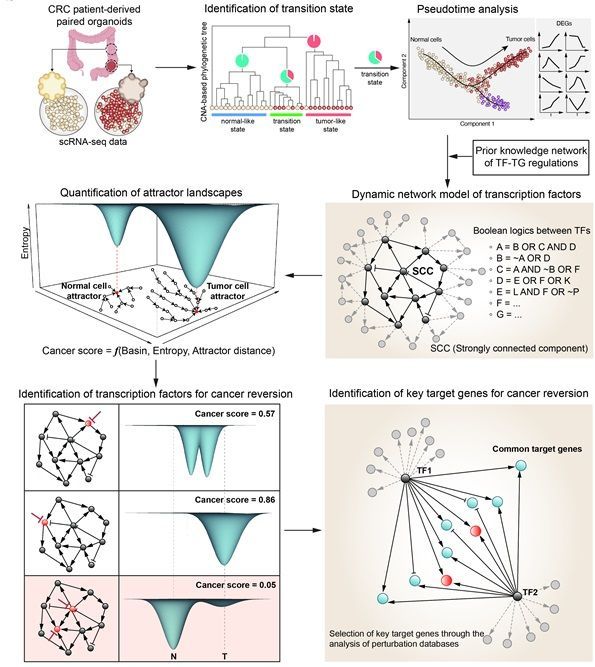 Overall concept diagram of technology development for automatic construction of gene networks from single-cell gene expression data of colorectal cancer cells and discovery of molecular switches for cancer reversion through computer simulation analysis. Provided by Professor Kwanghyun Cho's team
They developed a fundamental technology that automatically infers the gene network governing the critical transition in cancer development from single-cell gene expression data, and systematically identifies molecular switches for cancer reversibility through simulation analysis. This technology is expected to be applicable to the development of reversible therapies for other cancer types in the future.
Professor Kwang-Hyun Cho explained, "We captured the critical transition moment just before normal cells irreversibly change into cancer cells and discovered molecular switches that can revert the fate of cancer cells back to a normal cell state."
He added, "In particular, this study detailed the intracellular changes behind cancer development at the gene network level, which had long been a mystery. This is the first research to reveal that the key clues to reverting cancer cells back to normal cells are hidden in these moments of change."
Dr. Dong-Kwan Shin (currently at the National Cancer Center), Dr. Jeong-Yeol Gong, and PhD student Seo-Yoon Jeong from KAIST participated in the study, which was conducted with colon cancer patient organoids (ex vivo cultured tissues) provided by a research team at Seoul National University. The results were published online on January 22 in the international journal Advanced Science, published by Wiley.
© The Asia Business Daily(www.asiae.co.kr). All rights reserved.
![Clutching a Stolen Dior Bag, Saying "I Hate Being Poor but Real"... The Grotesque Con of a "Human Knockoff" [Slate]](https://cwcontent.asiae.co.kr/asiaresize/183/2026021902243444107_1771435474.jpg)
















