Bank of Korea Analyzes Correlation Between Experienced Hiring and Youth Employment
"17 Percentage Point Gap in Regular Employment Rate Between 20s and 30s; 40% Attributable to Experienced Hiring"
"Young Adults in Their 20s Becoming Vulnerable in Employment as Corporate Hiring Practices Change"
An analysis revealed that 40% of the employment rate gap between people in their 20s and 30s is due to the expansion of experienced hires. While those in their 30s who have already succeeded in finding jobs are re-employed as experienced workers, young adults in their 20s entering the workforce are facing increasing difficulties as job opportunities narrow. Delayed entry into the labor market has also been found to reduce lifetime earnings by about 13%.

On the 4th, the Bank of Korea released these findings in its 'BOK Issue Note: Increase in Experienced Hiring and Youth Employment.'
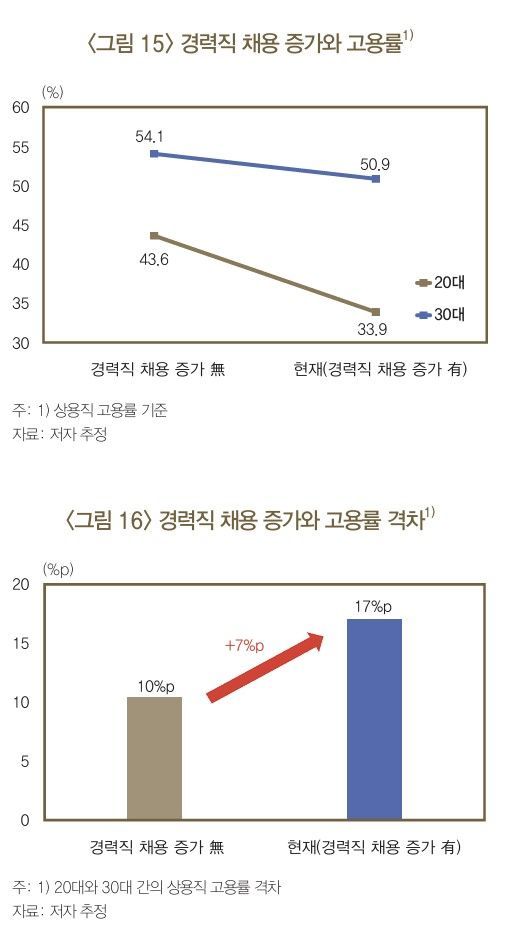
According to the Bank of Korea’s analysis using a search and matching model between firms and workers, the current employment rate gap for regular workers between those in their 20s and 30s is 17 percentage points. However, when assuming no experienced hiring, the employment rate gap decreases to 10 percentage points. This means that experienced hiring accounts for a 7 percentage point difference in the employment rate gap. Cha Min-seok, head of the Employment Analysis Team, stated, "It can be interpreted that more than 40% of the current employment rate gap for regular workers between those in their 20s and 30s is due to the expansion of experienced hiring."
As a result, the first employment for people in their 20s is delayed, reducing both total employment duration and income. Assuming a young worker newly entering the labor market participates in economic activities for 30 years, the total lifetime employment period decreases by 2 years, from an average of 21.7 years to 19.7 years. Consequently, the expected total lifetime income, analyzed in present value terms, falls from 390 million KRW to 340 million KRW, a 13.4% decrease.
If young people reduce their job-seeking efforts, the employment rate could decline further. Assuming that the job-seeking effort of inexperienced workers decreases by about 30%, the employment rate for those in their 20s would drop by 5.4 percentage points compared to the current rate. The gap with those in their 30s would widen by 1.1 percentage points. In this case, the total lifetime employment period would shorten by 3 years and 6 months, and the present value of lifetime income would decrease by an additional 10.4%.
The Bank of Korea evaluated, "The increase in experienced hiring is a natural and, in some ways, inevitable phenomenon arising from the weakening concept of lifelong employment from the worker’s perspective and the increasing sophistication of required skills from the company’s perspective. However, for young people without prior work experience, it inevitably has negative effects, such as making it more difficult to find quality jobs."
It added, "We need to prepare multifaceted measures to help young people adapt to changes in the labor market caused by the increase in experienced hiring and to utilize these changes as opportunities." Specifically, it proposed ▲expanding job experience opportunities through internship programs and industry-academia cooperation ▲improving matching efficiency by introducing youth-specialized job search platforms ▲providing incentives for sustained job-seeking activities.
The Bank of Korea also emphasized, "It may be a more desirable strategy for young people to start gaining work experience quickly in small and medium-sized enterprises and non-regular jobs, where entry is relatively easier, and to develop their careers. However, this requires prior alleviation of the dual labor market structure, including wage gaps and job security."
© The Asia Business Daily(www.asiae.co.kr). All rights reserved.


















