Despite Declining School-Age Population, Private Academies Show Stronger Performance
Major Players Like Megastudy Education and HiConsy Continue to Grow
Heavy Reliance on Private Education Places Financial Strain on Parents
Although the school-age population is steadily decreasing due to low birth rates, major private academies have shown solid performance. While the number of children per household has decreased, this has rather intensified the tendency to 'go all-in' on a single child. Additionally, the preference for metropolitan area universities not only in medical schools but also among mid-tier students has contributed to an increase in repeat test-takers (N-su students). It is also analyzed that private academies' focus on 'per capita unit price' rather than 'number of students' in response to changes in the educational environment has contributed to the strong performance of these academies.
According to the Ministry of Education's "2024 Projection of Elementary, Middle, and High School Student Numbers" released on the 4th, the school-age population is expected to decline every year, dropping from 5,021,845 this year to 3,835,632 in 2031, falling below 4 million. During this period, the number of elementary students will decrease from 2,350,409 to 1,545,525, middle school students from 1,370,501 to 1,070,021, and high school students from 1,300,935 to 1,220,086.
A rebound seems unlikely because the lower the grade, the fewer the students. Next year, first graders in elementary school (300,092) will be 120,000 fewer than sixth graders (422,129), and in 2031, the difference will still be 75,000.
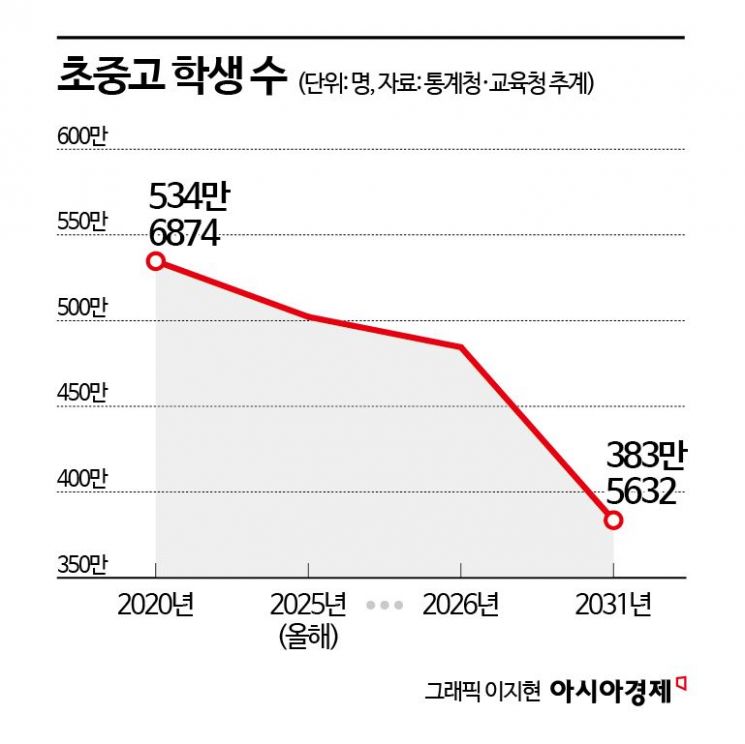
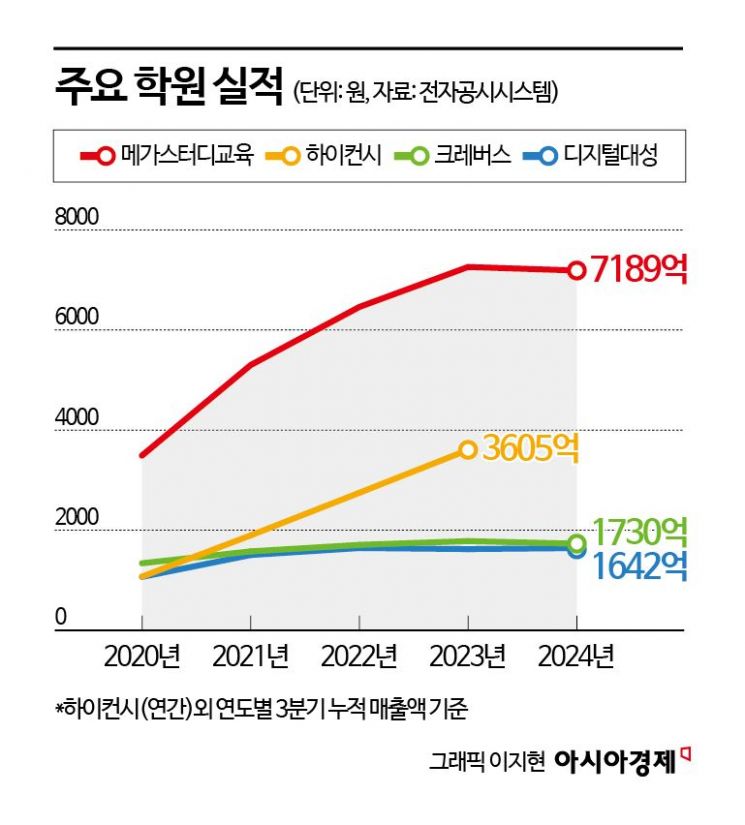
Despite the noticeable decrease in the school-age population, private academy sales are actually moving in the opposite direction.
According to the electronic disclosure system, Megastudy Education recorded cumulative sales of 718.9 billion KRW and operating profit of 106.7 billion KRW in the third quarter of last year. Compared to the full-year 2023 sales and operating profit of 935.2 billion KRW and 127.4 billion KRW respectively, they have already achieved 76.9% and 83.8% of the previous year's performance by the third quarter.
HiConsy, which operates Sidae Injae Academy, an emerging powerhouse in the Daechi-dong academy district, also shows remarkable growth. Operating profit, which was 7.2 billion KRW in 2018 when its performance was first disclosed, surpassed 10 billion KRW for the first time in 2021 with 14.9 billion KRW, and reached 26 billion KRW in 2023. During the same period, sales increased nearly fivefold from 63.9 billion KRW to 331.2 billion KRW over five years. On a consolidated basis, sales reached 360.5 billion KRW and operating profit 28.9 billion KRW, marking the highest record since its incorporation in 2016.
Creverse, which operates Cheongdam Language Academy and CMS Youngjaegwan, recorded cumulative sales of 173 billion KRW by the third quarter of last year. Looking at cumulative performance over the past four years for the same period, sales steadily increased: 133.9 billion KRW (2020), 157.7 billion KRW (2021), 170.7 billion KRW (2022), and 178.2 billion KRW (2023).
Digital Daesung, which operates dormitory academies targeting repeat test-takers and N-su students, posted cumulative sales of 164.2 billion KRW by the third quarter of last year, a 1.23% increase compared to the same period the previous year. This company has also shown continuous growth in cumulative third-quarter sales since 2020: 106.7 billion KRW, 150.4 billion KRW (2021), 164.3 billion KRW (2022), and 162.2 billion KRW (2023).
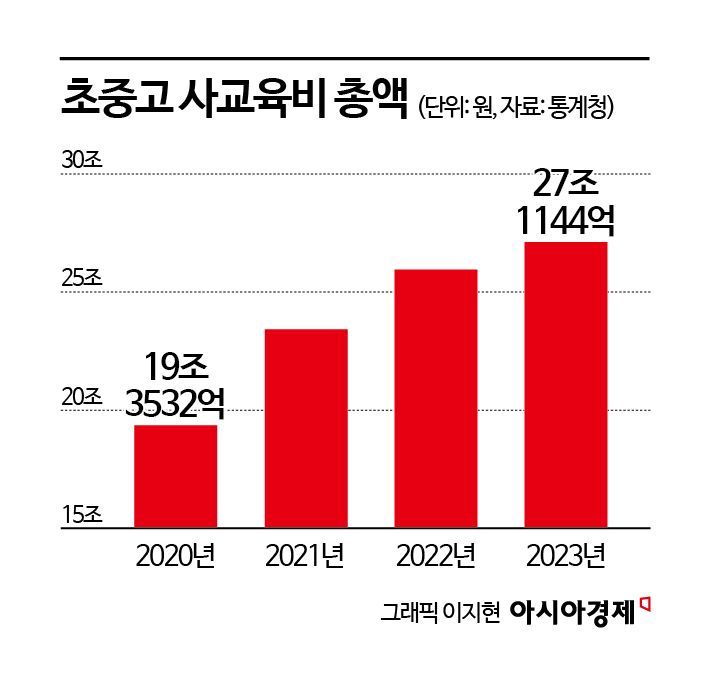
The persistent reliance on private education is cited as a reason why private academy performance remains solid despite the decline in the school-age population. According to the latest survey on private education expenses for elementary, middle, and high school students by Statistics Korea, 78.5% of domestic students received private education in 2023. The total private education expenditure for elementary to high school students reached 27 trillion KRW, a 40.1% increase from 19 trillion KRW in 2020. Meanwhile, the school-age population decreased by about 880,000 (14.5%) from 6,088,827 to 5,209,029 during the same period. The fact that private education expenses increased despite the declining school-age population indicates that per capita educational spending has grown.
According to the government's announced trend of average monthly private education expenses for elementary to high school students, per capita private education expenses rose 43.7% from 302,000 KRW in 2020 to 434,000 KRW last year. Parents' perceived private education spending is even higher. In a survey conducted by the civic group "No Private Education Worries" in November last year, respondents participating in private education reported spending an average of 1,061,000 KRW per month.
The prevailing atmosphere that it is better to enter a top-tier university even after repeating the college entrance exam once or twice has led to the popularity of repeat academies and dormitory academies, which in turn has driven up academy unit prices. For example, in Digital Daesung's case, 131.6 billion KRW (80.15%) of its third-quarter sales last year came from Daesung MyMac, which offers online lectures for the College Scholastic Ability Test (CSAT), and dormitory academies such as Gangnam Daesung Dormitory S Hall and Gangnam Daesung Dormitory Medical School Hall. While the monthly fee for individual online lectures averages 108,000 KRW, the regular monthly tuition for dormitory repeat classes averages 3.5 million KRW, up 410,000 KRW (13.3%) from 3.09 million KRW in 2022. Not only Digital Daesung but also Megastudy and HiConsy are expanding dormitory academies with high per capita unit prices. Lim Seong-ho, CEO of Jongro Academy, said, "Dormitory academies cost over 4 million KRW per month including meals, so the unit price itself is high," adding, "Despite the cost burden, due to demand for professional and systematic management, the private education market including academies will not be significantly impacted by the decline in the school-age population going forward."
© The Asia Business Daily(www.asiae.co.kr). All rights reserved.



















