Concerns Over 'Trump-Triggered Tariff War' Lead to Strong Dollar
Won Rises by 36 in Just Two Trading Days After Lunar New Year Holiday
The won-dollar exchange rate, which broke through 1,470 won again during the session amid concerns over the 'Trump-triggered tariff war,' closed at the 1,460 won level.
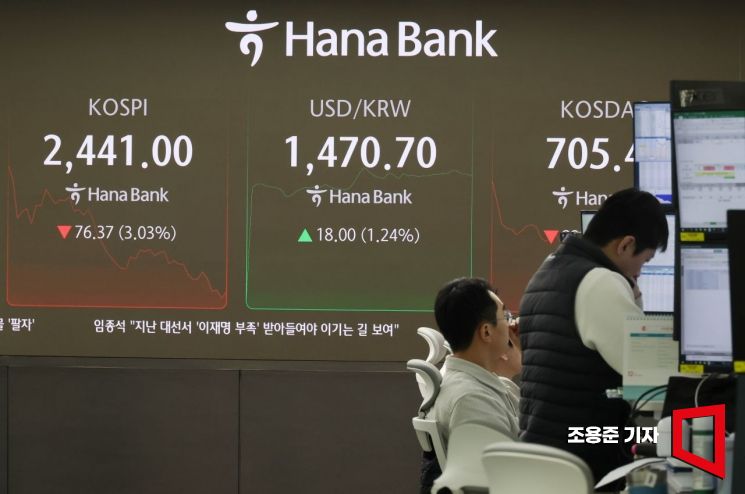 Due to increased uncertainty in the domestic stock market caused by Trump's tariff war, the KOSPI index plunged by up to 3% during the trading session on the 3rd. The status board in the dealing room of Hana Bank in Jung-gu, Seoul, displays the KOSPI index and the KRW/USD exchange rate. On that day, the KOSPI opened at 2,468.74, down 48.63 points (1.93%) from the previous close, and the KRW/USD exchange rate started the session at 1,446.0 won, up 13.3 won. Photo by Jo Yong-jun
On the 3rd, in the Seoul foreign exchange market, the won-dollar exchange rate closed at 1,467.2 won, up 14.5 won from the previous trading day as of 3:30 p.m. This is the highest weekly closing price since the 13th of last month (1,470.8 won).
U.S. President Donald Trump pushed forward with imposing universal tariffs on Canada, Mexico, and China, intensifying concerns over a global trade war. The exchange rate opened at 1,466.0 won, up 13.3 won from the previous day's closing price, broke through the 1,470 won level early in the session, rising to 1,472.5 won, but gave up some of the gains in the afternoon.
On the 1st (local time), President Trump signed an executive order imposing tariffs on Canada, Mexico, and China under the International Emergency Economic Powers Act (IEEPA). Starting from the 4th, an additional 25% tariff will be imposed on products from Canada and Mexico (10% on Canadian oil and natural gas), and a 10% additional tariff on Chinese products. These countries have responded by filing complaints with the World Trade Organization (WTO) and announcing retaliatory tariffs on U.S. products. The European Union (EU) is also expected to impose tariffs.
With the start of the Trump-triggered tariff war, concerns grew that prices in the U.S. would rise, increasing the burden on consumers. Price increases are a factor that hinders the Federal Reserve's (Fed) trend toward lowering interest rates. Accordingly, the U.S. dollar also showed strength.
The exchange rate surged nearly 36 won over two trading days, including the 31st of last month, reaching the high 1,460 won range from the 1,430 won level. On the 31st of last month, external variables during the Lunar New Year holiday, such as the deep-sea shock, U.S. tariff announcements, and the Fed's decision to hold the benchmark interest rate steady, were reflected all at once, causing a 21.4 won increase.
© The Asia Business Daily(www.asiae.co.kr). All rights reserved.
![Clutching a Stolen Dior Bag, Saying "I Hate Being Poor but Real"... The Grotesque Con of a "Human Knockoff" [Slate]](https://cwcontent.asiae.co.kr/asiaresize/183/2026021902243444107_1771435474.jpg)
















