Mandatory Installation of Barrier-Free Devices Since Last Month
Small Business Owners Sympathize with the Policy but Struggle with Costs
Ministry of Health and Welfare: "Positions Differ... Consultations to Follow After Discussions"
Small business owners' dissatisfaction is rising over the government's policy mandating the installation of 'Barrier-Free kiosks.' They face not only additional installation costs amid severe business difficulties but also fines of tens of millions of won if they fail to comply.
According to the industry on the 4th, there are growing voices that the mandatory installation of barrier-free kiosks increases the burden on small business owners. Barrier-free kiosks are unmanned ordering terminals equipped with functions such as voice recognition and guidance, and screen magnification for the visually and hearing impaired. According to the revised Act on the Prohibition of Discrimination Against Persons with Disabilities, from January 25 this year, businesses with 15 pyeong or more and fewer than 100 employees must install 'barrier-free' devices when introducing new kiosks. If a kiosk is already installed, it must be replaced by January 28, 2026. Failure to comply may result in fines of up to 30 million won.
Small business owners sympathize with the policy's intent but are distressed by the sudden financial burden. Yoon, a woman in her 40s who has run a cafe in Yeouido, Seoul for 20 years, said, "I heard about mandatory installation for the first time. It's too burdensome." Yoon, who purchased a kiosk for 2 million won, questioned, "If I say I got rid of it after the device rental contract ended, wouldn't the government be unaware?"
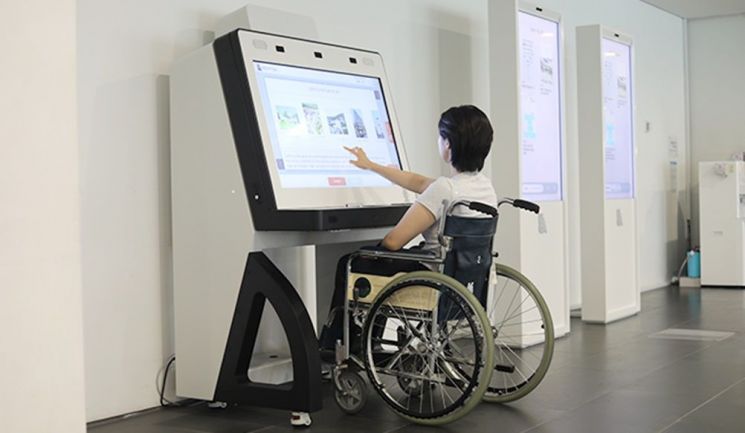
According to a survey by the Korea Federation of SMEs, the average purchase cost of kiosks is about 3.56 million won per stand-type unit and about 1.33 million won per table-type unit. Regarding kiosk installation and operating costs, 61.4% of respondent companies felt burdened. To alleviate this burden, the government has been running the 'Smart Store Technology Dissemination Project' since 2022, supporting 70% of device costs. However, due to insufficient promotion, no barrier-free kiosks were installed through this project in 2023, and last year fewer than 200 units were installed.
In response, the Korea Federation of Small and Medium Business issued a statement on the 24th of last month, strongly urging an indefinite postponement of the application until conditions acceptable to small business owners are met. The federation appealed, "Small business owners have become subjects of fines in a situation where proper preparation was not made," adding, "They are forced to buy expensive devices reluctantly, risking becoming lawbreakers overnight."
This is a plea to consider the reality of small business owners, who are facing a wave of closures. According to the Korea Employers Federation, the number of business closures in 2023 was about 986,000, the highest since related statistics began in 2006. Especially in industries with many small business owners, such as food service (16.2%) and retail (15.9%), the closure rates far exceeded the average closure rate (9.0%).
A Ministry of Health and Welfare official said, "The requests from the Korea Federation of Small and Medium Business and persons with disabilities differ, so this is something that needs to be proceeded with time," adding, "After discussions among related ministries, consultations will be conducted."
© The Asia Business Daily(www.asiae.co.kr). All rights reserved.

















