At the Public Hearing, Experts and Citizens Call for Swift Implementation
Approval Application to the Ministry of Land in February... Targeting Completion by 2032
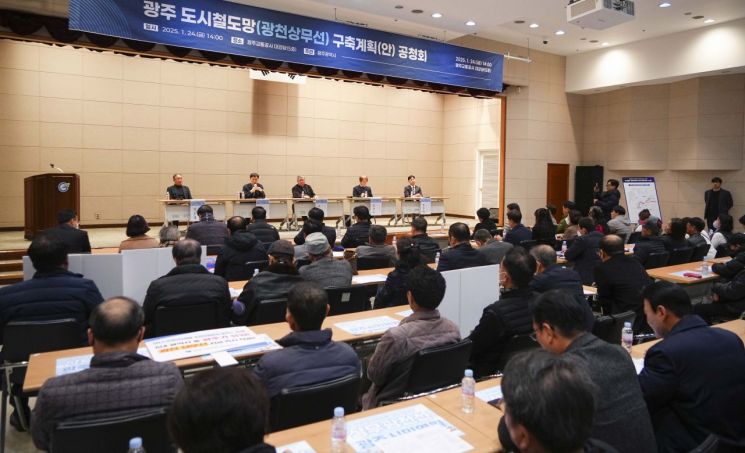 Gwangju City held a public hearing on the "Gwangcheon Sangmu Line Urban Rail Network Construction Plan (Draft)" at Gwangju Transportation Corporation on the 24th of last month. Photo by Gwangju City
Experts have given high marks for the feasibility of the Gwangcheon-Sangmu Line Urban Railway, a core facility in Gwangju’s transportation policy aimed at alleviating traffic congestion in the Gwangcheon area and promoting a “public transportation, bicycle, and pedestrian-oriented” city.
Experts argued that the urban railway network, which boasts punctuality, safety, and speed, should be implemented as soon as possible. They noted that it will be linked with Gwangju Urban Railway Lines 1 and 2, the Gwangju General Bus Terminal, Gwangju Kia Champions Field, and large-scale development plans in the Gwangcheon area, all of which have high demand for public transportation.
According to Gwangju City on the 2nd, a public hearing on the “Gwangcheon-Sangmu Line Urban Railway Network Construction Plan (Draft)” was held at Gwangju Transportation Corporation on the 24th of last month.
The hearing began with a presentation of the draft plan by Vice President Jung Soonjae of the consulting firm, followed by a panel discussion and a Q&A session with the audience. The expert panel included Professor Choi Dongho of Gwangju University, Moon Jinsu, Team Leader at the Korea Transport Institute, and Kwon Seongdae, Senior Researcher at the Chonnam National University Institute of Industrial Technology.
Vice President Jung Soonjae emphasized the necessity of the Gwangcheon-Sangmu Line, stating, “The construction of the Gwangcheon-Sangmu Line is a key project in Gwangju’s urban railway network plan (2026?2035), which is established every 10 years according to the Urban Railway Act. As a route connecting Sangmu Station, the terminal, Jeon-Ilbang site, and Gwangju Station, it can improve user convenience through linkage with Lines 1 and 2.” He added, “According to the economic analysis, the benefit-cost ratio (B/C) is 0.88 and the comprehensive evaluation (AHP) is 0.616, indicating a high level of project feasibility.”
The expert panel also assessed the project as highly feasible. Professor Choi Dongho commented, “It takes about 80 minutes to complete a full loop on Line 2, the metropolitan circular line. If transfers are possible in the middle, travel time will be halved, making a mid-line connection on Line 2 essential. If the Gwangcheon-Sangmu Line is built, not only will passenger demand increase, but the city will be revitalized and economic viability will be secured.”
Citizens attending the hearing also expressed support for the construction of the Gwangcheon-Sangmu Line and called for its prompt implementation. One citizen stated, “With large shopping malls and residential redevelopment underway in the Gwangcheon area, even greater traffic problems are expected in the future. Please expedite the Gwangcheon-Sangmu Line, which is the only solution to traffic congestion.”
Mayor Kang Gijung said, “The Gwangcheon-Sangmu Line is an essential transportation measure at a time when the city is concentrating and traffic volume is surging due to projects like The Hyundai Gwangju, Gwangju Shinsegae, and Gwangcheon Redevelopment. We will do our utmost to ensure the Gwangcheon-Sangmu Line is built in a direction and at a pace that citizens desire, fully reflecting the opinions of both citizens and experts.”
Gwangju City will finalize the plan after gathering residents’ opinions through the public hearing and consulting with the Gwangju City Council in February. The city then plans to apply for approval of the urban railway network construction plan from the Ministry of Land, Infrastructure and Transport at the end of February. By completing administrative procedures such as the ministry’s approval process and the Ministry of Economy and Finance’s preliminary feasibility study in the first half of this year, the city aims to focus its administrative capacity to ensure completion by 2032.
The Gwangcheon-Sangmu Line, meanwhile, is a 7.78 km east-west cross-city route that starts at Sangmu Station (an interchange station for Urban Railway Lines 1 and 2 and the Gwangju-Naju metropolitan railway), passes through the Gwangcheon area and Sinan-dong, and connects to the rear entrance of Gwangju Station.
Linked to large-scale development plans around the Gwangcheon area, the line will pass through high-demand locations such as the Gwangju General Bus Terminal and Gwangju Kia Champions Field. Unlike Line 2, construction will be carried out using an underground tunnel method to minimize inconvenience to citizens caused by traffic issues during construction.
© The Asia Business Daily(www.asiae.co.kr). All rights reserved.

















