'Trump 2.0' Administration May Reconsider Semiconductor Subsidies for Korean Firms
TSMC Expresses Confidence Thanks to Swift Local Production
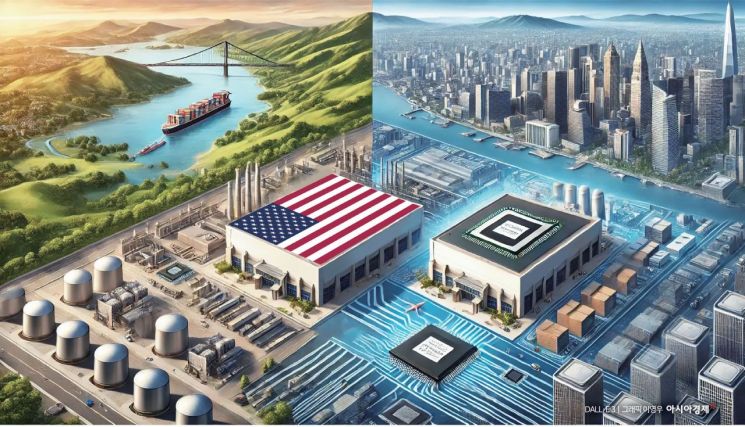
With the launch of the 'Trump 2.0' administration, concerns have grown over whether Korean companies will be able to receive subsidies as planned under the CHIPS and Science Act (CSA). Meanwhile, Taiwan's foundry (semiconductor contract manufacturing) company TSMC is showing confidence. Analysts say this is the result of TSMC's swift response to the U.S. government's demand for 'local production.'
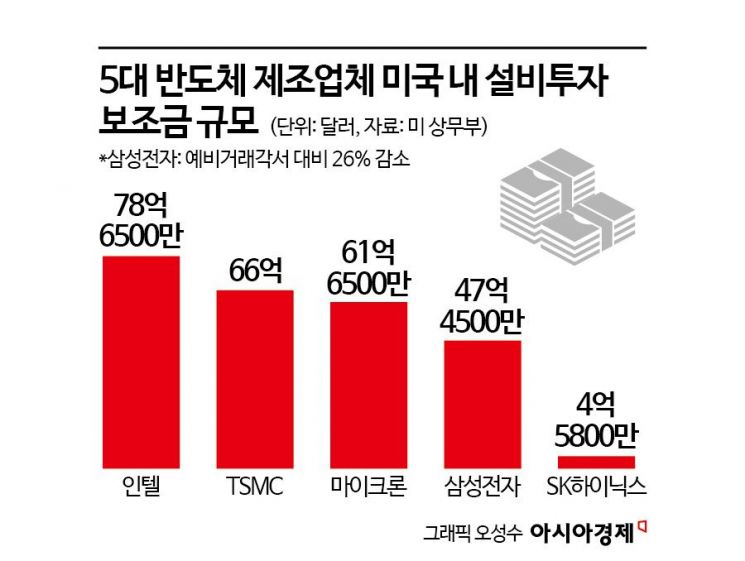
According to industry sources on the 1st, Samsung Electronics was set to receive $4.745 billion (6.9 trillion KRW) and SK Hynix $458 million (660 billion KRW) in subsidies from the U.S. government. However, with President Donald Trump overturning policies from the Biden administration that do not align with his agenda, it is uncertain whether these payments will be made.
Howard Lutnick, nominee for U.S. Secretary of Commerce, said at a Senate confirmation hearing on the 29th of last month (local time) in response to a question about whether he would honor contracts confirmed with the U.S. government to receive subsidies under the CHIPS Act, "I cannot fulfill something I have not read," adding, "We need to review this carefully and do it properly." A day earlier, Wes Bach, acting director of the White House Office of Management and Budget (OMB), notified government agencies of a temporary suspension of federal subsidy and loan expenditures, including the CHIPS incentive program.
If these measures are fully implemented, there is speculation that subsidies for Samsung Electronics and SK Hynix, which are pushing for large-scale facility investments in the U.S., could be affected. If the U.S. determines that 'advanced semiconductor production domestically' will take considerable time, it could overturn already signed contracts.
Korean companies are often compared to Taiwan's TSMC. TSMC has already received $1.5 billion (about 2.2 trillion KRW) out of $6.6 billion in subsidies. Wendell Huang, TSMC's Chief Financial Officer (CFO), recently expressed confidence in an interview with CNBC that "subsidies will continue to flow under the Trump administration."
The difference is as follows. Unlike Korean companies that delayed local factory investments, TSMC quickly began advanced chip production in the U.S. It started investing in Arizona in 2020 and announced in April last year that it would increase its U.S. investment to $65 billion (about 95 trillion KRW) and expand semiconductor factories to three locations.
The first of these factories has already started mass production of 4nm (1nm = one billionth of a meter) chips. This is the first time 4nm-class semiconductor production has taken place in the U.S. It is reported to be supplying Apple and Nvidia, among others.
Samsung Electronics' advanced semiconductor production in the U.S. is expected to begin no earlier than the second half of next year. It is building a foundry plant in Taylor, Texas. SK Hynix plans to establish an advanced packaging production base for artificial intelligence (AI) memory in West Lafayette, Indiana. The company aims to mass-produce high-bandwidth memory (HBM) and other products at this facility, with operations expected to start in the second half of 2028.
The pace of investment has also affected the scale of subsidies. Samsung Electronics' subsidy ratio relative to its investment amount is about 13%, which is relatively high. However, while other foreign companies have secured subsidies at the initially planned levels, Samsung Electronics faced significant cuts. Samsung reduced its planned U.S. investment from $44 billion last year to $37 billion. Although the investment amount decreased by 16%, subsidies were cut by 26% during the same period.
Both Samsung Electronics and SK Hynix are on high alert. If the subsidies they are supposed to receive are reduced, the timeline each company has planned from groundbreaking to production will inevitably be disrupted. An industry insider said, "Nothing concrete has developed yet," but added, "We are closely monitoring the situation."
Some believe that if subsidies for Korean companies are reduced, it could also jeopardize the 'local production' that the U.S. desires, leading to optimistic views on subsidy payments. Ki-Hyun Ahn, Executive Director of the Korea Semiconductor Industry Association, pointed out, "If subsidies are reduced, groundbreaking will inevitably be delayed," adding, "If companies' production is delayed, the U.S. will also suffer."
© The Asia Business Daily(www.asiae.co.kr). All rights reserved.
![Clutching a Stolen Dior Bag, Saying "I Hate Being Poor but Real"... The Grotesque Con of a "Human Knockoff" [Slate]](https://cwcontent.asiae.co.kr/asiaresize/183/2026021902243444107_1771435474.jpg)
















