Trump Firm on Tariffs for Canada and Mexico
Selective Tariffs Possible on Items Like Steel
Tariff Measures to Be Announced, Negotiations to Continue
U.S. President Donald Trump has declared that he will impose a 25% tariff on Mexico and Canada starting February 1 as scheduled, but it is reported that the scope of the tariff imposition has not yet been finalized. Regarding steel, which is likely to be subject to tariffs, the Wall Street Journal (WSJ) reported that strong opposition from labor unions makes it difficult to push the tariffs through unconditionally.
On the 30th (local time), the Wall Street Journal (WSJ), citing sources familiar with the matter, reported that negotiations are underway to impose tariffs on Canada and Mexico, and that the Trump administration has not yet decided whether to impose tariffs on all goods imported from those countries.
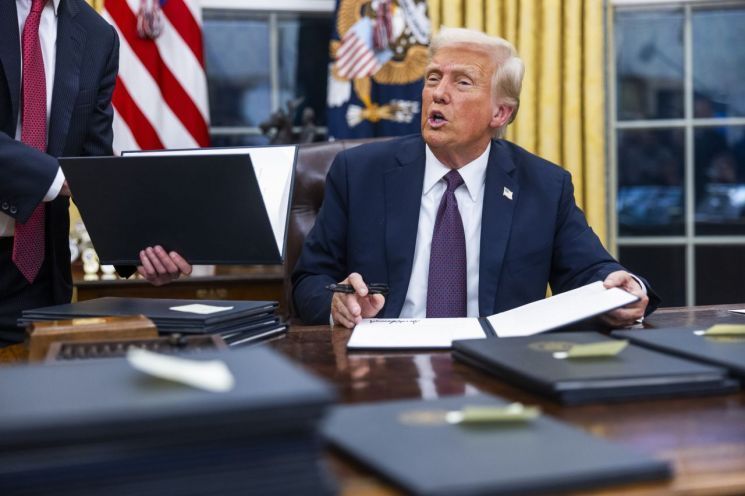
President Trump's determination to impose tariffs on Mexico and Canada remains firm. At an executive order signing ceremony held at the White House that day, when asked by reporters whether tariffs on Canada and Mexico would start on Saturday (February 1), Trump replied, "We will do it on Saturday the 1st." He reiterated his commitment to imposing tariffs.
He said, "I will impose a 25% tariff on Canada and separately a 25% tariff on Mexico," adding, "We have a very large (trade) deficit with these countries, so we really need to impose tariffs. These tariffs may increase over time or they may not."
While it is highly likely that President Trump will announce a series of tariff measures by the 1st of next month, there are also views that tariffs may be limited to specific items such as steel and aluminum. WSJ, citing sources, reported that preparations are underway to impose tariffs on specific industries such as steel rather than adopting a universal tariff approach that applies to all imports.
In particular, the decision on whether to impose tariffs on crude oil is expected to be made that day. When asked if crude oil would also be subject to tariffs, President Trump said, "We may or may not impose tariffs. We will probably make a decision on crude oil tonight."
If tariffs are imposed as planned by President Trump, opposition from domestic companies and labor organizations in the U.S. is expected. North American companies and labor groups are concerned that comprehensive tariff imposition will disrupt supply chains and raise prices of some items such as crude oil. They also argue that trade dependence on hostile regimes such as China and Venezuela will increase.
The steel union, which was an ally of President Trump in the recent election, emphasized the importance of Canadian crude oil and urged the withdrawal of the tariffs. The steel union highlighted that about 30,000 steelworkers work at refineries using Canadian crude oil and pointed out that if Canadian crude oil prices become too high, it could be replaced by oil imported from other countries such as Venezuela.
On the other hand, the steel industry and President Trump's external trade advisors are reportedly demanding the restoration of tariffs on steel and aluminum from Mexico and Canada, which were eliminated during the 2019 United States-Mexico-Canada Agreement (USMCA) negotiations, according to WSJ.
Some sources said that tariff measures may be announced in two days but with a grace period before implementation, allowing negotiations with Canada and Mexico to continue.
Administration officials have publicly stated that Canada and Mexico are making progress in meeting Trump's demands, raising expectations that the two countries may avoid immediate tariff measures. President Trump has demanded that Mexico and Canada strengthen their borders to prevent the influx of drugs such as fentanyl and illegal immigrants.
David McGuinty, Canada's Minister responsible for border affairs, recently stated that the Canadian government is negotiating with the U.S. to establish a new 'North American Fentanyl Response Team.' He said that if this matter is finalized, more investment in personnel and infrastructure will be made.
Claudia Sheinbaum, President of Mexico, also expressed her intention to actively communicate with the U.S. regarding the issues of illegal immigration and drug inflow, which President Trump has consistently raised.
© The Asia Business Daily(www.asiae.co.kr). All rights reserved.
![Clutching a Stolen Dior Bag, Saying "I Hate Being Poor but Real"... The Grotesque Con of a "Human Knockoff" [Slate]](https://cwcontent.asiae.co.kr/asiaresize/183/2026021902243444107_1771435474.jpg)















