Generative AI 'R1' Triggers Industry Shift
Low Dependence on High-Performance Semiconductors
ChatGPT-Level Performance Achieved at Minimal Cost
Moves to Block China's Cost-Effective Semiconductors

Chinese artificial intelligence (AI) startup DeepSeek's generative AI model ‘R1’ is expected to shake up the global semiconductor industry landscape. It has become an opportunity to spread the perception that ‘excellent AI models do not necessarily require cutting-edge semiconductors,’ leading to the assessment that not only the development of large language models (LLMs) led by the United States but also the global semiconductor ecosystem have fallen within China’s ‘cost-effectiveness (performance per price)’ range.

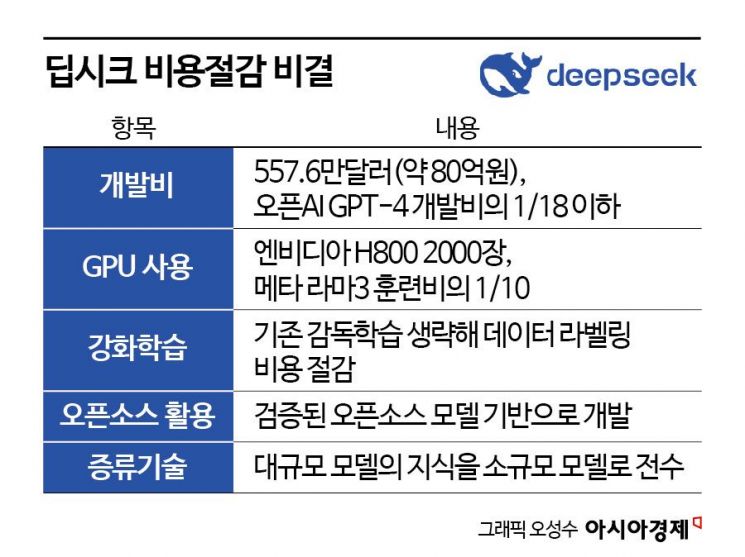
DeepSeek built a cost-effective AI infrastructure by utilizing low-spec graphics processing units (GPUs) such as Nvidia’s H800 chip in parallel. Unlike previous AI model development, which heavily depended on high-performance semiconductors, they achieved ChatGPT-like performance at minimal cost.
The most notable company in China’s AI semiconductor industry currently is Huawei. Its self-developed Ascend series offers performance comparable to Nvidia’s H100 while maintaining high price competitiveness, challenging Nvidia’s monopolistic position in the Chinese market.
Alibaba is also actively developing AI semiconductors. The ‘Han Guang 800’ chip, unveiled in 2019, recorded performance 15 times higher than Nvidia’s T4 GPU and 46 times higher than the P4 GPU. Baidu is expanding the application range of its AI chip ‘Kunlun’ series across various fields such as cloud computing, autonomous driving, and smart city construction.
A representative from the domestic semiconductor industry said, “The technological capabilities of Chinese semiconductor companies like CXMT and SMIC have reached a level that cannot be ignored,” adding, “In the past, Chinese companies circumvented Southeast Asia to secure Korean semiconductors, but now they have established a system to directly secure semiconductors through their own domestic semiconductor supply chain.”
Moves to block China’s cost-effective semiconductors are expected to intensify. According to the Wall Street Journal (WSJ) on the 30th (local time), John Moolenaar, chairman of the U.S. House China Communist Party Special Committee, strongly stated, “The Trump administration should consider export controls on Nvidia’s H20 chip, which DeepSeek has heavily used.” The U.S. Democratic Party holds a similar stance.
However, considering DeepSeek’s development method, some analyses suggest that chip control measures may not be very effective. According to a paper released by DeepSeek, the core of their cost reduction strategy lies in a reinforcement learning?centered approach. Previously, supervised learning, where large-scale data was manually labeled by humans, was mainly used. However, DeepSeek omitted this step and, much like a child naturally improving skills by playing games, the AI enhanced its abilities through repeated trials and improvements.
However, some voices express concerns about DeepSeek’s security issues. Dongin Jang, a professor in charge at KAIST Graduate School of AI, warned, “DeepSeek’s large model (671B) is so large that it can only be used by accessing its own servers, and in this process, all data is handed over to the Chinese side,” calling this “a very dangerous matter.”
© The Asia Business Daily(www.asiae.co.kr). All rights reserved.
![Clutching a Stolen Dior Bag, Saying "I Hate Being Poor but Real"... The Grotesque Con of a "Human Knockoff" [Slate]](https://cwcontent.asiae.co.kr/asiaresize/183/2026021902243444107_1771435474.jpg)

















