Suspicions Rise Over Huawei's Semiconductor Ambitions Behind Deepseek R1 'Whirlwind'
Possibility of Repeating the 2023 7nm Smartphone Chip Incident That Overcame U.S. Export Controls
Huawei Steps Up with Software Support to Rival Nvidia CUDA
Apple iPhone Also Experiences Decline in China Amid Huawei's Rise
Behind the "thinking" artificial intelligence (AI) 'R1' introduced by Chinese AI startup Deepseek, which achieved results comparable to those in the U.S. at an absurdly low cost of about $5 million compared to American competitors, is the growing diagnosis that 'Huawei' is the driving force.
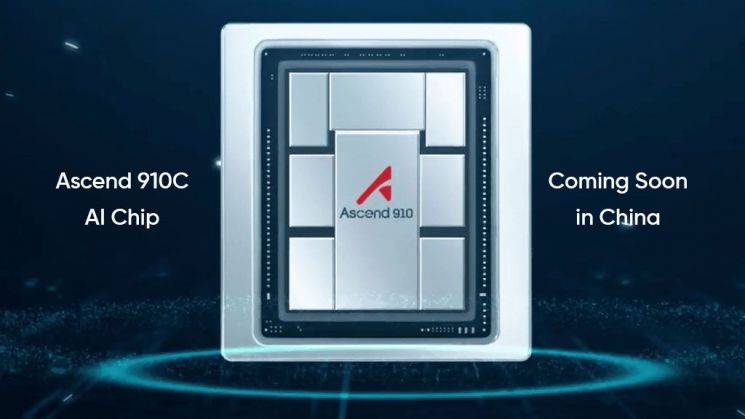
While some in the U.S. suggest that China may have downplayed training costs for external propaganda purposes or secured large quantities of Nvidia's H100-class graphics processing units (GPUs), which are restricted for export, through smuggling, the interpretation is that the advancement of Chinese semiconductor technology is the true source of strength. Previously, Nvidia CEO Jensen Huang warned that U.S. restrictions on China might instead stimulate China's independent GPU semiconductor development. The fact that China is virtually the only country capable of making a significant impact in the GPU market, which is monopolized by American companies, serves as a new "warning siren" for semiconductor companies worldwide.
According to foreign media and experts on the 31st, the equipment presumed to have been used by Deepseek is Huawei's Ascend GPU. Huawei, a telecommunications equipment company, has focused on the semiconductor sector in line with the Chinese government's semiconductor industry promotion policies. The result is the Ascend 910C. The Ascend 910C is like a "spark of hope" for China's AI industry.
Famous analyst and tipster @Dorialexander stated that Deepseek was trained on Nvidia's H800 processor, which is a model for mass export, but suggested that inference would be executed on Huawei's Ascend 910C processor.
In response, the semiconductor industry interprets this as "Huawei again." This is not Huawei's first counterattack. Huawei shocked the U.S. by unveiling the Mate 60 Pro smartphone using a 7nm (1nm = one billionth of a meter) semiconductor process in 2023. China revealed this phone during U.S. Commerce Secretary Gina Raimondo's visit to China, catching the U.S. off guard.
The U.S. controlled the export of extreme ultraviolet (EUV) lithography equipment from Dutch company ASML, essential for entering the sub-7nm semiconductor process, to curb China in this field, but did not fully succeed. Huawei produced chips designed by its semiconductor subsidiary HiSilicon through SMIC and re-entered the smartphone market. Although progress has been slow since then, the results are remarkable. Last year, Huawei unveiled a twice-folding foldable smartphone, leading a patriotic consumption movement that eroded Apple's solid market share in China. The decline in iPhone sales in China also started with Huawei's offensive.
The Ascend 910C lags behind Nvidia's A and H series GPUs in performance, especially still struggling to compete with the H100. Nevertheless, the Ascend 910C is evaluated to be somewhat close to the 'A100.' Delivering similar performance at about 30% lower cost, around $15,000 to $20,000, is a meaningful achievement. The A100 is still the GPU used by most AI-related companies in Korea, including Samsung Electronics, Naver, Kakao, SK Telecom, KT, and LG Uplus. The higher-performance H100-class GPUs are known to number fewer than 2,000 units domestically. The Ascend 910C is also reported to consume less power compared to Nvidia GPUs.
Huawei has even prepared an alternative to CUDA, the "perfect match" for developers using Nvidia GPUs. It is called 'MindSpore.' As the use of Huawei GPUs and MindSpore increases within China, China's independent AI development will gain momentum.
Support from the Chinese government is also a background to Huawei's growth. The U.S. classifies Huawei as a company linked to the Chinese government and is imposing sanctions. Because of this, Huawei faces pressure to be excluded from overseas markets. To overcome these challenges, both Huawei and the Chinese government need technological development. Yet, once again, the U.S. has been caught off guard.
There are weaknesses as well. The performance and development speed of Ascend, as well as the number of MindSpore users, still fall far short of Nvidia and CUDA. Low yield rates are also a challenge to overcome. U.S. GPU export restrictions are expected to become even stricter.
© The Asia Business Daily(www.asiae.co.kr). All rights reserved.
![Clutching a Stolen Dior Bag, Saying "I Hate Being Poor but Real"... The Grotesque Con of a "Human Knockoff" [Slate]](https://cwcontent.asiae.co.kr/asiaresize/183/2026021902243444107_1771435474.jpg)
















