After the holiday break, the KOSPI opened lower. It is interpreted that various overseas issues that occurred during the holiday period were simultaneously reflected, affecting the index. In particular, semiconductors have fallen sharply due to the impact of DeepSeek, dragging the index down. Experts predict that the market will resume its upward trend after digesting the events that occurred during the holiday.
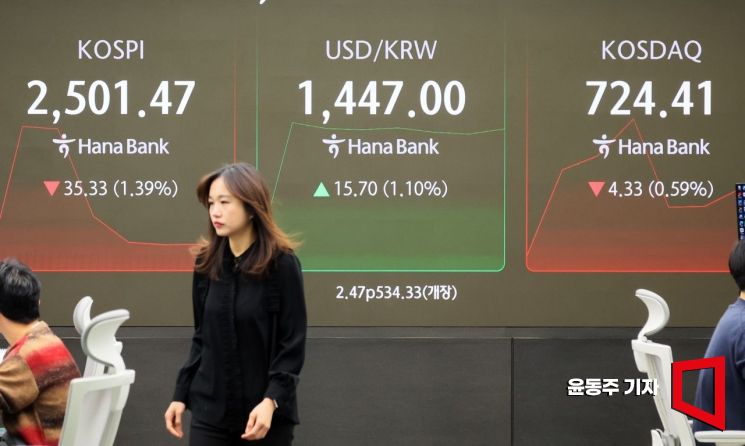 The KOSPI index started the trading day around 2,500 with a weak tone on the first day of trading after the Lunar New Year holiday on the 31st. The index and other figures are displayed on the index status board in the dealing room at the Hana Bank headquarters in Jung-gu, Seoul. Photo by Yoon Dong-joo
As of 9:50 a.m. on the 31st, the KOSPI recorded 2,516.56, down 20.24 points (0.80%) from the previous session. The KOSDAQ showed a decline of 3.41 points (0.47%) to 725.33.
The larger drop in the KOSPI compared to the KOSDAQ is attributed to the weakness in semiconductors, led by major stocks such as Samsung Electronics and SK Hynix. Samsung Electronics fell more than 2%, dropping to the 52,000 won range, while SK Hynix plunged 8%. SK Hynix even broke below the 200,000 won level early in the session.
During the Lunar New Year holiday when the domestic stock market was closed, China-originated artificial intelligence (AI) DeepSeek shocked global stock markets. Lee Kyung-min, a researcher at Daishin Securities, analyzed, "The reason DeepSeek was shocking is that despite the U.S. imposing strict restrictions on access to Nvidia’s latest AI semiconductors in China, where it was under intense scrutiny, an AI model comparable to ChatGPT was released." He added, "The U.S. AI industry was shaken, with the Nasdaq index falling 3% and Nvidia dropping nearly 17% on the 27th."
With the emergence of DeepSeek causing significant declines in U.S. AI hardware stocks including Nvidia, AI hardware-related stocks in the domestic market also appear to be affected. Kim Dae-jun, a researcher at Korea Investment & Securities, explained, "The reason DeepSeek shocked the market is that although its performance was similar to OpenAI’s ChatGPT, it drastically reduced investment costs. This suggests that AI model training can be done with less use of high-performance chips like Nvidia’s graphics processing units (GPUs), which acted as a negative factor for the AI hardware sector." He added, "Volatility in domestic stocks related to high-bandwidth memory (HBM) used in AI hardware could significantly increase."
Short-term volatility in AI semiconductor stock prices is expected to be inevitable. Han Ji-young, a researcher at Kiwoom Securities, said, "At this point, it is appropriate to focus on changes in the existing AI narrative. AI hardware companies like Nvidia are likely to be caught up in noise related to skepticism about large-scale investments by big tech for high-cost, high-performance chips, as well as concerns over semiconductor export restrictions under the Trump administration. Short-term price shocks in AI semiconductor stocks such as high-bandwidth memory (HBM) are unavoidable." She added, "However, from a medium-term perspective, the story changes. If inference and training costs decrease by utilizing open-source AI models like DeepSeek, the adoption speed of AI could accelerate, ultimately expanding the AI industry."
During the holiday, the U.S. Federal Open Market Committee (FOMC) for January also took place. As expected by the market, the Federal Reserve (Fed) kept the benchmark interest rate unchanged at 4.25?4.50%. Fed Chair Jerome Powell mentioned at the FOMC press conference that there is no need to rush to change policy. He also explained that the removal of phrases related to labor market easing and inflation progress should not be given much significance.
Na Jung-hwan, a researcher at NH Investment & Securities, forecasted, "At this point, concerns about a U.S. recession are low, and the Fed’s monetary policy is likely to remain at the current level for the time being. Therefore, issues such as the intensity of Trump’s tariff enforcement, earnings of major U.S. information technology companies (big tech), and evaluations of DeepSeek’s impact will have a greater influence on the stock market than the Fed."
The stock market is expected to gradually recover after reflecting the events during the holiday. The KOSPI, which fell more than 1% early in the session, is gradually reducing its losses. Researcher Kim said, "The China-originated AI shock has somewhat faded while we were off, and the FOMC results did not significantly raise market interest rates, so I do not see an environment where the stock market will face severe pressure. The KOSPI is likely to gradually recover after opening lower today, and the extremely undervalued valuation will also gradually normalize."
However, since various events still remain, it seems necessary to maintain caution in February. Researcher Na said, "February is packed with various events such as Trump’s tariffs, manufacturing indicators, and earnings of major U.S. information technology companies (big tech), so it is necessary to stay cautious. So far, big tech earnings have been favorable, but with Google and Amazon’s earnings announcements coming next week, attention should be paid to whether capital expenditures (Capex) will continue to expand following the DeepSeek issue."
© The Asia Business Daily(www.asiae.co.kr). All rights reserved.
![Clutching a Stolen Dior Bag, Saying "I Hate Being Poor but Real"... The Grotesque Con of a "Human Knockoff" [Slate]](https://cwcontent.asiae.co.kr/asiaresize/183/2026021902243444107_1771435474.jpg)
















