Suspicion of Unfair Merger Between Samsung C&T and Cheil Industries
Prosecution Seeks Five-Year Prison Term in Appellate Trial
Indictment Amended to Reflect Administrative Court Ruling
The appellate court ruling for Samsung Electronics Chairman Lee Jae-yong, who was indicted on suspicion of unfair merger between Samsung C&T and Cheil Industries, will be announced on February 3. In the first trial, Chairman Lee was acquitted of all 19 charges brought by the prosecution, but the revised charges following the Seoul Administrative Court’s first trial ruling, which found some accounting fraud at Samsung BioLogics (Samsung Bio), are expected to be a variable in the appellate court’s decision.
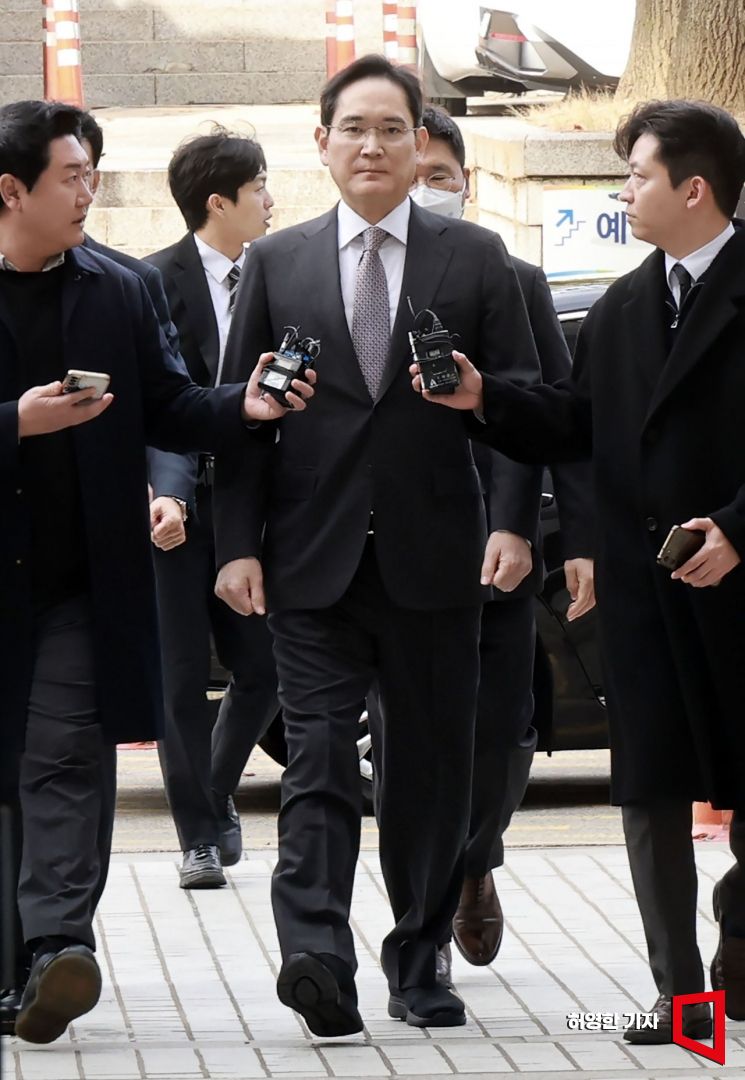 Samsung Electronics Chairman Lee Jae-yong is entering the Seoul High Court building to attend the appellate trial verdict hearing on the alleged unfair merger of Samsung C&T and Cheil Industries held on November 25 last year. Photo by Heo Young-han
According to the legal community on the 31st, the 13th Criminal Division of the Seoul High Court (Presiding Judges Baek Gang-jin, Kim Seon-hee, and Lee In-su) will hold the second trial verdict session at 2 p.m. on February 3 for Chairman Lee and 14 others, including former Samsung Group Future Strategy Office chief Choi Ji-sung, who were indicted on charges including violations of the Capital Markets Act. This appellate decision comes about a year after the first trial on February 5 last year, where all defendants were acquitted. In the appellate trial closing arguments on November 25 last year, the prosecution requested a sentence of five years in prison and a fine of 500 million won for Chairman Lee.
Earlier, Chairman Lee was indicted in September 2020 on charges of involvement in various fraudulent transactions, market manipulation, and accounting fraud orchestrated by the Future Strategy Office during the merger process of Samsung C&T and Cheil Industries, aimed at securing management rights at minimal cost and strengthening control. The key issues are violations of the Capital Markets Act, breach of fiduciary duty, and violations of the External Audit Act. However, the first trial court in February last year ruled that the merger of the two companies was not solely for Chairman Lee’s succession or strengthening control, and overall could not be deemed unfair. It also found no evidence to prove that the unfair ratio caused shareholder damage, acquitting Chairman Lee of all 19 charges.
In the second trial, the suspicion of Samsung BioLogics’ accounting fraud is expected to be a key issue. In August last year, the Seoul Administrative Court judged that Samsung BioLogics’ accounting treatment of loss of control over Samsung Bioepis in 2015 was a violation of accounting standards, stating that the loss of control was processed without reasonable grounds mainly to avoid issues such as capital erosion. This differs somewhat from the first trial court’s ruling in Chairman Lee’s case, which found Samsung BioLogics’ loss of control accounting appropriate and no accounting fraud, leading to his acquittal. Reflecting this administrative court ruling, the prosecution amended the indictment during the second trial.
The possibility of a change in the court’s evaluation of evidence is also expected to become a new issue. The first trial court completely excluded the evidentiary value of key evidence secured by the prosecution, such as electronic information seized from Samsung BioLogics’ servers, on the grounds that it was obtained without a selective procedure. If the second trial follows this, an acquittal will be issued, but if the judgment differs, the legal community does not rule out the possibility of a different conclusion.
© The Asia Business Daily(www.asiae.co.kr). All rights reserved.

















