KAIST and Sogang University Joint Research Team Publishes in "Nature"
Generates Over 10 Times More Spin Current Than Classical Methods
Domestic researchers have discovered the quantum mechanical spin pumping phenomenon occurring at room temperature for the first time in the world.
The Ministry of Science and ICT announced that the joint research team of Professors Kyung-Jin Lee and Gap-Jin Kim from the Korea Advanced Institute of Science and Technology (KAIST) and Professor Myunghwa Jung from Sogang University, supported by the Ministry’s Basic Research Program, published their research results in the international journal Nature on the 30th (Korean time).
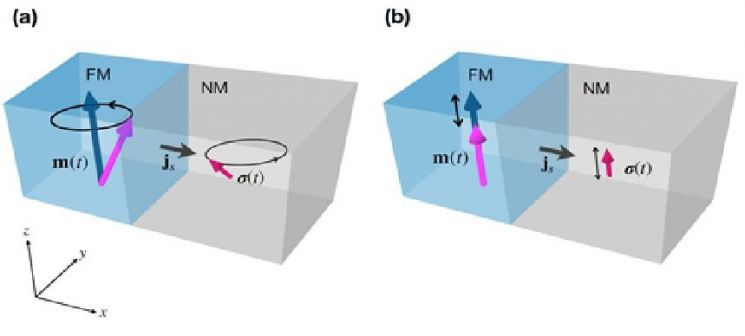 Schematic diagrams of classical spin pumping (a) and quantum spin pumping (b). Spin pumping occurs when a ferromagnet (FM, blue) and a non-magnetic material (NM, gray) are joined. In classical spin pumping depicted in (a), spins flow into the non-magnetic material due to the precession motion while the magnitude of magnetization m(t) (pink arrow) is maintained. In contrast, quantum spin pumping shown in (b) indicates spins flowing into the non-magnetic material as the magnitude of magnetization m(t) (pink arrow) changes. Illustration and provided by Professor Kyungjin Lee (KAIST), Professor Gapjin Kim (KAIST), and Professor Myunghwa Jung (Sogang University).
Electrons possess both electrical properties called charge and magnetic properties called spin (the electron’s intrinsic quantum angular momentum). Most electronic devices operate using charge current, but when current flows, electrons collide with atoms in the material, generating heat that leads to increased energy consumption and reduced efficiency.
To overcome this, researchers are studying electronic devices that use spin current instead of charge current, a field known as spintronics. The core of implementing spintronics technology is generating spin current, and the research team focused on the spin pumping phenomenon, where spins move from a ferromagnet to a non-magnetic material due to precessional motion.
Professor Myunghwa Jung’s team fabricated ferromagnetic thin films of iron (Fe) and rhodium (Rh), and together with Professor Gap-Jin Kim’s team, observed a large spin current by utilizing the characteristics of the thin films. Professor Kyung-Jin Lee’s team interpreted this through quantum mechanical theory and verified it with additional experiments.
While most quantum mechanical phenomena are observed only at ultra-low temperatures, this study is significant as it observed spin pumping at room temperature for the first time worldwide, and proposed a method that generates more than ten times the spin current compared to conventional classical methods, expected to contribute to the development of next-generation electronic devices.
The joint research team stated, "While previous spintronics research used classical spin motion, this study is meaningful in proving that utilizing the quantum nature of spin is more effective in terms of applications."
© The Asia Business Daily(www.asiae.co.kr). All rights reserved.
![Clutching a Stolen Dior Bag, Saying "I Hate Being Poor but Real"... The Grotesque Con of a "Human Knockoff" [Slate]](https://cwcontent.asiae.co.kr/asiaresize/183/2026021902243444107_1771435474.jpg)
















