17 Flights in 48 Hours Before the Accident
Ministry of Land, Infrastructure and Transport to Announce 'Aviation Safety Innovation Plan' by April
About a month after the Muan Jeju Air disaster, a fire accident occurred on an Air Busan aircraft at Gimhae Airport, once again putting the safety issues of low-cost carriers (LCCs) under scrutiny. Although it is believed that the cause was not a mechanical defect, users' anxiety is growing. Meanwhile, the Ministry of Land, Infrastructure and Transport plans to prepare an aviation safety innovation plan to be announced in April.
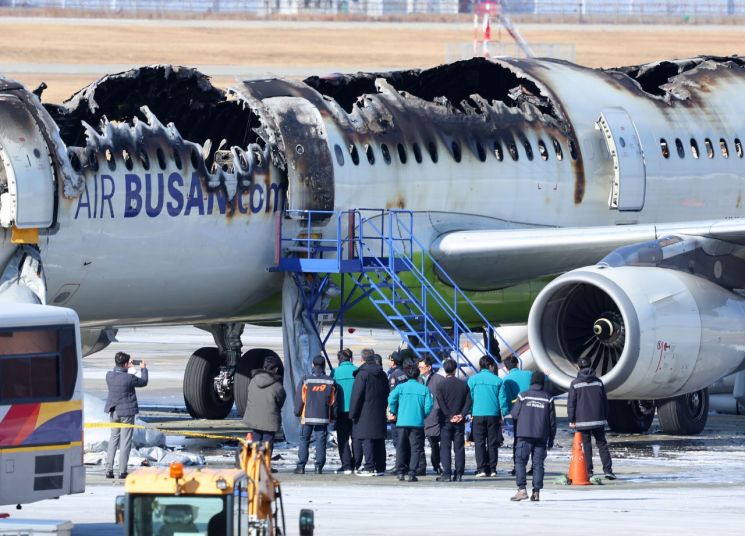 On the 29th, at Gimhae International Airport in Gangseo-gu, Busan, Busan Mayor Park Hyung-jun, along with fire authorities and related airport officials, are observing the Air Busan passenger plane fire scene. Photo by Yonhap News
According to the aviation industry on the 29th, at around 10:15 p.m. the previous day, a fire broke out on Air Busan flight BX391 (HL7763) bound for Hong Kong, which was preparing for takeoff at the Gimhae Airport apron, and all 176 passengers and crew evacuated in an emergency.
The accident resulted in no fatalities and only three minor injuries. However, given that this aircraft accident occurred just a month after the Muan Jeju Air disaster that claimed 179 lives, concerns about the safety of domestic aviation, including LCCs, are spreading. In particular, there are criticisms that excessive operations by LCCs may have caused the accident.
According to the aircraft tracking website FlightAware, the Jeju Air flight 7C2216 involved in the accident last month operated a total of 13 flights in the 48 hours prior to the accident, raising concerns about maintenance neglect. It was confirmed to have flown between Muan, Jeju, Incheon airports, and Bangkok, Thailand.
Air Busan’s HL7763 aircraft also operated a total of 17 flights in the 48 hours before the accident the previous day. The total flight time was 942 minutes, or 15 hours and 42 minutes. The routes included Gimpo~Jeju, Jeju~Gimhae, Gimpo~Gimhae, and Gimhae~Macau.
According to the Ministry of Land, Infrastructure and Transport’s Aviation Information Portal, as of 2023, the number of aircraft owned by domestic airlines are: Korean Air 161, Asiana Airlines 81, Jeju Air 42, T’way 30, Jin Air 27, and Air Busan 22.
As LCC safety issues reignited, the Ministry of Land, Infrastructure and Transport, the aviation safety authority, is seeking countermeasures. On the 23rd, the ministry held a special inspection meeting chaired by Minister Park Sang-woo, discussing safety enhancement measures with CEOs of nine domestic LCCs.
At this meeting, LCCs announced safety enhancement measures such as reducing aircraft utilization rates, increasing personnel, expanding investment in safety sectors, and pilot training. Jeju Air plans to reduce its average daily operating hours from 14 to 12.8 hours, about a 9% decrease, and increase maintenance personnel from the current 309 to 350 by the end of the year.
The Ministry of Land, Infrastructure and Transport will conduct safety system and facility inspections of 11 domestic airlines including LCCs and airports nationwide through a joint public-private inspection team by the end of this month. Based on the results, it plans to prepare an 'Aviation Safety Innovation Plan' by April.
The ministry stated, "If LCCs focus only on profit pursuit and fail to implement fundamental safety reforms, the future of the aviation industry cannot be guaranteed," adding, "We will concentrate all capabilities until public concerns about LCC safety are dispelled."
© The Asia Business Daily(www.asiae.co.kr). All rights reserved.
![Clutching a Stolen Dior Bag, Saying "I Hate Being Poor but Real"... The Grotesque Con of a "Human Knockoff" [Slate]](https://cwcontent.asiae.co.kr/asiaresize/183/2026021902243444107_1771435474.jpg)
















