Yongin Light Rail Temporarily Suspended, Then Resumed
KTX Trains Running Slowly on Some Sections, Delays Ongoing
111 Flights Canceled, 24 Roads Closed
On the 28th, a day before Lunar New Year, heavy snow fell nationwide, causing flight operations to be suspended and roads to be closed in many areas. Some light rail services were temporarily halted but have since resumed, and KTX trains are operating at reduced speeds. The snow, frozen by subzero temperatures, has turned many roads across the country into icy surfaces, requiring caution.
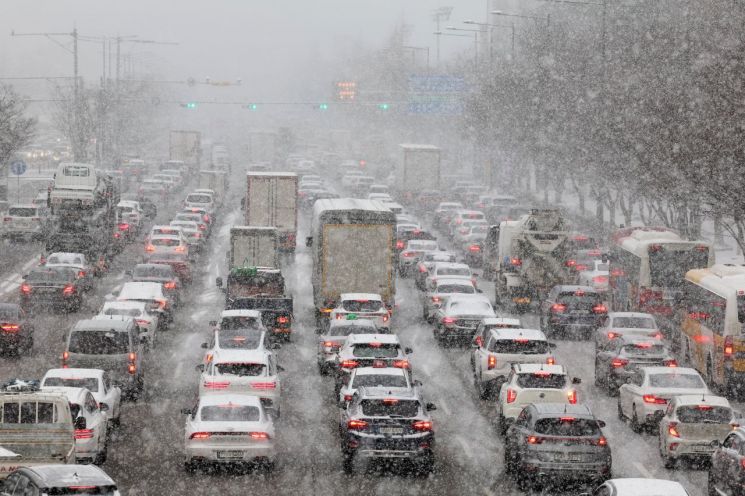
According to the Central Disaster and Safety Countermeasures Headquarters (CDSCH) of the Ministry of the Interior and Safety as of 11 a.m. on the 28th, 111 flights were canceled that day. This includes 68 flights at Incheon, 5 at Gimpo, 7 at Gimhae, 16 at Jeju, 11 at Cheongju, and 1 each at Wonju, Gunsan, Sacheon, and Pohang-Gyeongju. Due to the heavy snow continuing from the previous day, passenger ferry operations on 73 routes with 96 vessels, including Mokpo~Jeju, Yeosu~Geomundo, and Pohang~Baengnyeongdo, were also suspended.
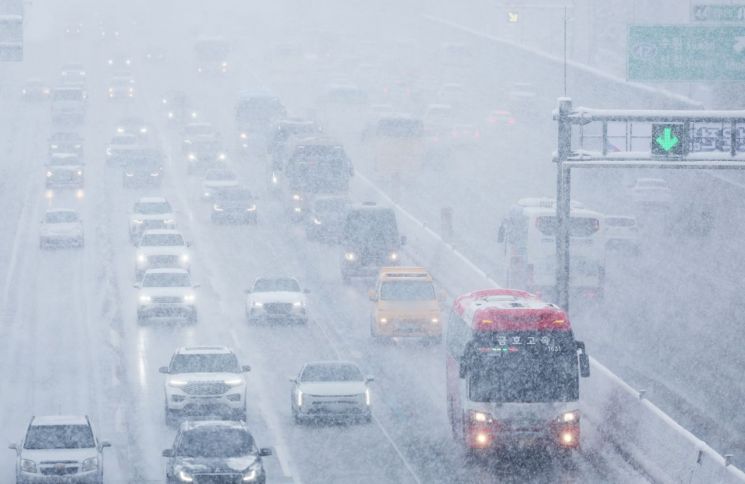
On the roads, 24 local roads were closed, including 5 locations in Jeju and 5 in Jeonnam. According to Korea Expressway Corporation, traffic congestion continues on major routes such as the Gyeongbu Line and Seohaean Line due to the heavy snowfall. Travel time by car from Seoul to other regions is approximately 6 hours and 40 minutes to Busan, and 5 hours and 10 minutes to Gwangju and Mokpo.
KTX trains are also operating at reduced speeds on the Gyeongbu High-Speed Line, Honam High-Speed Line, Gangneung Line, and Jungang Line to ensure safety amid the heavy snow and cold wave. The Suseo High-Speed Railway (SRT) is also running slower trains on some sections of the Gyeongbu Line. On some sections, trains that normally run at speeds up to 300 km/h are operating at speeds between 170 and 230 km/h. As a result, train travel times are expected to be 10 to 30 minutes longer than usual.
Light rail services were temporarily suspended as well. The Yongin Light Rail temporarily halted operations at around 8:36 a.m. for safety reasons but resumed service after about two and a half hours. Yongin received up to 20.1 cm of heavy snow that day, with particularly heavy snowfall of 2 cm per hour between 6 a.m. and 9 a.m.
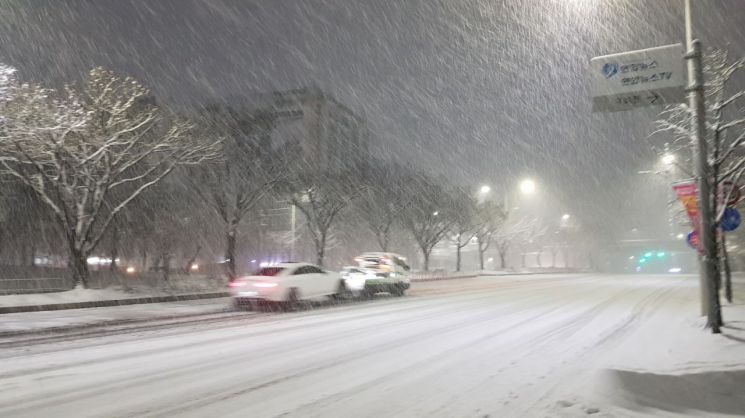
The plummeting temperatures caused the snow to freeze, leading to a series of traffic accidents. Around 8:32 a.m., on the Seohaean Expressway in Boryeong, Chungnam, a collision between a highway bus and a passenger car resulted in six people sustaining serious to moderate injuries. Earlier, around 3:10 a.m., an 18-ton tanker truck overturned near Seungjigyo Bridge close to the Shinyeong Tunnel on the Dangjin~Daejeon Expressway heading toward Daejeon in Gongju City.
At around 9 p.m. the previous day, a 12-vehicle pileup occurred on the Iksan-Pyeongtaek Expressway heading toward Buyeo in Pyeongtaek City, believed to be caused by icy road conditions, injuring two people with minor injuries. At about 7:30 p.m., near Hwansung-ri on National Route 29 (Daesan~Seosan), one commuter bus slipped on the snowy road and overturned, causing eight following commuter buses to collide in a chain accident, injuring 48 people.
In Gangwon Province, where heavy snow fell over two days, 40 people were rescued through 37 emergency 119 dispatches related to snow-covered road accidents and isolation from the previous day through the morning of the 28th.
According to the CDSCH, as of 11 a.m., heavy snow warnings were issued for Daejeon, Sejong, Gyeonggi, Gangwon, Chungbuk, Chungnam, Jeonbuk, and Gyeongbuk. The central region and Jeonbuk, where strong snow clouds are passing, are expected to receive heavy snowfall of 1 to 3 cm per hour until the Lunar New Year day on the 29th, raising concerns about additional damage.
The CDSCH elevated its alert level to Stage 2 around 10 p.m. the previous day and raised the heavy snow crisis warning from ‘caution’ to ‘alert’ level.
© The Asia Business Daily(www.asiae.co.kr). All rights reserved.
![Clutching a Stolen Dior Bag, Saying "I Hate Being Poor but Real"... The Grotesque Con of a "Human Knockoff" [Slate]](https://cwcontent.asiae.co.kr/asiaresize/183/2026021902243444107_1771435474.jpg)

















