Trump Issues Executive Order Banning Central Bank Digital Currencies (CBDCs)
South Korea Prepares to Issue Institutional CBDCs
Experts Highlight High Usability of Deposit Tokens Based on CBDCs
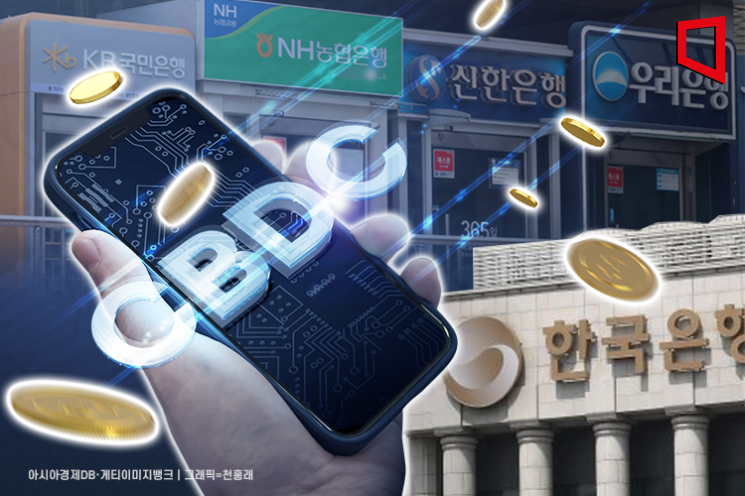
As U.S. President Donald Trump moves to regulate central bank digital currencies (CBDCs), there is growing interest in the potential impact on South Korea's CBDC initiatives. While South Korea's Bank of Korea, Financial Services Commission, and major banks are steadily preparing pilot projects for CBDCs, analysts note that the country is not entirely free from the influence of the U.S. atmosphere. However, many experts believe that given the numerous advantages of CBDCs, it is advisable to actively introduce deposit tokens based on wholesale (institutional) CBDCs domestically, independently of the U.S. stance.
Trump Administration's CBDC Ban Order
Shortly after taking office, on the 23rd, President Trump signed an executive order that included the establishment of a 'Presidential Task Force' on virtual assets. This task force will submit a report to President Trump in the future, containing legislative proposals including an evaluation of national-level digital asset reserves. The market expects the U.S. government to consider ways to reserve Bitcoin.
The executive order also includes a prohibition on the establishment and issuance of CBDCs. President Trump had opposed the introduction of CBDCs even before his election, arguing that they could infringe on individuals' private rights, and this opposition was formalized through the executive order. CBDCs refer to central bank money issued in electronic form. They have advantages such as lower issuance costs compared to cash, improved convenience, and enhanced transparency. However, concerns exist regarding the potential leakage of personal information, especially for retail (general-purpose) CBDCs.
With the Trump administration moving to regulate CBDCs, central banks in major countries worldwide, including Europe and South Korea, which are preparing to introduce CBDCs, face deep concerns. Since CBDCs are legal tender that can be used internationally, it would be impractical for countries other than the U.S., a dominant reserve currency nation, to adopt them alone.
South Korea is also preparing to conduct usability tests for CBDCs with financial authorities and commercial banks, targeting implementation by March or April. The plan involves banks issuing deposit tokens to the general public for actual transactions. Deposit tokens are tokenized digital payment instruments based on bank deposits, integrating digital payment methods into traditional bank deposits that have served as money.
Major domestic banks plan to issue deposit tokens to 100,000 general users, which will be used at some convenience stores, supermarkets, bookstores, and other outlets. Real transaction tests will be conducted where final settlements between banks are completed based on institutional CBDCs. Since deposit tokens allow consumers to transact directly with sellers without intermediaries such as card companies or VAN (Value Added Network) providers, payment procedures and costs can be reduced.
By utilizing CBDC systems and deposit tokens, voucher programs provided by the government and local governments can be operated more efficiently, and cross-border payments, which have required high fees, can also be improved. Since the pilot project is conducted only for institutional use, concerns about information leakage are minimal.
Innovation in Payment and Settlement Expected with Deposit Token Introduction
Experts predict that the introduction of deposit tokens will have a revolutionary impact on the payment and settlement sector in the future. The Korea Institute of Finance expects that deposit tokens can internalize additional services such as escrow (third-party payment agency), vouchers, and local currency functions, and enhance the efficiency of cross-border payments, thereby bringing innovative changes to the payment and settlement field.
Lee Myung-hwal, Senior Research Fellow at the Korea Institute of Finance, emphasized, "The Trump administration is negative about CBDC adoption, mainly concerning general-purpose CBDCs. South Korea needs to prepare for the introduction of deposit tokens based on institutional CBDCs in line with global trends by conducting experiments and organizing regulatory frameworks."
He added, "If the U.S. bans all forms of CBDC issuance in the future, weakening the global momentum for CBDC adoption, South Korea should consider issuing deposit tokens first without institutional CBDCs and prepare for deposit token introduction by addressing legal and regulatory shortcomings."
There are also calls for a proactive approach from financial authorities to institutionalize deposit tokens, as their introduction under the innovative finance exemption has limitations regarding business sustainability. The Bank of Korea and the Financial Services Commission have stated that they will first conduct usability tests under the innovative finance exemption and then consider institutionalizing deposit tokens. However, clearer standards are needed to properly carry out related projects.
Shin Sang-hee, Senior Researcher at Hana Financial Research Institute, stated, "For banks to continue deposit token-related businesses, it is necessary for financial authorities to provide interpretations or legal grounds on whether deposit tokens are considered deposits and subject to deposit-related regulations. Since major European countries recognize the equivalence of deposit tokens and deposits, a similar approach is possible in South Korea."
© The Asia Business Daily(www.asiae.co.kr). All rights reserved.
![Clutching a Stolen Dior Bag, Saying "I Hate Being Poor but Real"... The Grotesque Con of a "Human Knockoff" [Slate]](https://cwcontent.asiae.co.kr/asiaresize/183/2026021902243444107_1771435474.jpg)
















