54 Days After December 3 Emergency Martial Law Incident
First Sitting President Arrested in Constitutional History
Court Rejects Detention Extension Request, Prosecutors Call It "Unjust"
President Yoon Seok-yeol, who was the first sitting president in constitutional history to be arrested on charges of leading a rebellion, has been brought to trial. This comes 54 days after the December 3 emergency martial law incident was triggered.
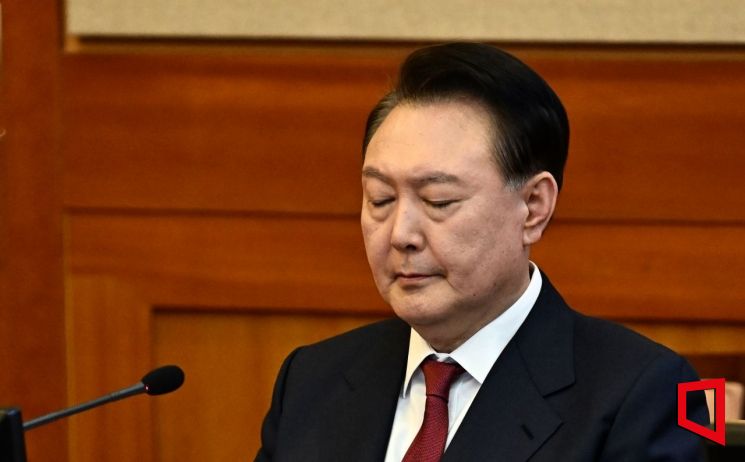 President Yoon Seok-yeol, who was arrested on charges of leading an insurrection, is attending the 4th impeachment trial hearing held at the Constitutional Court in Jongno-gu, Seoul, on the afternoon of the 23rd.
 The Special Investigation Headquarters for Emergency Martial Law under the Prosecution (Headed by Park Se-hyun, Chief Prosecutor of the Seoul High Prosecutors' Office) announced on the 26th that President Yoon was arrested and indicted on charges of leading a rebellion.
The prosecution explained, "After comprehensively reviewing the evidence from co-conspirator cases investigated so far, as well as evidence from cases transferred from the police, we judged that it is reasonable to indict the defendant."
However, the prosecution applied only the charge of leading a rebellion, excluding other charges such as abuse of power and obstruction of rights. The prosecution stated, "Considering that concerns about evidence tampering have not been resolved even after (President Yoon's) arrest, we have indicted only on the charge of leading a rebellion, which does not fall under the non-prosecution privilege of a sitting president, before the expiration of the first detention period."
After receiving the case from the High-ranking Officials' Crime Investigation Office (Gong-su-cheo) on the 23rd, the prosecution applied to the court to extend President Yoon's detention period for supplementary investigation, but the request was denied. They applied again, but this was also rejected.
In response, the Supreme Prosecutors' Office held a nationwide meeting of high and district prosecutors on the day before President Yoon's detention period expired to discuss the direction of the disposition. The Supreme Prosecutors' Office reported, "The attendees agreed that the denial of the prosecution's requests for detention extension twice on unreasonable grounds contradicts precedents where guilt was confirmed based on evidence secured through supplementary investigations of cases sent by Gong-su-cheo, such as the Seoul Superintendent of Education case, and that it is an unfair decision contrary to the criminal procedure law and criminal justice system that define the prosecutor's responsibilities and duties regarding supplementary investigations, prosecution decisions, and maintenance of prosecution."
Subsequently, the Supreme Prosecutors' Office instructed the Special Investigation Headquarters to file charges, summarizing opinions that "sufficient evidence necessary to prove the charges has been secured through investigations of key personnel involved in the rebellion, including former Minister of Justice Kim Yong-hyun, and investigation records transferred from the police, including Police Chief Jo Ji-ho." As a result, a face-to-face interrogation of President Yoon by the prosecution did not take place.
President Yoon is accused of declaring an unconstitutional and illegal emergency martial law and deploying armed martial law troops to constitutional institutions such as the National Assembly and the National Election Commission, thereby inciting a riot with the purpose of disrupting the constitutional order.
© The Asia Business Daily(www.asiae.co.kr). All rights reserved.
![Clutching a Stolen Dior Bag, Saying "I Hate Being Poor but Real"... The Grotesque Con of a "Human Knockoff" [Slate]](https://cwcontent.asiae.co.kr/asiaresize/183/2026021902243444107_1771435474.jpg)















