Galaxy S24 Equipped with Ocean Mode Used for Environmental Activities
Recycled Materials Applied to Exterior of Galaxy S25 Standard and Plus
Discarded Fishing Nets, a Cause of Marine Pollution, Also Used as Device Components
"By turning on the 'Ocean Mode' in the Galaxy S24 Ultra's camera application (app) and completing the camera settings, underwater photography becomes possible."
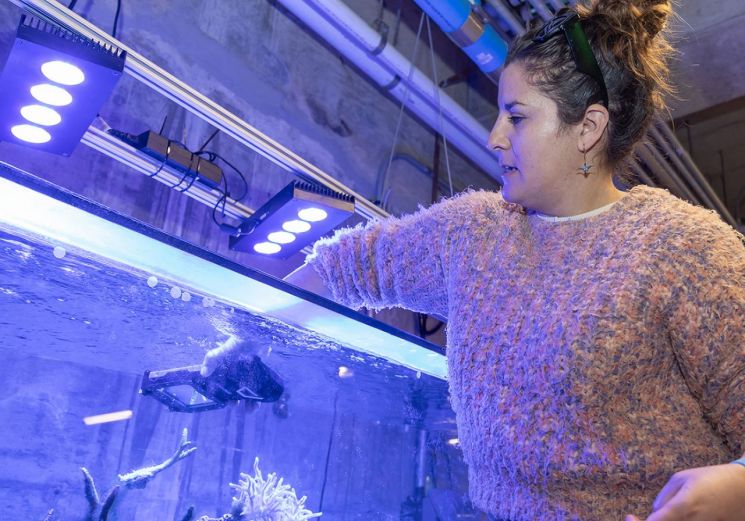 On the 24th (local time), a Scripps representative was filming inside an aquarium with a Galaxy S24 in 'Ocean Mode' in the basement of the Scripps Institution of Oceanography at the University of California, San Diego (UCSD) / Photo by Samsung Electronics
On the afternoon of the 24th (local time), in the basement of the Scripps Institution of Oceanography at the University of California San Diego (UCSD), California, USA. A Scripps official said this while placing a Galaxy S24 Ultra in a waterproof case into an aquarium. Scripps is conducting the marine restoration project 'Coral in Focus' together with the U.S. nonprofit organization Seatrees. This project monitors and restores coral reefs in major habitats such as Florida in the U.S., Bali in Indonesia, and Fiji, using photos taken with Galaxy phones by local activity groups in each region.
Ocean Mode is a camera mode developed by Samsung Electronics for this project, and local activity groups have been using this feature, which has been installed on the Galaxy S24 since last year, to take photos. In Ocean Mode, settings such as shutter speed (to minimize blurriness), white balance (to reduce excessive blue tones), and interval shooting (capturing thousands of shots at once) are available, allowing researchers to check the unique colors of coral reefs underwater in high resolution. A Scripps official stated, "Especially with the interval shooting setting, it is easy to take photos underwater without pressing the shutter button."
The photos taken through this process are delivered to the research institute and used for creating 3D coral reef restoration maps and research. Local activity groups then use this as a basis to begin coral reef restoration work.
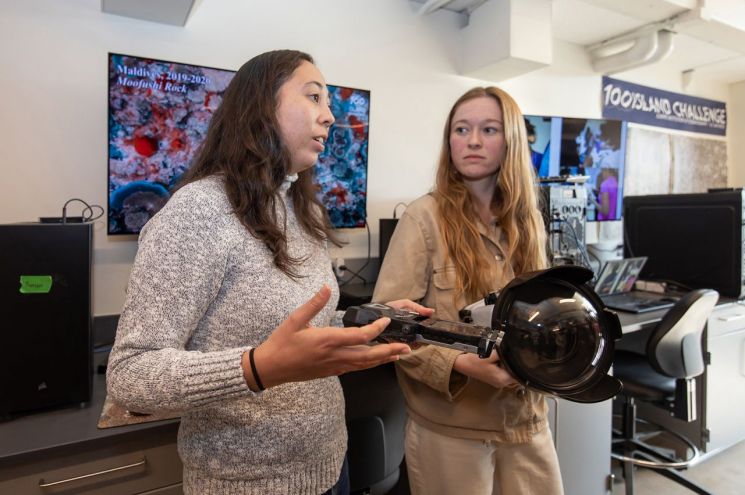 Scripps officials are explaining the tools used for filming the coral reef restoration project. On the left is a Galaxy S24 encased in a waterproof case, and on the right is a camera previously used in the project before the Galaxy phone. Photo by Samsung Electronics
Professor Stewart Sandin of Scripps said, "Securing a large amount of high-resolution photo data is very important in coral reef research, and mobile technology has played a big role," adding, "It is also very meaningful in that it allows more people to understand the importance of coral reef protection."
Samsung Electronics' eco-friendly initiatives can also be seen in the Galaxy S25 series unveiled recently at Galaxy Unpacked 2025. Recycled materials have been applied to all external parts of the standard and Plus models. Recycled glass is used on the front and back of the products, and recycled aluminum is used for the side keys, volume keys, and SIM tray. The recycled plastic material is made from wafer trays discarded during the semiconductor manufacturing process at Samsung Electronics' DS division. For the first time, recycled armor aluminum material is partially included in the metal frame.
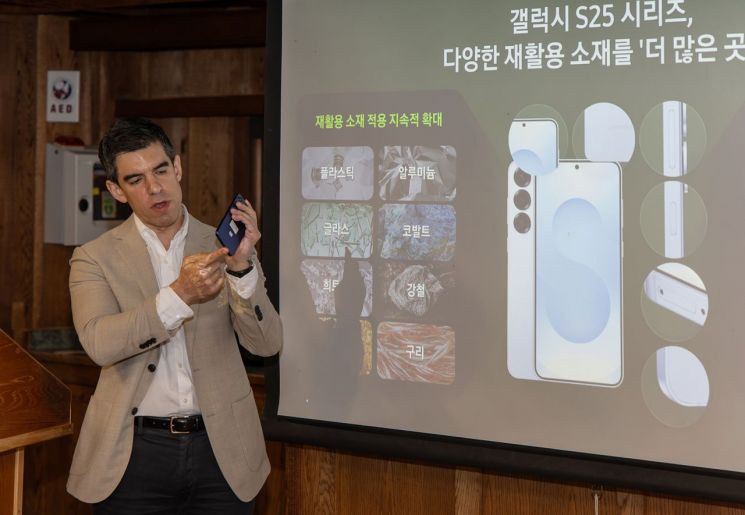 Daniel Araujo, Executive Director of the Sustainability Management Office at Samsung Electronics MX Division, is explaining the recycled materials used in the Galaxy S25 series components. Photo by Samsung Electronics
The battery uses cobalt extracted from Galaxy's own recycled batteries, and old Galaxy smartphones collected from consumers through trade-in programs and others are being recycled.
Samsung Electronics has also succeeded in recycling discarded fishing nets, which threaten marine ecosystems when they reach the end of their life or are discarded, into materials for Galaxy smartphone components. This material was first applied in the 2022 Galaxy S22 series and has since been expanded to the entire Galaxy ecosystem, including tablets, PCs, and wearables.
Daniel Araujo, Executive Director of the Sustainability Management Office at Samsung Electronics MX Division, said, "As part of technological innovation for marine environmental protection, Samsung Electronics has utilized over 150 tons of marine plastics in Galaxy products, starting with discarded fishing nets," adding, "We will continue technological innovation with Galaxy to go beyond marine environmental protection and toward marine ecosystem restoration."
© The Asia Business Daily(www.asiae.co.kr). All rights reserved.
![Clutching a Stolen Dior Bag, Saying "I Hate Being Poor but Real"... The Grotesque Con of a "Human Knockoff" [Slate]](https://cwcontent.asiae.co.kr/asiaresize/183/2026021902243444107_1771435474.jpg)

















