Kia EV6 Receives 5.8 Million KRW National Subsidy
Meets All Criteria for Performance and Safety
First-Time Young Buyers Get Additional 20% Discount
According to the Ministry of Environment's Zero-Emission Vehicle Integrated Website on the 27th, Kia's EV6 (Long Range 2WD 19-inch) will receive a government subsidy of 5.8 million KRW this year. This is the highest amount among all electric vehicles. When combined with subsidies provided by local governments, the discount could be even greater. However, due to changes in the maximum subsidy limit for electric vehicles, the amount has decreased by 1.04 million KRW compared to last year.
The EV6 is the only electric vehicle that met all the criteria to receive the subsidy. Electric vehicle subsidies are determined based on performance according to driving range, battery information provision, vehicle data collection device installation, and various incentives. Hyundai's Ioniq 5 and Ioniq 6, which received the maximum subsidy last year, did not meet the revised criteria.
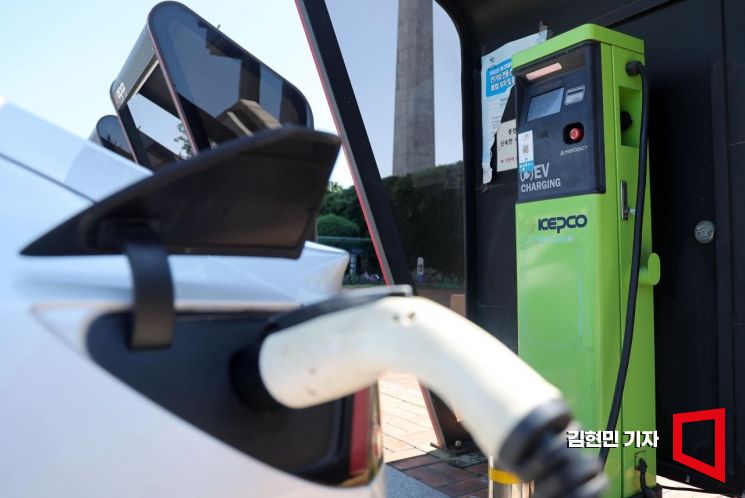
This year, the Ministry of Environment further differentiated subsidies based on single-charge driving range. Until now, electric passenger cars received reduced subsidies if their single-charge driving range was below 400 km for mid-to-large size or below 250 km for compact-to-small size. For mid-to-large vehicles, 68,000 KRW was deducted per 10 km, and for compact-to-small vehicles, 45,000 KRW was deducted per 10 km. This year, the thresholds were expanded to below 440 km and 280 km respectively. The subsidy reduction amounts were also increased to 81,000 KRW and 50,000 KRW respectively. The charging speed criterion to receive the full subsidy was raised to 250 kW, 50 kW higher than last year.
Battery safety subsidies were also increased. Last year, only 200,000 KRW was provided for installing a vehicle data collection device, but starting this year, an additional 200,000 KRW subsidy for battery status information provision and 100,000 KRW for the battery management system (BMS) alert function have been added. A new 500,000 KRW subsidy was established for electric cargo vehicles, which previously had no battery safety subsidy. For electric passenger vans, the BMS alert function must be installed to receive the safety subsidy.
According to the revised criteria, Kia's EV3 Long Range is set to receive a government subsidy of 5.65 million KRW. The EV9 will receive 2.75 million KRW, and the Niro EV 4.99 million KRW. For Hyundai Motor Company, the Ioniq 6 Long Range 2WD 18-inch is allocated 5.75 million KRW, and the The New Ioniq 5 2WD Long Range 19-inch is set at 5.77 million KRW. The Casper Electric subsidy is about 5 million KRW, 200,000 KRW less than last year. KG Mobility's Torres EVX will receive a subsidy of 3.56 million KRW.
The Tesla Model Y (RWD), which was the best-selling model last year, will receive a subsidy of 1.69 million KRW this year, down 420,000 KRW (19.9%) from 2.11 million KRW last year. This is believed to be due to the use of Chinese-made batteries, which scored lower in terms of recycling value and efficiency. Volkswagen's 2025 ID.4 subsidy is 4.22 million KRW, the highest among imported electric vehicles. The subsidy for BYD's (Build Your Dreams) compact electric sport utility vehicle (SUV) Atto 3 will be finalized next month after passing the Ministry of Environment's emission and noise certification procedures.
Meanwhile, to overcome the electric vehicle chasm (temporary demand stagnation), the government offers an additional 20% subsidy to young people (aged 19 to 34) purchasing an electric vehicle for the first time in their life. For example, if receiving a national subsidy of 5.8 million KRW, an additional discount of 1.16 million KRW can be obtained.
© The Asia Business Daily(www.asiae.co.kr). All rights reserved.
![Clutching a Stolen Dior Bag, Saying "I Hate Being Poor but Real"... The Grotesque Con of a "Human Knockoff" [Slate]](https://cwcontent.asiae.co.kr/asiaresize/183/2026021902243444107_1771435474.jpg)















