Bangkok Shrouded in Thick Smog
Free Public Transportation Introduced to Reduce Emissions
As Bangkok, Thailand suffers from severe air pollution, the Thai government has implemented measures such as school closures and free public transportation usage.
On the 25th (local time), AFP and local media Bangkok Post reported that the Bangkok city authorities issued a school closure order for 352 schools due to air pollution. This is the first time since 2020 that so many schools in Bangkok have closed due to air quality issues.
The Swiss air quality analysis company IQAIR announced that the highest concentration of fine particulate matter (PM2.5) in Bangkok reached 108㎍/㎥ the previous day. This exceeds the World Health Organization (WHO) daily average safe guideline for fine particulate matter by more than seven times. The WHO's daily average safe guideline for PM2.5 is below 15㎍/㎥.
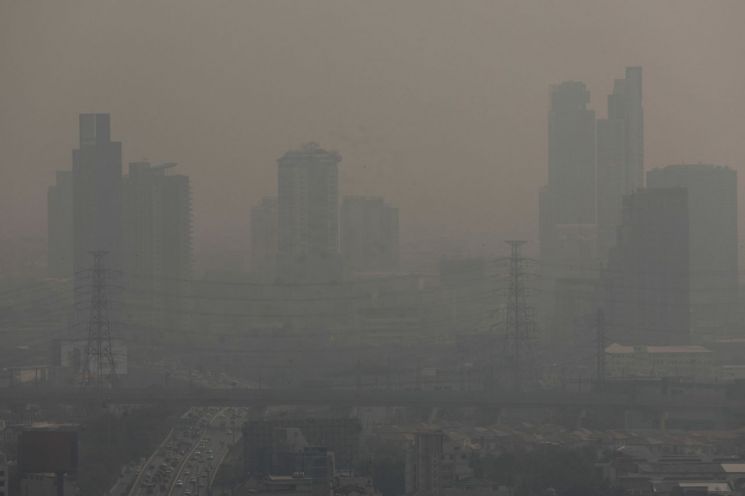 On the 24th (local time), the city of Bangkok, Thailand, covered in severe smog. Photo by Reuters and Yonhap News.
As the city of Bangkok was engulfed in thick smog all day, outdoor vendors and workers experienced great discomfort. Beverage vendor Benchawan Suknae said to AFP, "It is hard to breathe and my throat really feels like it's burning," adding, "I think (school closures) will help to some extent."
The Thai government quickly took various measures. Prime Minister Prayut Chan-o-cha instructed on social media (SNS) that "government agencies and companies should allow telecommuting to reduce exposure to air pollution and vehicle use." Additionally, Transport Minister Suriya Jungrungreangkit announced that from the 25th, public transportation such as subways and buses will be free for one week. The government hopes that during this period, citizens who usually use private cars will switch to public transportation, thereby reducing vehicle emissions and traffic congestion.
Along with this, the operation of trucks and other heavy equipment in downtown Bangkok was restricted, and the operation of over 2,700 trucks violating this was suspended. Earlier, Deputy Prime Minister and Interior Minister Anutin Charnvirakul issued a ban on burning crop residues on the 23rd. Thai authorities are also conducting experimental artificial rain measures by dispersing dry ice over Bangkok's skies to reduce air pollution.
Meanwhile, in the IQAIR world air pollution ranking released the previous day, Ho Chi Minh City, Vietnam ranked 2nd, Bangkok 4th, and Phnom Penh, Cambodia 5th, with Southeast Asia occupying three of the world's five most polluted cities. In Thailand, air quality deteriorates to some of the worst levels globally every winter dry season from December to March. The main causes of air pollution include stagnant air, burning of crop residues, and increased use of heating fuels.
© The Asia Business Daily(www.asiae.co.kr). All rights reserved.
![Clutching a Stolen Dior Bag, Saying "I Hate Being Poor but Real"... The Grotesque Con of a "Human Knockoff" [Slate]](https://cwcontent.asiae.co.kr/asiaresize/183/2026021902243444107_1771435474.jpg)















