Punishment for Divorce Due to "Improper Motives and Purposes"
Stricter Abortion Controls Linked to Declining Birth Rate
There has been testimony from North Korean defectors that punishments for divorce and abortion have recently been strengthened in North Korea.
According to the "North Korean Human Rights White Paper 2024," prepared by the Korea Institute for National Unification on the basis of in-depth interviews with 16 male and 16 female defectors who entered South Korea between 2019 and 2024, as well as recently obtained North Korean legal documents, those who divorce with "improper motives and purposes" under the Administrative Punishment Law in North Korea are subject to labor re-education punishment. Improper reasons for divorce include ▲ personality conflicts ▲ issues related to supporting parents-in-law ▲ divorces based on "selfish motives and purposes" such as financial problems.
The white paper pointed out that "the circumstances that prevent divorce make it difficult for women suffering from domestic violence or unfair treatment to escape inhumane situations," and that restrictions on freedom to divorce mainly result in violations of women's human rights.
A man in his 20s who defected in 2023, Mr. A, testified, "Now, you cannot divorce recklessly," adding, "Since around 2020, if you divorce, you have to go to a labor training camp for six months."
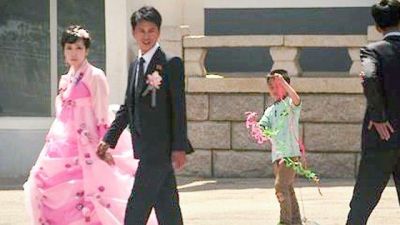 A couple in North Korea. The photo is not directly related to the article content. Photo by Yonhap News.
A woman in her 50s who also defected the same year, Ms. B, stated, "From 2023, if you divorce, you are sentenced to one year of re-education, so even if you don't want to live together, many couples fight and continue living together," and "In August 2023, the people's unit announced that divorce punishments would be strengthened, instructing those who want to divorce to do so by October."
The white paper also reported that controls and punishments on abortion have been strengthened since 2022, which appears to be related to the decline in birth rates.
It was confirmed that a separate special law called the "Enemy Goods Disposal Law," which imposes the death penalty for the inflow of South Korean goods such as leaflets sent to North Korea, was enacted in February 2023.
Enemy goods are defined as "all items brought in with the purpose of undermining and collapsing our socialist system." This includes goods bearing the trademarks, pictures, or writings of the puppet regime, puppet currency, items given by enemies, and filth entering from enemy-controlled areas by land, sea, or air.
Under this law, North Korean residents who fail to report or who possess, distribute, or use leaflets, storage devices (USBs), medicines, and other items sent from South Korea face severe punishment.
Researcher Lee Moo-cheol of the Korea Institute for National Unification explained, "Previously, punishments related to enemy goods under the Criminal Law and Administrative Punishment Law were labor re-education sentences," adding, "By abolishing the enemy goods-related provisions in the Criminal Law and Administrative Punishment Law and enacting a separate special law, punishments have been strengthened to include the death penalty."
© The Asia Business Daily(www.asiae.co.kr). All rights reserved.
![Clutching a Stolen Dior Bag, Saying "I Hate Being Poor but Real"... The Grotesque Con of a "Human Knockoff" [Slate]](https://cwcontent.asiae.co.kr/asiaresize/183/2026021902243444107_1771435474.jpg)















