"The Next Rate Hike Depends on Economic and Financial Conditions"
"High Uncertainty Surrounding Trump's Tariff Policy... Worth Watching"
The Bank of Japan (BOJ), Japan's central bank, raised interest rates to 0.5% on the 24th for the first time in 17 years. BOJ Governor Kazuo Ueda stated, "If the economy and inflation develop as projected, we will continue to raise the policy rate accordingly."
According to NHK and Nihon Keizai Shimbun (Nikkei), Governor Ueda said at a press conference following the Monetary Policy Meeting, "It is appropriate to gradually raise interest rates while confirming the effects of the rate hike."
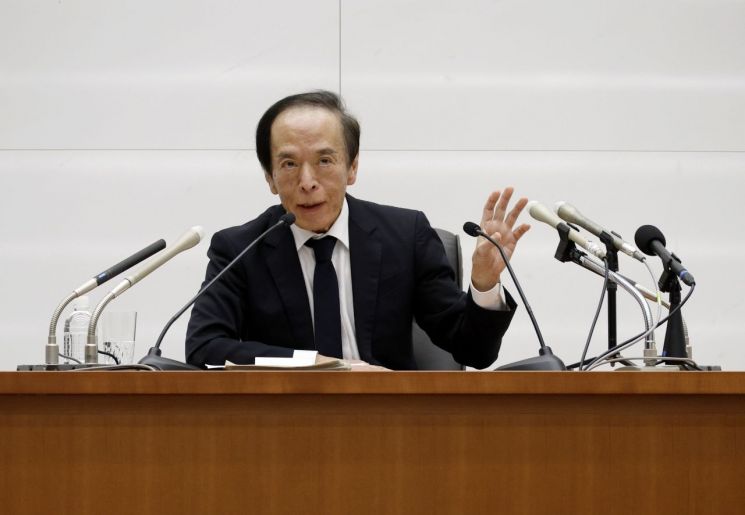 Ueda Kazuo, Governor of the Bank of Japan (BOJ), is holding a press conference after the Monetary Policy Meeting on the 24th. Photo by EPA Yonhap News
The BOJ decided at the two-day Monetary Policy Meeting held until this day to raise the short-term policy interest rate, the benchmark rate, from the current 0.25% to 0.5%. This rate hike was approved by 8 of the 9 BOJ board members, with 1 dissenting vote.
Governor Ueda said, "The current real interest rate is extremely low," adding, "There is a significant gap between the neutral interest rate and the current policy rate." The neutral interest rate is the rate level that neither stimulates inflation nor hinders growth at the potential growth rate.
Regarding further rate hikes, he said, "It depends on future economic and financial conditions, and we do not make premature judgments," adding, "We will continuously update economic and inflation forecasts and their feasibility using available data from various meetings and make appropriate policy decisions."
According to Nikkei, Japan's policy rate reaching 0.5% is the first time since October 2008, 17 years ago. Japan's policy rate had never exceeded 0.5% since September 1995. The BOJ ended its negative interest rate policy last March by raising the short-term policy rate for the first time in 17 years. Then, in July last year, it raised the rate from 0?0.1% to about 0.25%. This day marks an additional rate hike after six months.
Governor Ueda cited the reason for the rate hike as, "The economy and inflation have been moving according to projections so far, and the likelihood of these projections being realized is increasing," adding, "There are many voices saying that firm wage increases will be achieved in this year's Chuntu (spring wage negotiations), following last year."
Regarding U.S. President Donald Trump's tariff policy, he said, "There is very high uncertainty," adding, "Once the policy becomes somewhat clearer, we will reflect it in our outlook and utilize it in policy operations." He also said, "One of the most closely watched points is how the specific form of the tariff policy will be and what impact it will have on the global economy."
On the reason for deciding this rate hike amid the policy uncertainty of the Trump administration, he said, "So far, the movements of the new U.S. government have remained within expected ranges, so there has been no major market disruption."
Regarding concerns about inflation forecasts and the BOJ's delayed pace of rate hikes, he explained, "Inflation forecasts will be revised upward until mid-year but are expected to stabilize thereafter."
Although Japan continues to experience inflation in the 2% range, the declaration of escaping deflation (price decline during economic recession) has been continuously postponed. Governor Ueda said, "I am not confident that the probability of returning to deflation is zero, but it is certainly very low."
© The Asia Business Daily(www.asiae.co.kr). All rights reserved.
![Clutching a Stolen Dior Bag, Saying "I Hate Being Poor but Real"... The Grotesque Con of a "Human Knockoff" [Slate]](https://cwcontent.asiae.co.kr/asiaresize/183/2026021902243444107_1771435474.jpg)















