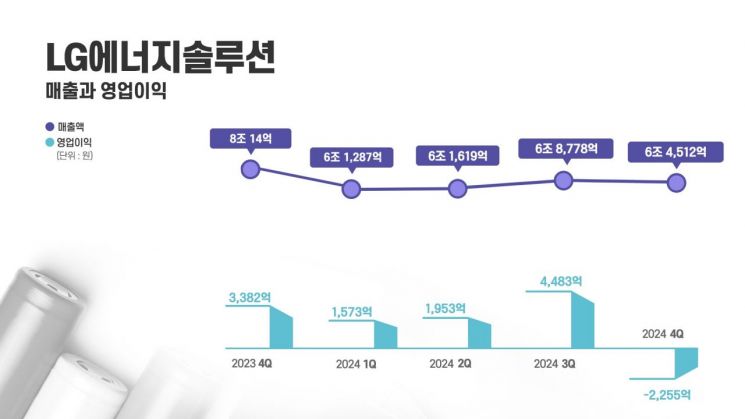
LG Energy Solution recorded an operating loss of 225.5 billion KRW in the fourth quarter of last year, turning to a deficit. This was due to a decline in factory operating rates caused by the electric vehicle chasm (temporary demand stagnation) and increased fixed cost burdens from the initial mass production at new factories.
On the 24th, LG Energy Solution announced that it posted sales of 6.4512 trillion KRW and an operating loss of 225.5 billion KRW in the fourth quarter of last year. Sales decreased by 19.4% compared to the same period last year, and operating profit turned to a loss during the same period. Annual sales increased by 24.1% to 25.6196 trillion KRW, while operating profit decreased by 73.4% to 575.4 billion KRW.
Excluding US Tax Credit, 602.8 Billion KRW Loss... Battery Market Expected to Grow by Mid-to-High 20% Next Year
The amount of the US Inflation Reduction Act (IRA) tax credit reflected in LG Energy Solution's operating profit for the fourth quarter of last year was 377.3 billion KRW. Excluding this, the fourth-quarter operating loss increases to 602.8 billion KRW.
Lee Chang-sil, Vice President and Chief Financial Officer (CFO) of LG Energy Solution, explained at the earnings briefing, "Although sales in the North American region increased compared to the previous year, overall company sales decreased by 24% due to contraction in the European market and price declines caused by weak metal prices. Operating profit fell by 73% year-on-year due to decreased operating rates and fixed cost burdens from initial mass production at new factories."
Regarding the global battery market size, the company forecasts growth in the mid-to-high 20% range based on capacity. For the electric vehicle (EV) market, a temporary demand slowdown is expected to continue for the time being, and policy changes such as subsidy revisions that directly affect consumer sentiment are also anticipated. However, the company expects a clear 'first-mover advantage' within major countries. If protectionist policies deepen in key markets such as the US, leading to the realization of high tariffs, companies that have proactively developed the market could expect significant benefits.
The energy storage system (ESS) market is expected to show relatively steady growth. This is due to the strengthening of 'energy security' policies in major countries, which is expanding demand for regional renewable energy infrastructure, and the acceleration of data center expansion driven by advanced AI technology, which is significantly increasing ESS demand. From next year, the US plans to raise import tariffs on Chinese-made ESS batteries, which is expected to further accelerate local demand in North America.
Investment Strategy of 'Selection and Concentration'... Maximizing Use of Existing Factories
On this day, LG Energy Solution announced its short- and long-term key strategies including ▲ proactive response to market volatility ▲ strengthening fundamental competitiveness.
In the short term, the focus is on proactive response to market volatility. Capacity expansion will be flexibly adjusted based on conservative forecasts, and capital expenditures (Capex) for production facilities will be deferred for non-urgent investments to enhance financial soundness.
The company will also maximize the utilization of existing factories. Idle lines at European factories will be used for mass production of newly developed chemistry products such as LFP and high-voltage mid-nickel (Mid-Ni) secured last year, and Chinese factories will increase operating rates by expanding new sales channels for standardized products such as cylindrical cells.
In the mid-to-long term, activities to strengthen fundamental competitiveness will continue. In the EV business, the portfolio will be strengthened from premium high-nickel (High-Ni) to mid-priced products such as high-voltage mid-nickel and LFP. In the ESS business, the company plans to increase added value based on high-capacity LFP cells and system integration (SI) capabilities.
Efforts to structurally enhance cost competitiveness will continue through the development of low-cost material technologies and equity investments in key raw material supply chains to fundamentally reduce material costs. Additionally, preparations for future technologies and business diversification will proceed without delay. Dry electrode technology is expected to secure mass production capability this year at the Ochang pilot line, and a pilot line for sulfide-based all-solid-state batteries will be established within the year.
The company set a sales growth target of 5-10% for next year. Although battery price increases are limited due to the downward stabilization of metal prices, the startup of new factories such as the Stellantis JV and Honda JV, as well as the launch of high value-added new products like the 46 series, are expected to have a positive impact.
Capital investment will be reduced by 20-30% compared to the previous year by controlling the pace of new facility investments and increasing utilization of existing production bases. The scale of IRA tax credit benefits this year is expected to increase by 40% compared to last year to about 45-50 GWh, due to the start of operations at new North American bases.
© The Asia Business Daily(www.asiae.co.kr). All rights reserved.
![Clutching a Stolen Dior Bag, Saying "I Hate Being Poor but Real"... The Grotesque Con of a "Human Knockoff" [Slate]](https://cwcontent.asiae.co.kr/asiaresize/183/2026021902243444107_1771435474.jpg)















