Burger King Raises Whopper Prices by 100 KRW Ahead of Lunar New Year
Starbucks Increases Prices of 22 Drinks by 200-300 KRW
Rising Raw Material and Logistics Costs, High Exchange Rates
No Price Control Tower Amid Impeachment Crisis
Food Prices Rose 7.5% During Park Geun-hye's Impeachment
The trend of food and dining price increases that began early this year is expected to become more pronounced after the Lunar New Year holiday. While the rising costs of raw materials, logistics, and exchange rates have increased the financial burden on companies, a significant factor is the government's failure to effectively manage prices amid the chaotic political situation, including the impeachment of President Yoon Seok-yeol. The wave of price hikes by companies, less constrained by government oversight, is raising concerns that it will exacerbate consumers' financial hardships.
 The trend of rising food and dining prices that began early this year is expected to become more pronounced after the Lunar New Year holiday. Photo by Getty Images
According to the Bank of Korea on the 31st, the consumer price index for living expenses rose by 2.7% in December last year. The living expense price index measures price changes of major goods and services consumed by households and is known to reflect the public's perceived inflation level. Among these, 'food' recorded a price increase of 2.7%, exceeding the average increase of 2.2% compared to the previous year. Notable price hikes were observed in radish (98.4%), carrots (65.5%), seaweed (34.3%), tangerines (32.4%), and napa cabbage (26.4%).
The increased prices have already been reflected in the cost of Lunar New Year ancestral rites tables. According to the Seoul Agricultural and Marine Products Corporation, the cost of setting up a Lunar New Year ancestral rites table this year was 224,040 KRW at Seoul traditional markets and 258,854 KRW at large supermarkets, marking increases of 1.0% and 2.5%, respectively, compared to the previous year.
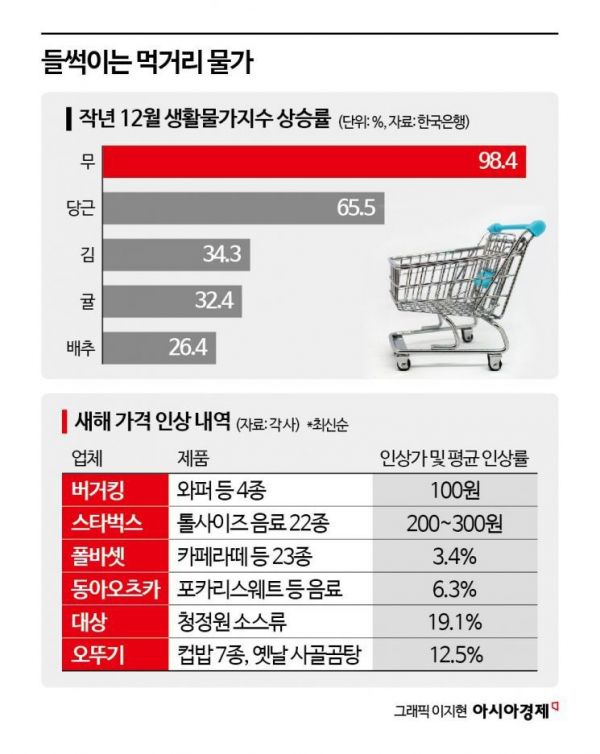
Products commonly found in large supermarkets and convenience stores are also raising prices one after another. Dong-A Otsuka raised the prices of beverages such as Pocari Sweat by an average of 6.3% at the start of the year, while Daesang increased prices of sauces including Cheongjeongwon mayonnaise and dressings, as well as pepper, by an average of 19.1% starting from the 16th. Ottogi plans to raise the prices of seven types of cup rice (based on convenience store prices) by 12.5% from February 1. The price of the traditional beef bone soup product (500g) will also increase from 2,500 KRW to 3,000 KRW, a 500 KRW rise.
In addition to food prices, franchise companies have also raised prices around the Lunar New Year holiday, increasing the burden of dining out. Burger King decided to raise the prices of some products by 100 KRW just before the holiday. The flagship Whopper will increase from 7,100 KRW to 7,200 KRW, the Garlic Bulgogi Whopper from 7,400 KRW to 7,500 KRW, and the Whopper Junior from 4,700 KRW to 4,800 KRW. French fries will rise from 2,100 KRW to 2,200 KRW. Starbucks also raised prices of 22 types of tall-sized drinks by 200 to 300 KRW, and Polbaset, operated by M's Seed, an affiliate of Maeil Dairies, increased prices of major products by 200 to 400 KRW.
The food industry anticipates that price hikes may continue in a chain reaction after the Lunar New Year. They suggest that companies may take advantage of the government's weakened price management control tower following President Yoon Seok-yeol's impeachment crisis to raise prices.
Until now, the government has been suppressing price increases through exchanges with major food companies, but recent pressure has reportedly eased significantly. Food companies may proactively raise prices to protect profitability before any policy changes. During the impeachment of former President Park Geun-hye, major food companies also engaged in a relay of price hikes. In early 2017, when the impeachment process was underway, food prices rose by 7.5%, double the usual increase.
Companies argue that price increases are inevitable due to soaring raw material costs and high exchange rates. The Russia-Ukraine war and abnormal weather have caused prices of key raw materials such as sugar, cocoa, and coffee beans to skyrocket, while the sharp rise in exchange rates has increased the burden of importing raw materials. Additionally, rising labor costs, electricity bills, public utility fees, and delivery expenses have made it difficult to endure. An industry insider said, "There are many reasons for price increases, but companies often absorb the costs themselves due to concerns about negative consumer reactions," adding, "More companies are expected to introduce dual pricing to minimize consumer backlash."
© The Asia Business Daily(www.asiae.co.kr). All rights reserved.
![Clutching a Stolen Dior Bag, Saying "I Hate Being Poor but Real"... The Grotesque Con of a "Human Knockoff" [Slate]](https://cwcontent.asiae.co.kr/asiaresize/183/2026021902243444107_1771435474.jpg)
















