Appealing as a Reliable Alternative to Contribute to U.S.-China Competition
Emphasizing Shared Interests Between South Korea and the U.S. Through a "Package Deal"
When U.S. President Donald Trump directs the "blade" of tariffs at China, it has been suggested that South Korea's semiconductor and battery industries should replace Chinese products based on reliability. This analysis emphasizes contributing to the U.S.'s strategic competition with China while also reducing the impact of tariffs through this approach.
Shin Won-kyu, a visiting research fellow at the Korea Economic Research Institute, presented this analysis on the 24th at a seminar hosted by the Korea Economic Association under the theme "Prospects for Trump's Second-Term Tariff Policy and Strategic Response Measures." He examined the complementary relationship between South Korea and the U.S. and the substitution relationship between South Korea and China regarding major South Korean exports to the U.S., such as semiconductors, batteries, and automobile parts.
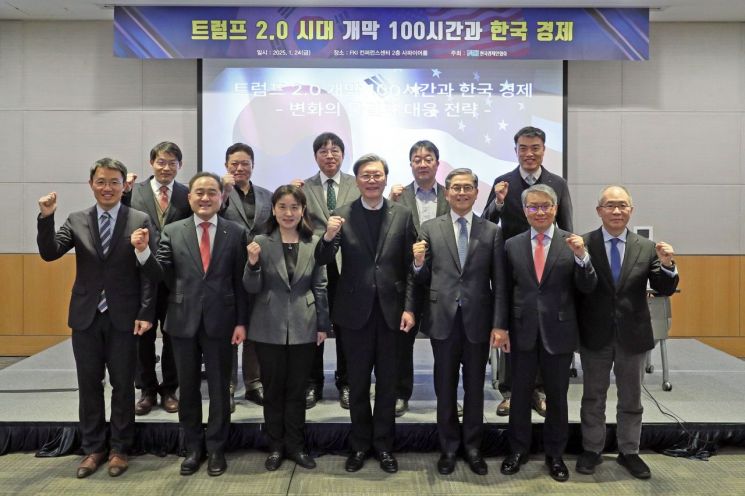 Kim Chang-beom, Executive Vice Chairman of the Korea Economic Association, and other guests are taking a commemorative photo at a seminar hosted by the Korea Economic Association on the 24th at the FKI Tower Conference Center in Yeouido, Seoul. Photo by Korea Economic Association
Researcher Shin stated, "I don't think Trump will impose tariffs indiscriminately," evaluating that "even during the first term, measures were based on objective data." He added, "There will be sufficient investigation until April to establish grounds," and predicted, "After that, there is a high probability of imposing general tariffs or tariffs targeting specific countries."
He first analyzed the substitution relationship between South Korean and Chinese industries after the U.S. imposed tariffs on China during Trump's first term in 2018. In the case of semiconductors and related components, decoupling occurred following the imposition of tariffs, but synchronization gradually reappeared under the Biden administration.
Regarding the battery industry, which is considered to be divided between South Korea and China in the global market, South Korea showed growth during Trump's first term, but China's dominance began after the Biden administration's "Green Deal" policy. The conclusion was that South Korean products stagnated.
Researcher Shin analyzed that high-bandwidth memory (HBM) and non-memory semiconductors such as GPUs and CPUs have a strong complementary relationship with the U.S. and a significant substitution effect against China. He advised strengthening cooperation to support the enhancement of U.S. industrial competitiveness in line with Trump's second-term policy emphasizing the artificial intelligence (AI) industry.
In the battery sector, he focused on electric vehicle batteries. It was analyzed that substitution effects occur when the tariff gap between South Korea and China exceeds 15%. Since President Trump has announced high tariffs on China, it is necessary to seize this opportunity to attempt to replace Chinese products in the market.
Researcher Shin emphasized, "While efforts to obtain post-tariff exemptions at the individual company level are important, the government should engage in a 'package deal' with the U.S." He stressed, "Highlighting that South Korea and the U.S. share economic security interests and securing preemptive tariff exemptions for strategic industries would be the best approach."
During the subsequent discussion, it was pointed out that establishing a control tower for U.S. policy is urgent for effective response. Kim Soo-dong, head of the Global Competitive Strategy Research Group at the Korea Institute for Industrial Economics and Trade, proposed, "A public-private integrated consultative body should be formed to create a unified communication channel to convey the opinions of our companies and government to the U.S. administration."
Additionally, advice was given to strengthen partnerships with local industry organizations and conduct sophisticated outreach activities in states such as California, Georgia, and Texas, where many Korean companies have entered. The intention is to engage stakeholders at the state level, targeting next year's gubernatorial and state legislature elections.
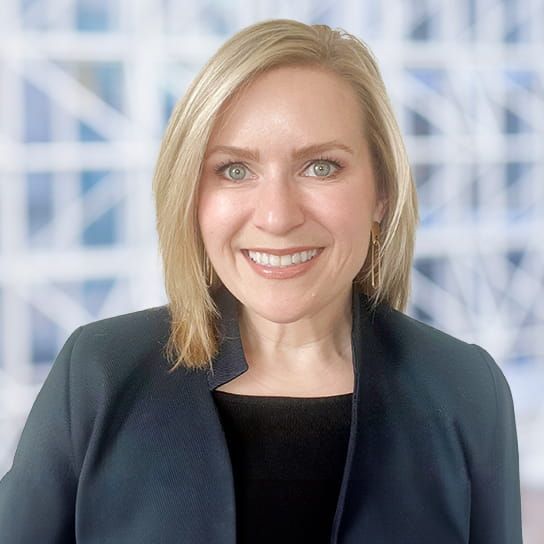 Kelly Ann Shaw, former Vice Chair of the U.S. National Economic Council (NEC). Provided by the Korea Economic Association
Meanwhile, at the seminar, Kelly Ann Shaw, former U.S. National Economic Council (NEC) deputy director from Trump's first term, who delivered the keynote speech in the first part, warned that South Korea is not exempt from the U.S. tariff war.
Former Deputy Director Shaw stated, "The U.S. is conducting a comprehensive review of its trade policy," and diagnosed, "While Mexico, Canada, and China will be the primary targets, South Korea is not 'off the hook'." She particularly emphasized, "The possibility of renegotiating the Korea-U.S. Free Trade Agreement (FTA) should also be kept open."
President Trump instructed the U.S. Trade Representative (USTR) to review existing trade agreements. Although South Korea was not specifically named, concerns arise that South Korea will find it difficult to avoid the blade considering its trade surplus with the U.S. President Trump also demanded renegotiation of the Korea-U.S. FTA in the first year of his first term.
Former Deputy Director Shaw also pointed out the specific timing when the "tariff bomb" might drop. She predicted, "If tariffs on Canada, Mexico, and China are imposed for 'non-economic reasons' such as illegal immigration and drug trafficking, tariffs on all trading partners worldwide will intensify after the government investigation is completed in April."
© The Asia Business Daily(www.asiae.co.kr). All rights reserved.


















