Early Repayment Fees Slashed by Half Starting on the 13th
Loan Refinancing Expected to Surge in the Second Half as Interest Rates Fall

This year, with interest rates entering a full-fledged decline and early repayment fees dropping from the 13th of this month, demand for 'loan refinancing' is expected to intensify starting in the second half of the year. While the financial authorities continue their household loan regulation stance, banks that cannot significantly increase new loans are expected to fiercely compete to attract refinancing demand by offering low fees and reduced interest rates.
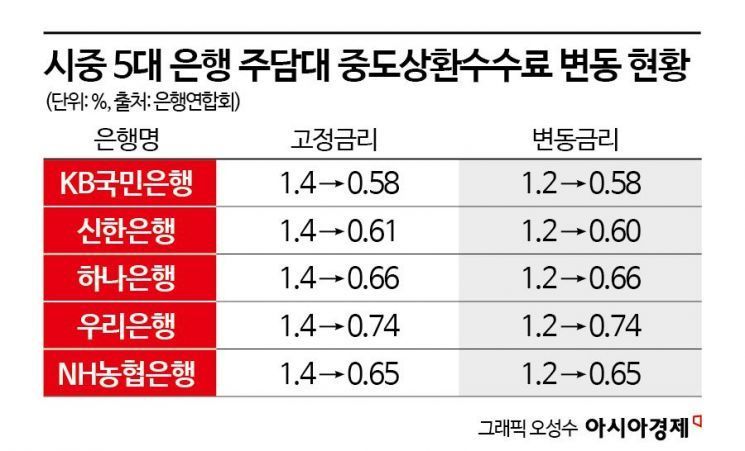
According to the banking sector on the 27th, the early repayment fee rates for mortgage loans at the five major commercial banks have been lowered from the previous 1.4% fixed interest rate to 0.58?0.74%, and from the previous 1.2% variable interest rate to 0.58?0.74%. Among the banks, KB Kookmin Bank had the lowest reduced fee rate at 0.58%, while Woori Bank had the highest at 0.74%. Other rates include Shinhan Bank fixed at 0.61% and variable at 0.60%, NH Nonghyup Bank at 0.65%, and Hana Bank at 0.66%. These rates apply to loan contracts signed after the 13th of this month.
Early repayment fees are a type of penalty that borrowers pay when repaying loans within three years. The financial authorities have previously ordered that early repayment fees, which were set without specific calculation standards, should only be charged within actual costs such as opportunity costs due to fund operation disruptions, various administrative costs related to loans, and recruitment costs.
For example, if a borrower takes out a 500 million KRW mortgage loan with a 30-year term at a fixed interest rate from KB Kookmin Bank and repays it after one year, they would have had to pay about 4.66 million KRW in early repayment fees. However, under the new early repayment fee rates, this amount decreases to about 1.93 million KRW, saving as much as 2.73 million KRW.
However, refinancing demand is expected to be low for other loan products excluding mortgage loans. Credit loans have short repayment periods, so refinancing demand is not high, and jeonse loans require the landlord's consent, making the process cumbersome.
From the second half of this year, when the effects of early repayment fee reductions and interest rate cuts become fully effective, mortgage loan refinancing is expected to accelerate. Loan refinancing is possible from six months after the original loan was taken out.
Also, as the authorities continue their household debt management stance this year, banks that cannot significantly increase new loans are expected to compete over refinancing demand using lowered early repayment fees and competitive interest rates as weapons.
A representative from a commercial bank said, "Currently, fixed interest rates on mortgage loans are about 1 percentage point lower than variable rates, so the proportion choosing fixed rates is high. Even if interest rates continue to fall for a while, fixed rates remain cheaper, but if variable rates become cheaper due to future rate cuts, refinancing is expected to accelerate thanks to the lowered early repayment fee rates."
Meanwhile, some argue that if financial authorities uniformly regulate early repayment fees, banks may pass the cost onto loan interest rates as their early repayment fee income decreases. There are also concerns that internet-only banks, which waive early repayment fees unlike commercial banks and offer lower interest rates, may attract more loan demand.
Another commercial bank representative said, "Early repayment fees are essentially opportunity costs for banks' fund operation losses," adding, "Ultimately, this could lead to increased spread rates at commercial banks or, in the case of internet banks where loan demand concentrates, they may lack incentives to lower interest rates."
© The Asia Business Daily(www.asiae.co.kr). All rights reserved.
![Clutching a Stolen Dior Bag, Saying "I Hate Being Poor but Real"... The Grotesque Con of a "Human Knockoff" [Slate]](https://cwcontent.asiae.co.kr/asiaresize/183/2026021902243444107_1771435474.jpg)
















