Trump to Appeal
Justice Department Vows Vigorous Defense
U.S. President Donald Trump’s executive order restricting birthright citizenship, signed on his first day in office, was temporarily blocked by the Seattle federal court, which ruled it "clearly unconstitutional." This marks the first setback for Trump’s aggressive illegal immigration crackdown policies.
On the 23rd (local time), according to U.S. CNN and AP News, Judge John Koener of the Seattle federal court issued a temporary restraining order blocking the executive order for 14 days in a lawsuit filed by the states of Washington, Arizona, Illinois, and Oregon, which argued that Trump’s executive order is unconstitutional. The ruling applies nationwide. Whether to block the executive order further will be decided at a hearing on the 5th of next month.
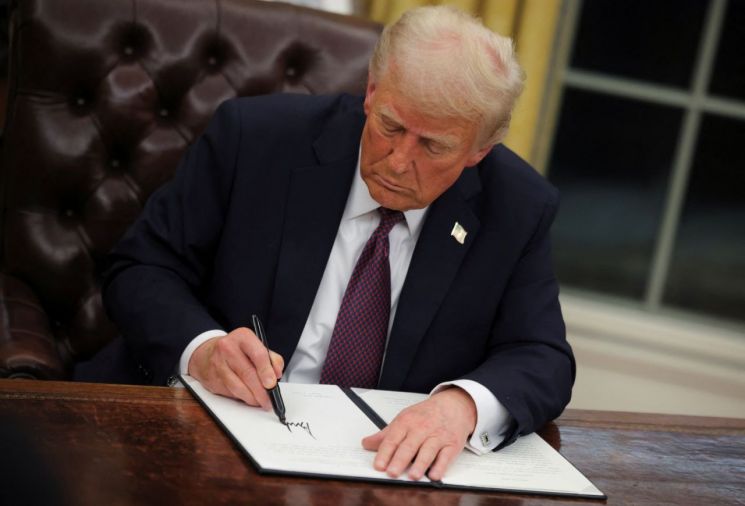 Donald Trump, President of the United States, signing an executive order. Photo by Reuters-Yonhap News
President Trump signed the executive order on the 20th, immediately after his inauguration, restricting the policy that automatically grants citizenship to babies born in the U.S. to exclude children of illegal immigrants.
Judge Koener described the order as "clearly unconstitutional" and said he could not understand lawyers’ arguments that the executive order is constitutional. He also said he could not recall any other case in his more than 40 years as a judge that was so clearly unconstitutional. Judge Koener was appointed during the administration of former President Ronald Reagan.
President Trump told reporters at the White House that he plans to challenge the federal court’s ruling. The U.S. Department of Justice stated in a press release that Trump’s executive order correctly interprets the 14th Amendment and that they will vigorously defend the order. This lawsuit is the first trial among six similar lawsuits filed by 22 states and various immigrant rights groups nationwide.
The birthright citizenship restriction executive order signed by President Trump states that children born in the U.S. to mothers who are not legally residing in the country and fathers who are neither U.S. citizens nor permanent residents will not automatically receive citizenship. It also includes cases where the mother is a legal temporary resident and the father is not a citizen or permanent resident.
The four Democratic state attorneys general who filed the lawsuit argue that the executive order is unconstitutional under the 14th Amendment, which states that "all persons born or naturalized in the United States, and subject to the jurisdiction thereof, are citizens of the United States and of the state wherein they reside." They claim that more than 150,000 newborns in the U.S. each year would be affected by the executive order.
© The Asia Business Daily(www.asiae.co.kr). All rights reserved.
![Clutching a Stolen Dior Bag, Saying "I Hate Being Poor but Real"... The Grotesque Con of a "Human Knockoff" [Slate]](https://cwcontent.asiae.co.kr/asiaresize/183/2026021902243444107_1771435474.jpg)















