Hyundai Mobis announced on the 22nd that it has succeeded in developing a new technology that can detect posture, behavior, and biometric signals to determine the safety status of not only the driver but also passengers including those in the rear seats.
This technology is expected to reduce safety accidents by preventing inattentiveness caused by drowsy driving or mobile phone use, and by allowing a quick check of whether children in the rear seats are properly secured in car seats.
Hyundai Mobis named this technology the 'In-Cabin Monitoring System (ICM)' and will begin full-scale order activities targeting global customers starting this year.
The system consists of cameras (hardware) that monitor passengers and software logic that analyzes the data. First, the cameras inside the vehicle detect passengers' posture, position, and biometric signals in real time. Then, the software logic analyzes the signals sent by the cameras to determine any risks and provides warnings and alerts to passengers through visual or audio means.
For example, if the driver closes their eyes and lowers their head due to drowsy driving, the vehicle sends a danger alert. The system has developed more than 10 scenarios including using a mobile phone while driving, removing hands from the steering wheel, not wearing a seatbelt, and leaving infants unattended in the rear seats when exiting the vehicle, contributing to the prevention of safety accidents.
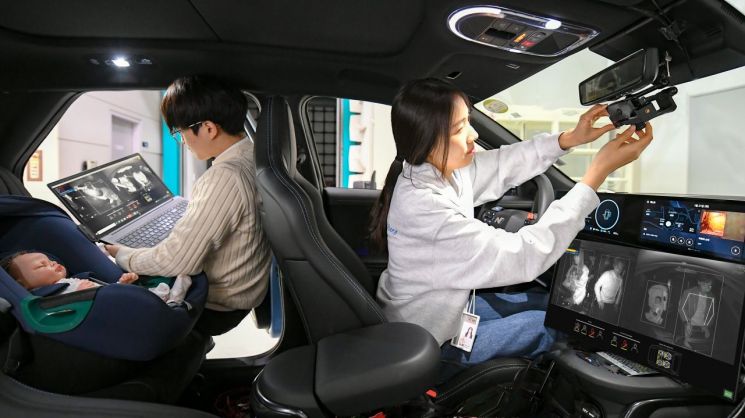 Hyundai Mobis researchers are analyzing data measured by the 'In-Cabin System'. Photo by Hyundai Mobis
Hyundai Mobis is actively pursuing orders by pre-releasing the In-Cabin Monitoring System to European automakers. According to global research institutions, Driver Monitoring Systems (DMS) using cameras is a field growing nearly 40% annually. With the mandatory installation of DMS in advanced markets such as Europe where safety standards are stringent, passenger safety technologies are expected to gain attention, especially in the luxury car market.
This year, Hyundai Mobis plans to strengthen healthcare functions that analyze drivers' biometric signals and accelerate the development of next-generation technologies (2.0) specialized for commercial fleet services.
Shin Gyu-cheol, Head of Electronic Control Development at Hyundai Mobis, said, "As autonomous driving advances, demand for safety technologies along with in-vehicle convenience features is increasing. We will focus on developing highly accurate software that finely analyzes the different physical structures of each passenger."
© The Asia Business Daily(www.asiae.co.kr). All rights reserved.
![Clutching a Stolen Dior Bag, Saying "I Hate Being Poor but Real"... The Grotesque Con of a "Human Knockoff" [Slate]](https://cwcontent.asiae.co.kr/asiaresize/183/2026021902243444107_1771435474.jpg)















