Trump Speaks at Press Conference on the 21st (Local Time)
"China Sends Fentanyl to Mexico and Canada"
Tariff Bomb Shakes Major Countries... Viewed as a 'Strategic Decision'
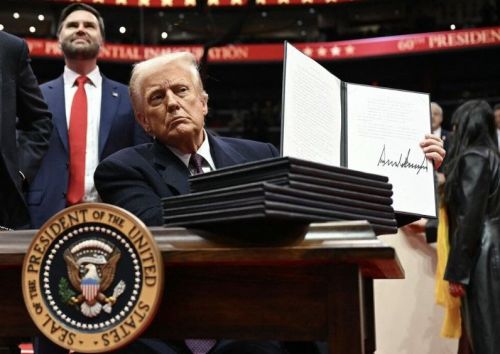 U.S. President Donald Trump is holding up the executive order he just signed at the inauguration event held on the 20th (local time) at Capital One Arena in Washington D.C., USA. (AFP·Yonhap News)
U.S. President Donald Trump warned on the 21st (local time) that there is a possibility of imposing an additional 10% tariff on China starting February 1. If implemented, higher taxes will be levied on imports coming from China, the United States' second-largest trading partner.
At a White House press conference that day, President Trump said, "We are discussing imposing a 10% tariff based on the fact that China is sending fentanyl (a zombie drug) to Mexico and Canada," adding, "The timing is probably February 1." This came just one day after he announced plans to consider imposing a 25% tariff on Mexico and Canada starting in February. Regarding a recent call with President Xi Jinping, he responded that they "did not talk much" about tariffs.
Last year, during his campaign as a U.S. presidential candidate, Trump threatened to impose tariffs exceeding 60% on Chinese goods. In November of last year, he also stated on his social media platform, Truth Social, that he had "demanded an additional 10% tariff on China."
There is analysis that the potential tariff imposition on China following Mexico and Canada is a strategic decision by the Trump administration. Rodrigo Catril, a strategist at National Australia Bank in Sydney, told Bloomberg, "Confusing the market and trade partners is part of the strategy," adding, "They aim to increase uncertainty and stimulate demand for the dollar as a safe-haven asset."
Meanwhile, the U.S.-China conflict continues not only economically but also in the industrial sector. The Chinese short-form video platform TikTok, whose major shareholder is the Chinese company ByteDance, is at the center of this. TikTok suspended its service but resumed it 14 hours later after the bipartisan national security law, known as the 'TikTok Ban Act,' took effect on the 19th (local time). President Trump also signed an executive order to delay the enforcement of the TikTok Ban Act for 75 days, instructing the Attorney General not to take any action to enforce the ban.
On the same day, President Trump expressed openness to Tesla CEO Elon Musk acquiring TikTok, owned by China's ByteDance. Trump said, "If he wants to buy (TikTok), I am open to it." He explained that if TikTok's U.S. service is suspended, the company has no value, but if it can continue operating in the U.S., its corporate value would be enormous, so half of the shares should be given to the U.S.
© The Asia Business Daily(www.asiae.co.kr). All rights reserved.
![Clutching a Stolen Dior Bag, Saying "I Hate Being Poor but Real"... The Grotesque Con of a "Human Knockoff" [Slate]](https://cwcontent.asiae.co.kr/asiaresize/183/2026021902243444107_1771435474.jpg)















