Final Report on the "Traffic System Efficiency Improvement Plan Establishment Service" to Be Held on the 21st
Ahead of the construction of Ulsan City's Tram Line 1, an optimal traffic system alternative for the entire operation section, including the final alternative to change the Gongyeoptap Rotary into a flat five-way intersection, will be presented.
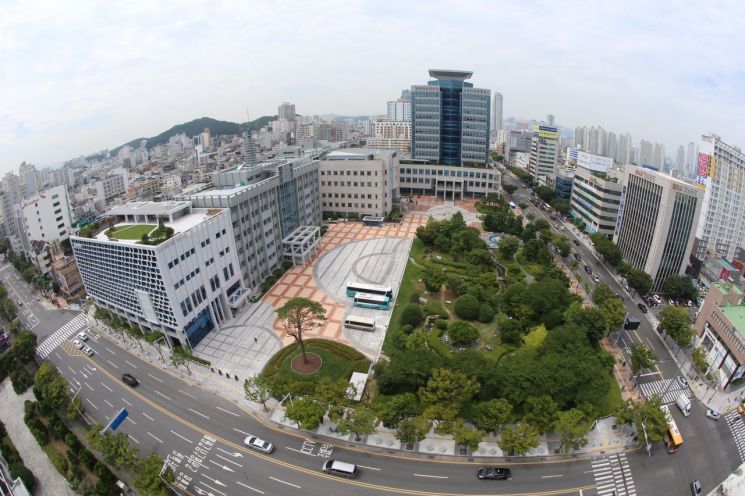
The city announced that on January 21 at 3 p.m., it will hold the final report meeting for the "Preliminary Traffic System Efficiency Improvement Plan Establishment Service for the Construction of Urban Railway Line 1" in the situation room on the 7th floor of the City Hall main building.
At the meeting, about 20 members including the Urban Transportation and Construction Subcommittee of the Ulsan City Policy Advisory Committee, the National Police Agency, and the dedicated task force (T/F) for the traffic sector of Urban Railway Line 1 will attend. Following the final report presentation by the service provider, they will discuss traffic system improvement plans for the Tram Line 1 operation section.
According to the final report, for the Gongyeoptap Rotary, additional improvements were made to the previously proposed plan in the interim report last October, including securing lanes from Duwang-ro East Gate to the Museum section, improving right turns, and resolving double stops on Suam-ro.
At the time of the tram opening in 2029, the delay during peak hours (6 p.m. to 7 p.m.) is expected to decrease from 232.2 seconds per vehicle if the rotary is maintained to 169.9 seconds per vehicle if converted to a flat five-way intersection, a reduction of 62.4 seconds per vehicle. Additionally, the level of service is expected to improve from "Double F (FF)" to "F".
The level of service refers to the qualitative level of traffic flow, evaluated based on control delay per vehicle, classified from (good) 'A' to 'Triple F (FFF)' (congested).
For the street sections, plans were proposed to minimize sidewalk reduction and reduce the roadway to a basic 1 to 2 lanes. For Samsan-ro, the number of lanes will be reduced from 8-9 to 6-7 lanes, and for Munsu-ro/Daehak-ro, from 7 lanes to 5-6 lanes.
The basic lane operation plan includes securing left-turn and U-turn lanes through tram alignment adjustments. Left turns will be preserved as much as possible except in unavoidable cases such as road capacity reduction, with 4 out of the current 46 locations being eliminated. For U-turns, considering station locations and accident risks, 13 out of the current 48 locations will be reduced.
Construction will proceed in stages: Stage 1 involves changing the Gongyeoptap system and road side construction; Stage 2 involves central road construction (relocation of obstacles); Stage 3 involves track subgrade construction; and Stage 4 involves intersection and station construction.
In addition, plans were proposed to minimize inconvenience to citizens during tram construction, provide effective alternative route guidance, and promote social and economic changes following the tram opening.
An official from Ulsan City stated, "This service is a process to pre-check an efficient traffic system plan in preparation for tram operation. In the future design process, we plan to make decisions through in-depth reviews with experts such as the National Police Agency and communication with citizens." He added, "We ask for continued interest and understanding to ensure convenient public transportation use for citizens."
© The Asia Business Daily(www.asiae.co.kr). All rights reserved.
![Clutching a Stolen Dior Bag, Saying "I Hate Being Poor but Real"... The Grotesque Con of a "Human Knockoff" [Slate]](https://cwcontent.asiae.co.kr/asiaresize/183/2026021902243444107_1771435474.jpg)















