No Delisting Cases in 10 Years...
Authorities to First Strengthen Ineffective Criteria
Delisting Requirements to Be Raised in Three Stages
KOSPI Market Cap Standard to Increase Tenfold by 2028
Lengthy Delisting Procedures to Be Shortened
Investor Protection Measures to Be Enhanced

The financial authorities' move to significantly raise the market capitalization and sales criteria for delisting, among other institutional improvements, stems from concerns that so-called 'zombie companies' are further deepening the Korea discount (the undervaluation of the Korean stock market). Since companies that should have been delisted long ago are extending their lifespans, thereby lowering overall market confidence and negatively impacting stock indices, it is deemed essential to weed out these marginal companies.
The delisting system improvement plan disclosed by the Financial Services Commission on the 21st focuses on strengthening delisting requirements and simplifying procedures to contribute to the overall value-up of the stock market through timely and appropriate exit of low-performing companies. Additionally, as the number of marginal companies being delisted increases, the plan includes institutional improvements to protect investors from potential damages.
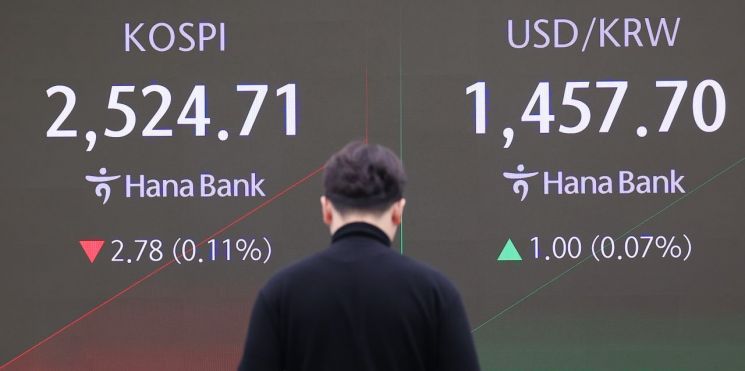
An official from the Financial Services Commission explained, "While the quantitative scale of our stock market, such as the number of listed companies and market capitalization, has continued to expand, the qualitative development in terms of individual listed companies' corporate value and growth potential has been relatively insufficient. This plan was prepared based on the view that institutional improvements in both market entry and exit are necessary to enhance the capital market's value." The number of companies delisted compared to those entering the domestic market is only about one-quarter. The market capitalization relative to the number of listed companies is 0.9, far below that of the U.S. (22.5), Japan (2.3), and Taiwan (2.0).
No Delisting for 10 Years... Strengthening Ineffective Criteria First
The main reason for the ineffectiveness of marginal company delisting is the excessively low market capitalization and sales criteria. Currently, the delisting thresholds for KOSPI and KOSDAQ are 5 billion KRW and 4 billion KRW in market capitalization, and 5 billion KRW and 3 billion KRW in sales, respectively. Falling below these means maintaining listing is impossible, yet there have been no delisting cases in the past 10 years. A Financial Services Commission official noted, "The low standards from 15 to 20 years ago have been maintained," explaining the need to strengthen the criteria due to repeated criticisms of ineffectiveness.
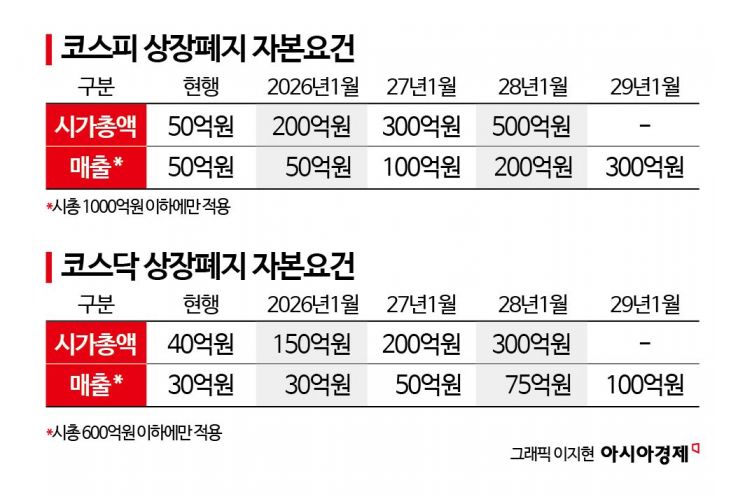
Accordingly, the authorities plan to strengthen these financial requirements over three years in three stages. From January 2028, the KOSPI market capitalization criterion will be raised tenfold to 50 billion KRW compared to the current level. In this case, the relative ratio of delisting requirements to entry requirements, currently only 2.5%, will match the 25% level of the U.S. New York Stock Exchange (NYSE). During the same period, the KOSDAQ market capitalization criterion will be raised to 30 billion KRW.
For sales, considering the need for an adaptation period, the application will be delayed by one year, with 30 billion KRW for KOSPI and 10 billion KRW for KOSDAQ applied from January 2029. The authorities will also establish a buffer by exempting the sales requirement if a company meets the minimum market capitalization requirement (KOSPI 100 billion KRW, KOSDAQ 60 billion KRW), considering companies with high growth potential but low sales.
According to simulations by the financial authorities, upon final completion of the upward adjustment, 62 companies on KOSPI and 137 companies on KOSDAQ were identified as not meeting the requirements, representing about 7-8% of each market. However, a Financial Services Commission official added, "Since the figures are based on 2024 data and various assumptions, results may vary depending on companies' value-up efforts and changes in market conditions."
Additionally, the two-strike-out system for adverse audit opinions will be introduced in July. This is also part of strengthening ineffective delisting criteria. Adverse audit opinions have been the top reason for delisting in the past five years (236 cases). Until now, even if there was an adverse audit opinion, companies were given a recovery period until the audit opinion of the second following fiscal year, but cases of abuse have continued. Therefore, the new system includes immediate delisting upon two consecutive adverse opinions. Exceptions (additional recovery periods) will be allowed only for companies undergoing rehabilitation or workout.
The delisting review system for surviving companies in spin-off re-listings will also be introduced on KOSPI from July 1. This measure considers the risk of spin-off re-listings where the surviving company deteriorates by transferring high-quality businesses to the newly established company, exploiting the fact that the surviving company is not subject to review.
Reducing Lengthy Delisting Procedures... Enhancing Investor Protection Measures
Besides strengthening criteria, the improvement plan also includes simplifying delisting procedures. Among 71 delisting cases in the past five years, 62 cases (87%) took more than one year from the occurrence of delisting reasons to final exit. Due to the prolonged procedures, as of the end of 2024, 83 companies are suspended from trading during delisting reviews.
Under the current system, KOSPI allows up to two appeals and a recovery period of four years, while KOSDAQ allows up to three appeals and a recovery period of two years. Compared to the U.S. NYSE and NASDAQ, where recovery periods are up to 18 months (two appeals) and 12 months (two appeals) respectively, Korea's periods are considered quite long. Japan also limits the recovery period to 12 months. Moreover, Korea sometimes extends the period further by using a continuation system to discuss the case in the next meeting if no conclusion is reached.
A Financial Services Commission official pointed out, "The maximum recovery period is relatively long to provide companies with sufficient recovery opportunities. However, the prolonged review structure delays the exit of low-performing companies, causing inefficient capital allocation, reduced overall market confidence, and limiting stock index growth."
Therefore, to simplify the review process, the authorities will reduce the KOSPI recovery period to a maximum of two years, cutting it by half. KOSDAQ will also be reduced to a maximum of two appeals and 18 months. Additionally, continuation will no longer be explicitly allowed, and if formal delisting reasons and substantive review reasons occur simultaneously, the two reviews will be conducted in parallel, with a delisting decision in either leading to final delisting.
Furthermore, anticipating an increase in delisted companies, investor protection measures have also been prepared. From January next year, the Korea Financial Investment Association's unlisted stock trading platform, K-OTC, will be used to support trading of delisted stocks after delisting, and information disclosure for investors during delisting reviews will be expanded. This aims to facilitate continued trading and strengthen investors' right to know.
© The Asia Business Daily(www.asiae.co.kr). All rights reserved.
![Clutching a Stolen Dior Bag, Saying "I Hate Being Poor but Real"... The Grotesque Con of a "Human Knockoff" [Slate]](https://cwcontent.asiae.co.kr/asiaresize/183/2026021902243444107_1771435474.jpg)

















