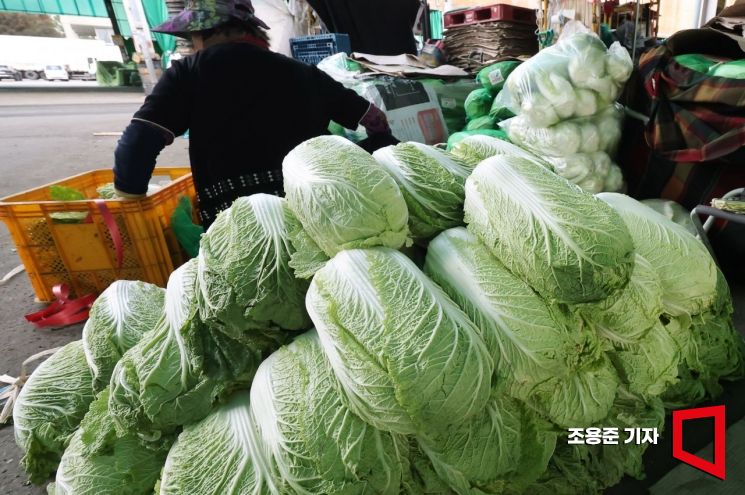
 On the 23rd, ahead of the kimchi-making season, a vendor at the vegetable section of Garak Market in Songpa-gu, Seoul, is trimming napa cabbage as prices of key kimchi ingredients such as napa cabbage and radish surge. Although the Producer Price Index announced by the Bank of Korea for September declined, prices of agricultural products including napa cabbage rose by 5.7%. Photo by Jo Yongjun
The government is launching a special joint inspection by relevant ministries on the overall distribution status of napa cabbage and radish, whose prices have surged ahead of the Seollal holiday.
On the 19th, the Ministry of Economy and Finance, the Fair Trade Commission, and the Ministry of Agriculture, Food and Rural Affairs formed a joint inspection team to check the entire production and distribution process of winter napa cabbage and radish, targeting item agricultural cooperatives, local distributors, and market wholesale corporations.
Despite an increase in wholesale market supply volumes due to government supply and demand measures, the current wholesale and retail prices in January remain high compared to the previous and average years due to increased storage demand from local distributors expecting further price rises and poor crop conditions of winter napa cabbage and radish.
A Fair Trade Commission official stated, "We plan to investigate the causes of the price increases of napa cabbage and radish and whether there are any unfair practices in the distribution process."
Earlier, to prepare for the Seollal peak season and winter shortages of napa cabbage and radish, the government has released over 200 tons daily of a total of 11,000 tons of government-available stock, including government reserves and shipment control facilities, into Garak Market, and has also expanded supply of contract cultivation volumes through the Nonghyup.
The government is advancing the early application of the napa cabbage tariff quota and extending the existing radish tariff quota until the end of April. Through agreements and other measures, transportation subsidies and shipment incentives will be provided to kimchi manufacturers and local distributors to actively encourage the release of stored quantities into the market.
The government expects supply and demand for spring crops to stabilize. According to the Korea Rural Economic Institute's forecast, this year’s spring napa cabbage cultivation area is expected to increase by 4.7% compared to last year and 2.5% compared to the average year, while spring radish is expected to increase by 6.3% compared to last year and 2.9% compared to the average year.
A government official said, “Through this joint inspection, we expect not only the rational price formation of napa cabbage and radish but also the establishment of a fair distribution order within the market.”
© The Asia Business Daily(www.asiae.co.kr). All rights reserved.
![Clutching a Stolen Dior Bag, Saying "I Hate Being Poor but Real"... The Grotesque Con of a "Human Knockoff" [Slate]](https://cwcontent.asiae.co.kr/asiaresize/183/2026021902243444107_1771435474.jpg)















